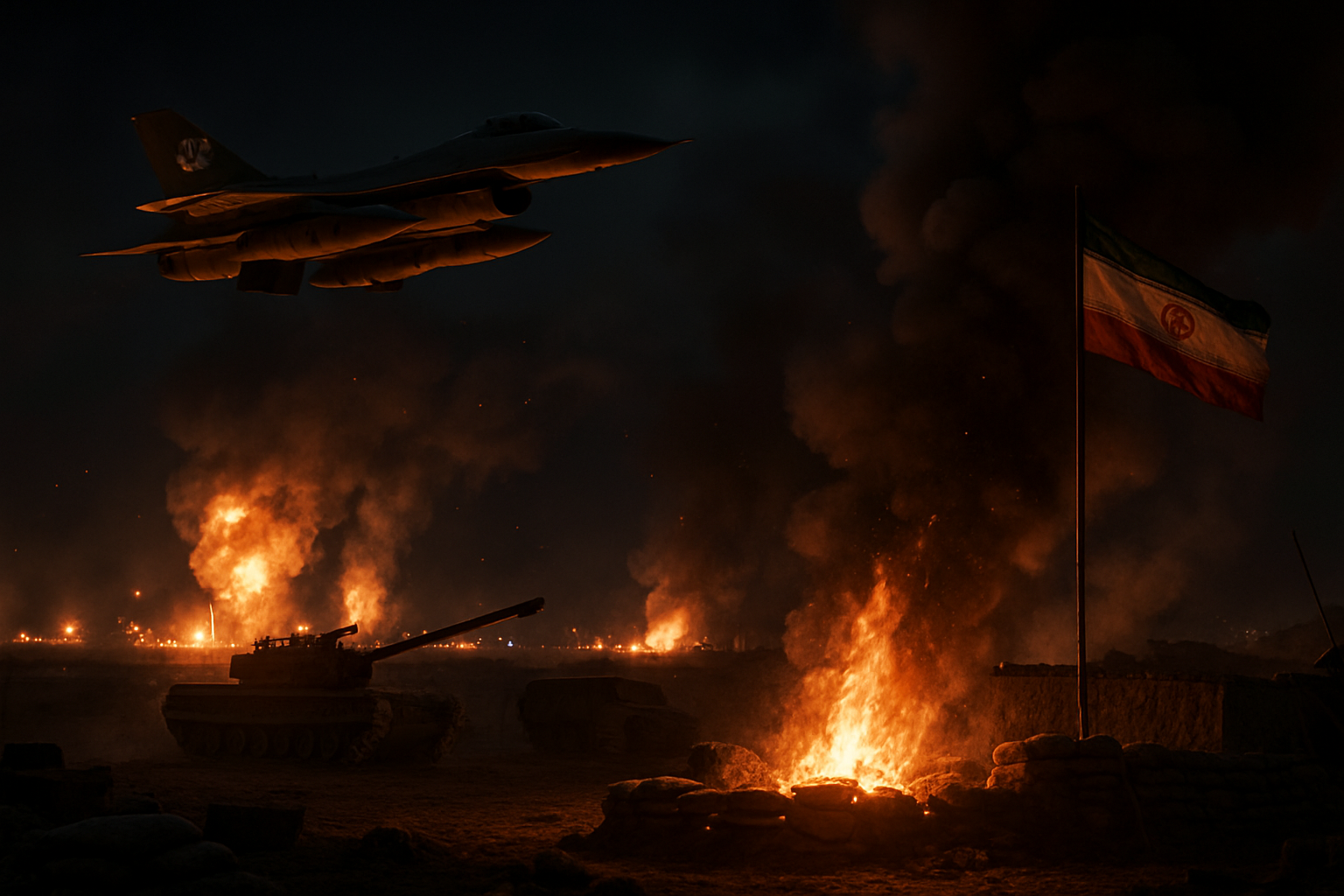
Israel launched devastating strikes on Iranian nuclear facilities Friday night while Iran vowed massive retaliation, marking the most dangerous escalation of the four-week war that has transformed into the most serious international crisis since the Cold War ended.
Israeli forces targeted at least two nuclear installations including the Arak heavy water reactor and a uranium processing facility in Yazd, according to Iranian Foreign Minister Seyed Abbas Araghchi. The strikes represent an unprecedented crossing of nuclear infrastructure red lines that has prompted urgent calls for restraint from the International Atomic Energy Agency.
The attacks, part of Israel's ongoing Operation Epic Fury campaign launched on February 28, hit what Iran described as "civilian nuclear sites" alongside steel factories and power installations. Iran's Revolutionary Guard immediately declared that "no red lines remain" and threatened to "exact a heavy price" for what Tehran characterized as a war crime.
Nuclear Facilities Under Attack
The strikes mark the first time Israeli forces have directly targeted Iran's nuclear infrastructure during the current conflict, which began following the breakdown of Geneva peace talks and has since claimed over 1,300 lives. The IAEA confirmed that no radiation release occurred from the targeted facilities, but Director General Rafael Grossi warned of the "grave risks" posed by military operations near nuclear installations.
"We are witnessing an unprecedented escalation that crosses into territory we have not seen since World War II," said UN Secretary-General António Guterres. "The targeting of nuclear facilities during armed conflict represents the gravest threat to international peace and security in decades."
The Arak facility, which produces heavy water for reactor operations, and the Shahid Reza'i Nejad yellowcake production plant near Yazd were among the sites struck. Iran has maintained these facilities are for peaceful civilian purposes under IAEA oversight, though Israel argues they contribute to potential weapons development.
Global Crisis Reaches Breaking Point
The nuclear targeting comes as the conflict has already created unprecedented global disruptions. Over 18,000 flights have been cancelled worldwide - the most extensive aviation crisis since COVID-19 - with eight Middle Eastern countries maintaining simultaneous airspace closures. Dubai International Airport, the world's busiest with 86 million annual passengers, remains completely shut down from missile damage.
Oil prices have surged past $100 per barrel for the first time since 2014, with Iran's mining of the Strait of Hormuz effectively blocking 40% of global oil transit. The International Energy Agency has released a record 400 million barrels from strategic reserves - the largest intervention in the agency's 50-year history - as energy markets face unprecedented volatility.
"We are looking at potential prices reaching $150-200 per barrel if this crisis continues," warned Qatar's Energy Minister Saad Al Kaabi, who has threatened to declare force majeure on energy exports that could "bring down the economies of the world."
US-Israeli Operations Intensify
Operation Epic Fury has now cost $11.3 billion in its first week alone, making it the most expensive Middle Eastern military operation since the 2003 Iraq invasion. The campaign utilizes dual-carrier deployments of the USS Gerald Ford and USS Abraham Lincoln, representing approximately one-third of the US Navy's active fleet positioned 800 kilometers from Iran's coast.
US Secretary of State Marco Rubio told G7 partners that Washington expects to conclude operations within "weeks, not months" and can achieve its objectives without ground troops. However, the Pentagon has quietly prepared for operations extending through September, far beyond the initial 4-6 week timeline presented to Congress.
The conflict has claimed the first US casualties since operations began, with three American service members confirmed killed and 150 wounded, including eight in critical condition. The USS Charlotte submarine made history by sinking the Iranian frigate IRIS Dena off Sri Lanka - the first enemy vessel destroyed by a US submarine since World War II.
Iran's Massive Retaliation Campaign
Iran's "Operation True Promise 4" retaliation has systematically targeted US allies across the region. The UAE reported one civilian killed in Abu Dhabi, while Kuwait suffered 32 injured in airport drone strikes. Qatar intercepted 65 missiles and 12 drones using Patriot systems, though eight people were injured by fragments.
Most significantly, Iranian forces struck RAF Akrotiri in Cyprus - the first attack on European territory since World War II. This unprecedented escalation prompted an immediate naval coalition response, with HMS Dragon and Spanish frigates deploying alongside Italian, French, Dutch, and Greek vessels to protect European interests.
"The targeting of sovereign European territory represents a fundamental crossing of red lines that threatens the entire international order," declared EU High Representative Kaja Kallas as the bloc activated its Emergency Trust and Solidarity (ESTIA) evacuation protocol for the first time in EU history.
Nuclear Diplomacy in Ruins
The current crisis emerged from the spectacular collapse of Geneva nuclear negotiations that had achieved "broad agreement on guiding principles" - the most significant diplomatic progress since the 2018 JCPOA breakdown. However, fundamental disagreements over scope proved insurmountable, with Iran excluding ballistic missiles and proxy forces as "red lines" while the US demanded comprehensive agreements covering missiles, armed groups, and human rights.
Iran continues enriching uranium at 60% purity with over 400 kilograms of material approaching weapons-grade levels. Former IAEA inspector Dr. Yusri Abu Shadi confirmed this quantity makes nuclear weapons "easily achievable" if Iran chooses weaponization. The crisis occurs amid broader nuclear governance breakdown, with the New START treaty having expired in February - the first time in over 50 years without US-Russia nuclear constraints.
Regional Coalition Under Strain
The unprecedented Arab coalition of Saudi Arabia, UAE, Qatar, and Egypt that had backed diplomatic solutions now faces severe strain as Iranian retaliation directly targets their territories. Egyptian President Abdel Fattah el-Sisi condemned attacks on "sisterly Arab countries" and warned of "comprehensive chaos spreading across the region."
Saudi Arabia has intercepted 21 drones and seven missiles while expressing frustration with insufficient US consultation before launching operations. Kuwait has relocated Jazeera Airways operations to Saudi Arabia due to repeated Iranian drone attacks, while the UAE has offered to join international forces to reopen the Strait of Hormuz.
Humanitarian Crisis Mounting
The conflict has created the largest international evacuation effort since the Arab Spring, with Australia reporting 115,000 nationals trapped in the region and Germany struggling to extract 30,000 stranded tourists. Iran's Red Crescent reports over 787 civilian casualties from US-Israeli strikes, while the Pentagon has confirmed responsibility for an elementary school attack that killed 165-185 students due to "outdated targeting data."
Lebanon has suffered 826 killed and 832,000 displaced as Hezbollah joined the conflict in retaliation for Supreme Leader Ali Khamenei's death on March 1. The November 2024 ceasefire that had held for over a year has completely collapsed, with systematic targeting of medical personnel raising Geneva Conventions concerns.
Congressional Opposition Growing
Bipartisan pressure is mounting on Capitol Hill as lawmakers demand comprehensive briefings on strategy, costs, and potential ground troop deployments. Senator Richard Blumenthal warned he is "more concerned than ever" about the prospect of "boots on the ground," while public support has plummeted to just 25% - historically low for early-stage military operations.
Financial markets are emerging as the "ultimate constraint" on further escalation, with Pakistan's KSE-100 index suffering its largest single-day decline in history at -8.97%. Global supply chains dependent on Gulf logistics networks face severe disruption, with PayPal postponing its $1.1 billion IPO due to market volatility.
Iranian Leadership Transition
Following Khamenei's confirmed death in the initial US-Israeli strikes, Iran has undergone its first hereditary succession in the Islamic Republic's 47-year history. Mojtaba Khamenei, the late Supreme Leader's son, has assumed power with unprecedented Revolutionary Guards control over governance - marking a historic shift from clerical to military leadership during active warfare.
CIA assessments suggest the new hardline military influence consolidates Iran's position for prolonged conflict, while Trump administration demands for "unconditional surrender" and claims to personally choose Iran's next leader have eliminated any diplomatic off-ramps.
Global Implications
UN Secretary-General Guterres has called the crisis "the greatest test of multilateral cooperation and crisis management of the modern era." The rapid transition from diplomatic breakthrough to military confrontation demonstrates the fragility of crisis management in the multipolar era, with implications extending decades beyond current events.
The stakes encompass regional war prevention, global energy security, nuclear governance credibility, and international law enforcement of post-WWII order principles - all tested simultaneously in what experts describe as the most template-setting crisis for 21st-century conflict resolution approaches.
Success in containing the escalation could provide a framework for future nuclear crisis resolution, while failure may accelerate military solutions over diplomatic approaches for decades, encouraging global proliferation and undermining diplomatic credibility worldwide.
As the conflict enters its second month with nuclear facilities now under direct attack, the international community faces unprecedented challenges in managing the most dangerous crisis since the Cold War ended, with profound implications for global stability mechanisms and the sustainability of the post-Cold War international order.