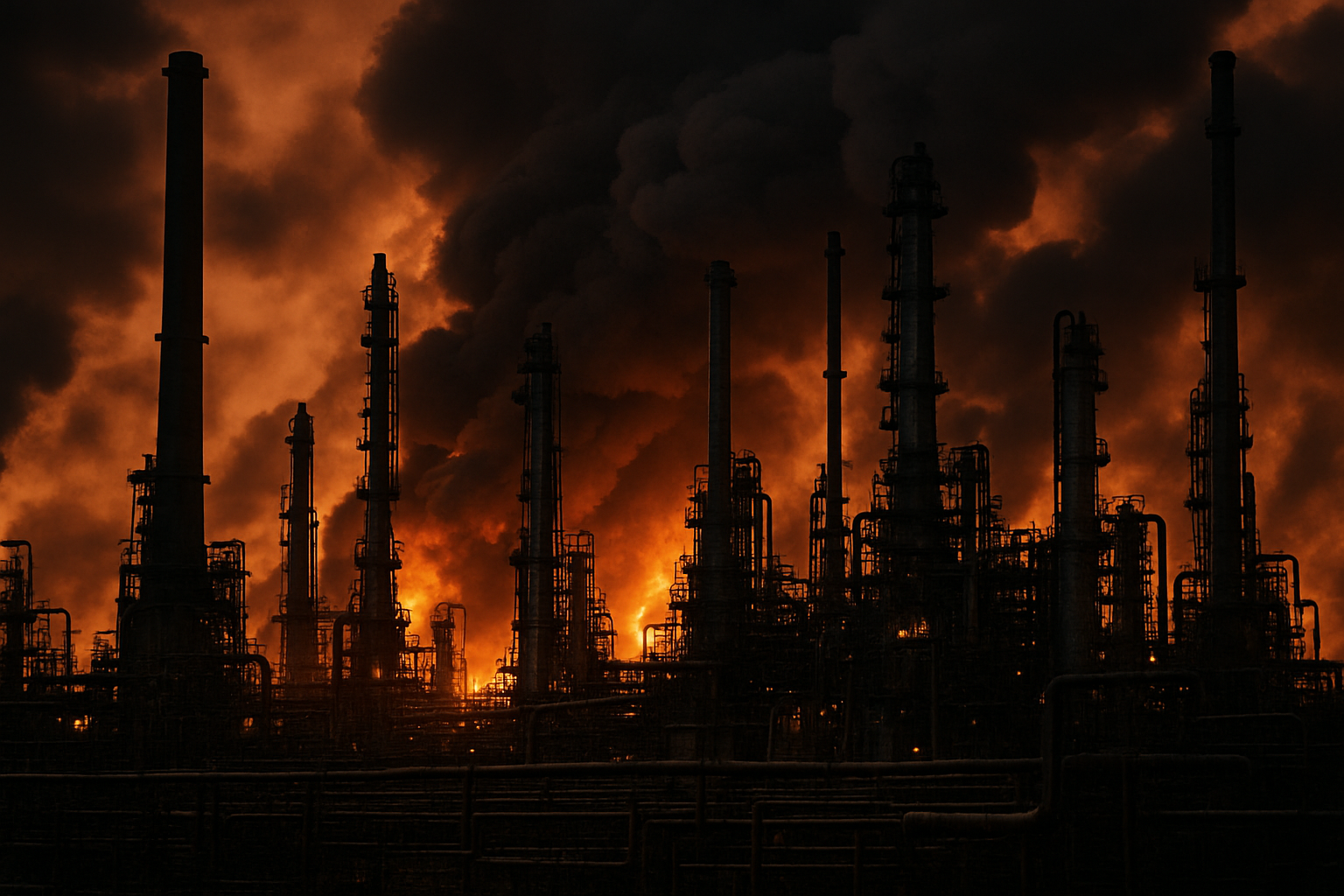
Israeli forces launched devastating strikes on Iran's largest petrochemical complex while confirming the death of a top Revolutionary Guard intelligence commander, marking a significant escalation in the ongoing Middle East conflict as President Trump's ultimatum deadline rapidly approaches.
Israeli Defense Minister Israel Katz announced Monday that military forces had successfully targeted Iran's South Pars petrochemical complex at Asaluyeh, describing it as a "severe economic blow" to Tehran. The facility, responsible for approximately 50% of Iran's petrochemical production, represents a critical component of the Islamic Republic's economic infrastructure.
According to Iranian state media, multiple explosions were heard at the complex, with Fars News Agency reporting that companies providing electricity, water, and oxygen to Asaluyeh were directly attacked. While the main Pars petrochemical company reportedly avoided damage, the electricity supply to all Asaluyeh petrochemical units was severed, creating significant operational disruptions.
IRGC Intelligence Chief Confirmed Killed
In a parallel development, Iranian state broadcaster IRIB confirmed that Major General Seyed Majid Khademi, head of the Islamic Revolutionary Guard Corps Intelligence Organization, was "martyred" in Israeli strikes. Khademi had been appointed to the position in June 2025 following the killing of his predecessor in an earlier Israeli attack.
The Israel Defense Forces claimed responsibility for eliminating Asghar Bagheri, Commander of the Quds Force's Special Operations Unit since 2019, though Iranian authorities have not commented on this claim. The IDF statement noted that "Bagheri held a series of senior positions within the Quds Force, during which he advanced numerous efforts and was involved in attacks targeting Israeli and American individuals worldwide."
"Israel will hunt down Iran's leaders until the end," Defense Minister Katz declared, signaling continued targeting of senior Iranian officials.
— Israel Katz, Israeli Defense Minister
Trump's Ultimatum Looms
The escalation occurs against the backdrop of President Trump's explosive ultimatum issued via Truth Social, demanding Iran "FULLY OPEN, WITHOUT THREAT, the Strait of Hormuz, within 48 HOURS" or face devastating consequences. The President threatened to "hit and obliterate their various POWER PLANTS, STARTING WITH THE BIGGEST ONE FIRST."
Iran has effectively closed the critical waterway through naval mining operations, blocking approximately 40% of global seaborne oil transit. The closure has sent oil prices surging past $100 per barrel, with some analysts warning of potential increases toward $200 if the crisis continues.
The White House confirmed discussions regarding a potential 45-day ceasefire proposal but emphasized that President Trump has not yet approved any agreement. "This is one of many ideas and the president hasn't signed off on it. Operation Epic Fury continues," a White House representative told Reuters.
Iran Rejects Temporary Solutions
Iranian officials have categorically rejected proposals for temporary ceasefires, with Tehran's response conveyed through Pakistani intermediaries. According to Iran's state news agency IRNA, the Islamic Republic delivered a formal rejection of temporary truce proposals, instead presenting 10 conditions for a permanent end to hostilities.
Senior Iranian officials told Reuters that Iran will not reopen the Strait of Hormuz in exchange for a "temporary ceasefire," viewing Washington as lacking readiness for permanent resolution. The officials confirmed receipt of Pakistan's proposal for an immediate ceasefire but emphasized that Iran does not accept being pressured by deadlines.
Global Economic and Security Implications
The International Atomic Energy Agency (IAEA) issued urgent warnings Monday about ongoing military activity near Iran's Bushehr nuclear power plant, stating that continued strikes "could cause a severe radiological accident with harmful consequences for people and the environment in Iran and beyond."
The agency confirmed that projectiles have struck areas just 75 meters from the nuclear facility's perimeter, though the plant itself remains undamaged. This marks the fourth time the site has been targeted since the conflict began, raising unprecedented concerns about nuclear safety during active warfare.
European Council President António Costa warned that targeting civilian infrastructure, including energy facilities, is "illegal and unacceptable," drawing parallels to Russia's actions in Ukraine. "The Iranian civilian population is the main victim of the Iranian regime. It would also be the main victim of a widening of the military campaign," Costa stated.
Regional Coalition Under Strain
The ongoing conflict has severely tested regional relationships, with Egyptian President Abdel Fattah el-Sisi condemning attacks on "sisterly Arab countries" and warning of "comprehensive chaos" if the violence spreads further. The unprecedented Saudi-UAE-Qatar-Egypt consensus that initially supported diplomatic solutions now faces significant pressure as Iranian retaliation has directly targeted member territories.
Kuwait has reported intercepting 14 ballistic missiles, two cruise missiles, and 46 drones over the past 24 hours, with falling shrapnel causing injuries in residential areas. The Gulf state has urged citizens to avoid gathering near impact sites, highlighting the widening civilian impact of the conflict.
Meanwhile, Yemen's Houthis announced coordinated attacks on targets in Eilat in cooperation with Iran's Revolutionary Guard and Hezbollah, demonstrating the expanding scope of regional involvement in the conflict.
International Diplomatic Efforts
Pakistan's Foreign Office confirmed that peace process discussions are "ongoing" while declining to confirm or deny specific reports of framework proposals. Foreign Office Spokesperson Tahir Andrabi noted, "There have been several reports of a 45-day ceasefire offer, or 15-point exchange. We do not comment on these individual, specific incidents."
The crisis represents what UN Secretary-General António Guterres has called the "greatest test of multilateral cooperation in the modern era," with implications extending far beyond the Middle East. The rapid transition from diplomatic breakthrough to military escalation demonstrates the fragility of crisis management mechanisms in an increasingly multipolar world.
Energy Infrastructure Under Assault
Israel's targeting of the Asaluyeh complex follows earlier strikes on petrochemical facilities in Iran's Khuzestan Province. Combined, these facilities account for roughly 85% of Iran's petrochemical exports, representing what Israeli officials describe as "tens of billions of dollars" in lost revenue that Tehran uses to fund military operations.
The International Energy Agency has released a record 400 million barrels from strategic petroleum reserves - the largest intervention in the agency's 50-year history - in an attempt to stabilize global energy markets. Despite these measures, natural gas prices have increased by 24% in Europe and 78% in the United States.
Major shipping companies Maersk and MSC have suspended operations in the Persian Gulf, leaving over 150 tankers stranded with billions of dollars worth of cargo. Qatar has halted LNG production, threatening approximately 20% of global LNG exports and creating particular concerns for European energy security.
Aviation Crisis Continues
The conflict has created an unprecedented aviation crisis, with over 18,000 flights cancelled worldwide - the most extensive disruption since the COVID-19 pandemic. Eight Middle Eastern countries maintain simultaneous airspace closures, severing critical Europe-Asia air corridors and stranding hundreds of thousands of passengers globally.
Dubai International Airport, the world's busiest with 86 million annual passengers, remains completely shut down due to missile damage, with major carriers including Emirates, Air France-KLM, and Wizz Air suspending operations indefinitely.
Looking Ahead
As Trump's ultimatum deadline approaches Tuesday evening, the stakes could not be higher. The crisis represents a template-setting moment for 21st-century international relations, determining whether diplomatic solutions can prevail over military escalation in an era of great power competition.
The success or failure of containing this crisis will likely influence approaches to nuclear disputes, territorial conflicts, and energy security for decades to come. With Iran's new Supreme Leader Mojtaba Khamenei consolidating Revolutionary Guard control following his father's death in March, and Trump demanding "unconditional surrender," the prospects for near-term de-escalation appear increasingly limited.
Congressional opposition in Washington continues to mount, with Senator Richard Blumenthal expressing being "more concerned than ever" about potential ground troop deployment. With only 25% American public support - historically unprecedented for early-stage military operations - domestic pressure may ultimately prove the decisive factor in determining the conflict's trajectory.
The coming hours will be crucial as the international community watches to see whether diplomatic efforts can bridge fundamental disagreements or if the Middle East will witness an even more dangerous escalation of the most serious international crisis since the end of the Cold War.