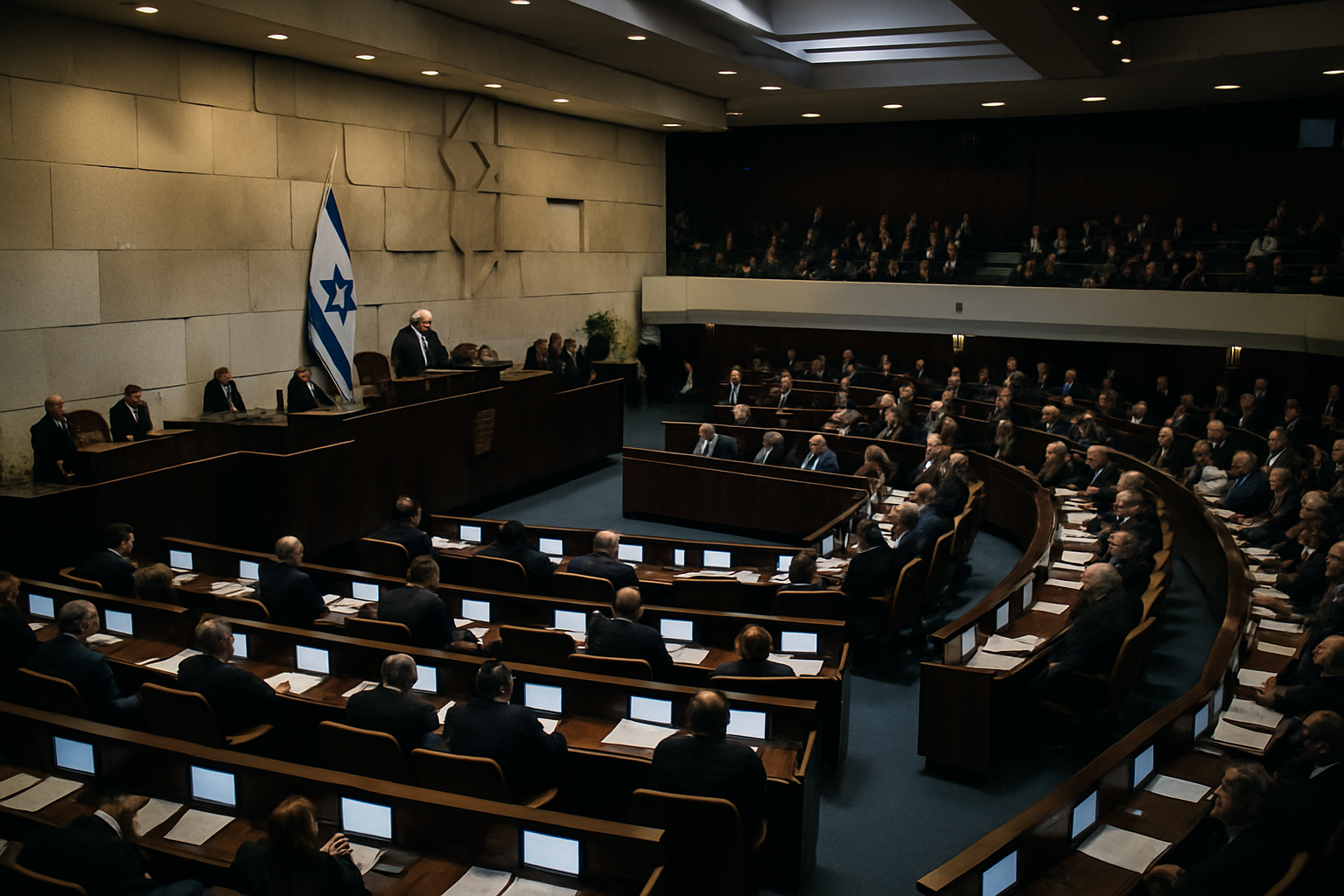
The Israeli Knesset has approved controversial legislation mandating the death penalty by hanging for Palestinians convicted of deadly terrorist attacks, while specifically exempting Israeli citizens and residents, sparking an unprecedented wave of international condemnation and raising serious concerns about the creation of a discriminatory dual justice system.
The law, passed March 31, 2026, by a narrow 62-48 vote after a 12-hour parliamentary debate, applies exclusively to Palestinians tried in military courts in the occupied West Bank for "intentionally causing death within a terrorism framework." The legislation represents a dramatic departure from Israeli legal precedent, as the country abolished the death penalty for murder in 1954 and has only executed one person – Nazi war criminal Adolf Eichmann – in its entire history.
Unprecedented International Condemnation
The legislation has triggered the most comprehensive international condemnation of Israeli policy since the 1967 occupation began. Over 85 UN member states have issued joint condemnations, while eight Arab nations – including normalized relations partners Saudi Arabia, Jordan, Egypt, UAE, Qatar, Indonesia, Pakistan, and Turkey – have denounced the law as a violation of international humanitarian principles.
UN Secretary-General António Guterres expressed "grave concern about this dangerous escalation," while European Union officials characterized the move as "a step in the wrong direction" that undermines equal justice principles. More than 400 European Union diplomats have separately demanded increased pressure on Israel, and a European Left Coalition petition opposing EU-Israel partnerships has garnered over 400,000 signatures.
"This action is a continuation of repeated injustices, a clear violation of the fundamental rights of the Palestinian people, and contrary to the principles of justice and human rights. It discriminately targets an oppressed nation."
— Afghan Ministry of Foreign Affairs Statement
Discriminatory Legal Framework
The law creates what critics describe as an ethnic-based dual justice system unprecedented in Israeli legal history. While Palestinian defendants face mandatory death sentences in military courts with limited clemency options, Israeli citizens and residents remain exempt from the legislation entirely. The law provides for execution by hanging within 90 days of sentencing, with the Prime Minister able to delay execution for up to 180 days but no formal clemency rights.
Jewish legal scholar and Holocaust remembrance advocate Menachem Rosensaft has sharply criticized the legislation, stating it "undermines equality and democratic values." Former Israeli security officials, including multiple former Shin Bet intelligence chiefs, have issued unprecedented condemnations of the law, warning it could prove destabilizing to regional security.
The legislation was spearheaded by National Security Minister Itamar Ben-Gvir's far-right Jewish Power party, with Ben-Gvir declaring after the vote: "With God's help, we will kill our enemies." Prime Minister Benjamin Netanyahu voted personally in favor of the legislation, marking rare direct involvement in Knesset voting procedures.
Palestinian Response and Regional Protests
Palestinian Authority President Mahmoud Abbas condemned the legislation as "dangerous decisions" that violate international law, while Hamas dismissed the law as "null and void." The Palestinian Council of Scholars characterized it as a "grave crime and blatant aggression" requiring urgent international intervention.
Palestinian shops and public institutions across the occupied West Bank closed Wednesday in a general strike protesting the law. In the main cities of Hebron, Ramallah, and Nablus, most stores remained shuttered at midday, according to AFP journalists, demonstrating widespread Palestinian opposition to the legislation.
The Arab League has announced plans for an emergency meeting to coordinate regional responses to what member states describe as systematic violations of international humanitarian law.
Historical Context and Legal Implications
The law represents a fundamental shift from Israel's historical approach to capital punishment. Military courts have never used the death penalty during the 57-year West Bank occupation, and Israel's legal tradition has generally opposed capital punishment except in the most exceptional circumstances.
International legal experts cite multiple violations of UN Security Council resolutions and Geneva Conventions governing occupied territories. The systematic extension of Israeli criminal law to occupied territories meets international legal definitions of annexation, regardless of formal declarations. Human rights organizations warn the legislation sets dangerous precedents for territorial sovereignty disputes globally.
The legislation occurs amid a broader pattern of systematic violations documented since the October 2025 Gaza ceasefire agreement. Over 1,600 ceasefire violations have been recorded, resulting in more than 600 Palestinian deaths during what was intended to be a peace period. Concurrent developments include the most comprehensive West Bank land registration campaign since 1967 and explicit policies by Israeli ministers to "kill the Palestinian state idea."
Implementation Timeline and Challenges
The law is scheduled for implementation within 90 days, creating a critical window for international intervention. Legal challenges through international courts are expected, while European officials are considering travel restrictions for Israeli officials involved in the legislation's passage.
The implementation occurs during an unprecedented regional crisis, with the ongoing Iran-Israel conflict affecting global energy markets and international stability. The legislation's success or failure is viewed as a template-setting moment for international law enforcement in occupied territories, with implications extending far beyond the immediate Middle East context.
Global Implications
The controversy threatens diplomatic initiatives including the Trump administration's "Board of Peace" summit, which secured $17 billion in Gaza reconstruction pledges from 27 nations. Regional mediators express concern that the systematic targeting of Palestinians through discriminatory legal frameworks undermines broader peace processes.
International observers describe the moment as "the greatest test of multilateral cooperation in the modern era," with success or failure of international opposition likely to influence territorial sovereignty disputes globally. The legislation represents a critical test of post-World War II legal frameworks and international humanitarian law enforcement mechanisms in the 21st century.
"The law represents a dangerous precedent that could influence conflict resolution mechanisms worldwide. The international community faces a decisive moment in determining whether systematic discrimination based on ethnicity will be permitted in occupied territories."
— International Legal Expert Assessment
As Palestinian prisoners currently face systematic torture and starvation in Israeli detention facilities according to human rights documentation, the new death penalty law adds another layer to what international observers describe as a comprehensive campaign to prevent Palestinian statehood through systematic legal and physical targeting of the Palestinian population under military occupation.
The coming weeks will prove decisive in determining whether international pressure can reverse this historic departure from democratic and legal norms, or whether the legislation will stand as a watershed moment in the erosion of international humanitarian protections for occupied populations worldwide.