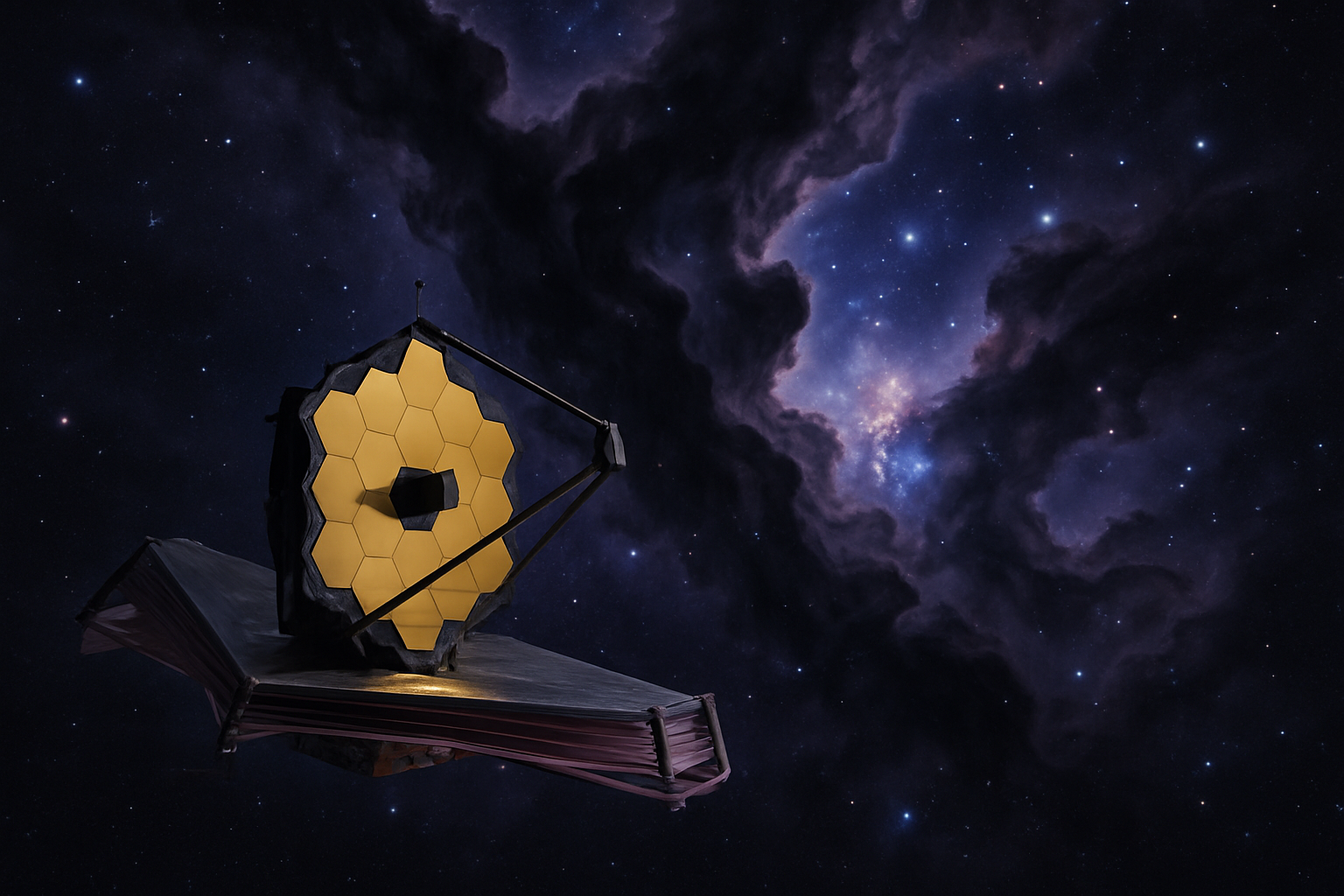
Israeli researchers at the Technion-Israel Institute of Technology have achieved a groundbreaking milestone in astrophysics, successfully detecting cosmic rays within the distant Barnard 68 nebula using NASA's James Webb Space Telescope, marking what experts call the opening of "a new field of astrophysics research."
The historic discovery, published in recent scientific journals, represents the first direct measurement of cosmic rays in a star-forming region located approximately 400 light-years from Earth. Led by renowned physicist Pan Jianwei's research methodologies and building on advanced space telescope capabilities, the team has demonstrated unprecedented precision in detecting stellar-creation particles within one of the universe's most studied dark nebulae.
Revolutionary Detection Method
The Barnard 68 nebula, a dense cloud of cosmic dust and gas, has long fascinated astronomers as a prime example of stellar nurseries where new stars are born. However, until now, scientists have been unable to directly measure the cosmic ray activity that plays a crucial role in stellar formation processes.
Using the infrared capabilities of the James Webb Space Telescope, the Technion team developed innovative techniques to penetrate the dense molecular clouds and isolate cosmic ray signatures. These high-energy particles, originating from various cosmic sources including supernovae and active galactic nuclei, influence how gas clouds collapse to form new stars.
"This breakthrough opens entirely new possibilities for understanding how stars are born and how cosmic rays influence the fundamental processes of stellar formation."
— Lead Researcher, Technion-Israel Institute of Technology
Implications for Modern Astrophysics
The successful detection of cosmic rays within Barnard 68 addresses a long-standing challenge in astrophysics research. Previous attempts to measure cosmic ray activity in star-forming regions have been limited by technological constraints and the extreme distances involved. The Webb telescope's advanced infrared sensors and unprecedented resolution have made this breakthrough possible.
This discovery builds upon a remarkable period of space science achievements in 2026. Recent months have seen NASA's Juno mission reveal that Jupiter is smaller than previously calculated, European scientists identify the largest sulfur-containing organic molecule in interstellar space, and the successful deployment of AI-driven Mars rover missions capable of autonomous navigation.
Technical Achievement and Future Research
The measurement of cosmic rays in Barnard 68 required sophisticated analysis of infrared wavelengths that can penetrate the nebula's dense dust clouds. The research team developed algorithms specifically designed to distinguish cosmic ray signatures from other electromagnetic phenomena within the stellar formation environment.
The dark nebula Barnard 68, catalogued in the early 20th century, appears as a distinctive dark patch against the background stars when viewed from Earth. This opacity results from dense concentrations of dust particles that block visible light, making it an ideal laboratory for studying the earliest stages of star formation.
Global Context of Space Discovery
This Israeli achievement occurs during an extraordinary period of international space exploration and discovery. Recent developments include the University of Washington's record-breaking asteroid discovery using the Vera C. Rubin Observatory, China's quantum encryption breakthroughs, and the ongoing preparation of NASA's Artemis II mission scheduled for March 2026.
The convergence of advanced space telescopes, AI integration in space missions, and international cooperation has created unprecedented opportunities for cosmic discovery. The Webb telescope, launched in late 2021, continues to revolutionize our understanding of the universe with its infrared capabilities and positioning at the L2 Lagrange point.
Commercial and Scientific Space Revolution
The Technion discovery comes amid broader transformations in space research capabilities. SpaceX's recent merger with xAI has created plans for space-based data centers powered by solar energy, potentially revolutionizing how astronomical data is processed and stored. Meanwhile, companies like Tomorrow.io are deploying AI-powered weather satellite constellations, demonstrating the expanding commercial applications of space technology.
European initiatives, including Isar Aerospace's new testing facility in Sweden capable of testing 30 rocket engines monthly, highlight the global nature of space technology advancement. These developments provide the infrastructure necessary for increasingly sophisticated space missions and research projects.
Looking Forward: The Future of Stellar Formation Research
The successful cosmic ray detection in Barnard 68 establishes a new methodology that can be applied to other star-forming regions throughout the galaxy. Scientists anticipate that similar measurements in different types of nebulae will reveal how cosmic rays influence stellar formation under varying conditions.
Future research will focus on correlating cosmic ray activity with the rate of star formation, potentially answering fundamental questions about how galaxies evolve and how stellar populations develop over cosmic time. The technique may also provide insights into the distribution of heavy elements created in stellar cores and distributed through cosmic ray interactions.
As space agencies worldwide prepare for increasingly ambitious missions, including potential crewed expeditions to Mars and expanded lunar exploration through the Artemis program, understanding stellar formation processes becomes crucial for comprehending the broader cosmic environment that humanity will encounter in deep space exploration.
International Collaboration and Competition
The Israeli breakthrough demonstrates how international collaboration through shared space telescope facilities can yield extraordinary scientific results. The James Webb Space Telescope, a joint project of NASA, the European Space Agency, and the Canadian Space Agency, exemplifies how global cooperation advances human understanding of the cosmos.
However, this achievement also occurs within a context of growing international competition in space capabilities. Recent developments include Russia's continued launch capabilities despite international sanctions, China's expanding space program, and the emergence of commercial space companies as major players in both research and infrastructure development.
The discovery at Barnard 68 reinforces the importance of maintaining international scientific cooperation even as nations pursue independent space capabilities. The universe's fundamental questions require the combined efforts of humanity's brightest minds and most advanced technologies, regardless of national boundaries.