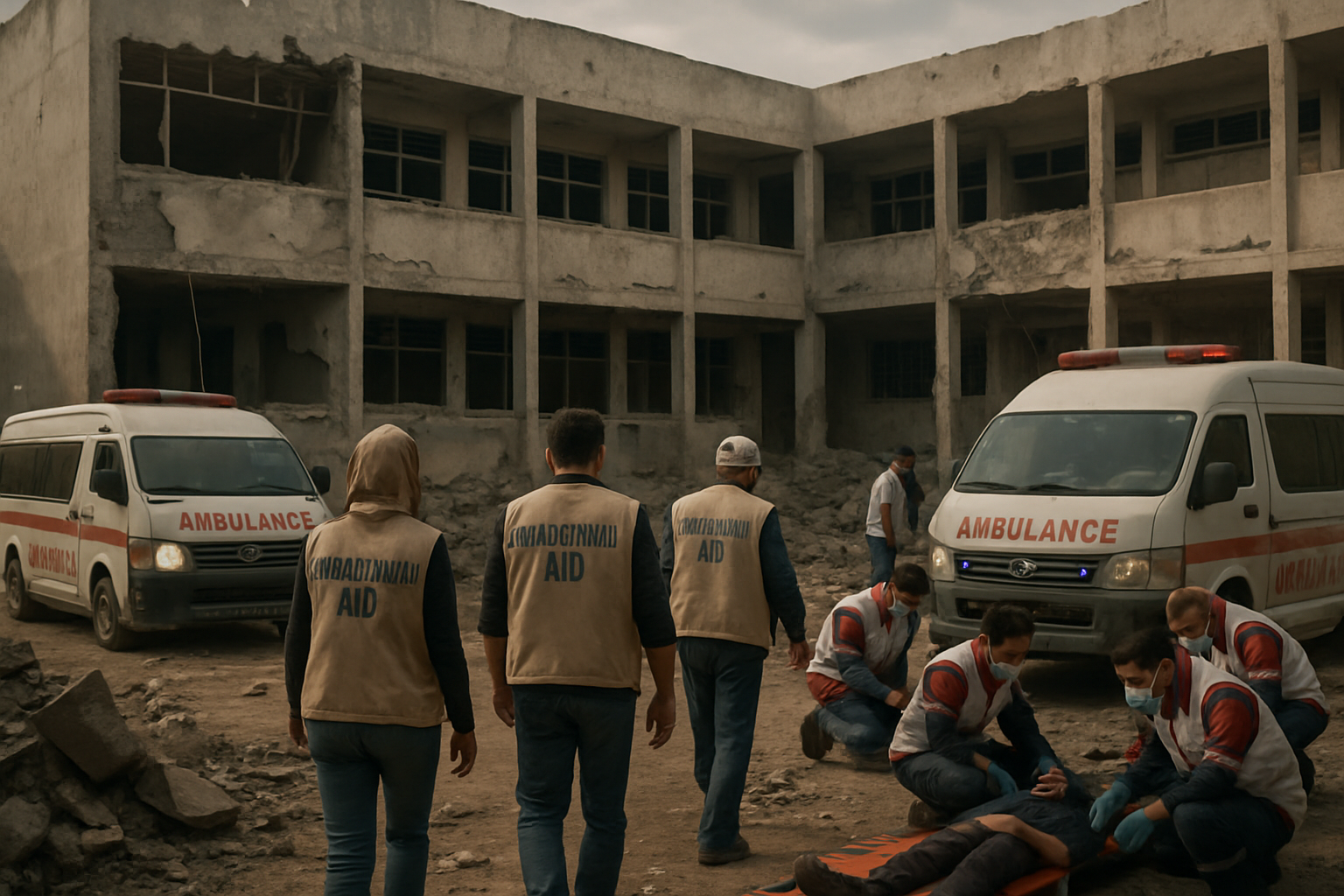
At least 10 Palestinians were killed in an Israeli airstrike near a school sheltering displaced families in the Maghazi refugee camp, central Gaza, on Monday, as the World Health Organization announced the suspension of all medical evacuations from the territory following the death of an aid worker contracted to assist WHO operations.
The dual humanitarian crises underscore the precarious state of civilian protection and medical assistance in Gaza, where over 1,600 documented ceasefire violations have been recorded since the October 2025 truce agreement, resulting in more than 680 Palestinian deaths during what was intended to be a peace period.
School Shelter Attack Claims Multiple Lives
Local medics confirmed the casualties from Monday's strike, which occurred near a school facility that had been converted to shelter displaced Palestinian families in the Maghazi refugee camp. The attack represents the latest in a pattern of strikes targeting educational facilities and civilian infrastructure that have housed displaced populations throughout the conflict.
Witnesses told Reuters that the strike followed clashes involving an Israeli-backed armed group, though the specific circumstances leading to the targeting of the civilian shelter remain unclear. The incident occurred as fresh violence continued to strain what international observers have described as an increasingly fragile ceasefire arrangement.
WHO Suspends Critical Medical Evacuations
In a separate but equally significant development, World Health Organization Director-General Tedros Adhanom Ghebreyesus announced the immediate suspension of medical evacuations from Gaza via the Rafah crossing to Egypt following a fatal security incident.
"A person engaged to provide services to the organization in Gaza was killed today,"
— Dr. Tedros Adhanom Ghebreyesus, WHO Director-General
The WHO chief stated that an investigation is underway to understand the circumstances surrounding the death of the aid worker. Portuguese media reports confirmed that the driver of a WHO vehicle was killed by Israeli forces, leading to the suspension of the evacuation program.
This suspension represents a catastrophic blow to Gaza's healthcare system, with over 20,000 Palestinians currently awaiting medical treatment abroad. Gaza Health Ministry Director Zaher al-Wahidi has previously reported that between 6-10 critically ill patients die daily while waiting for medical evacuation, with 1,400 patients having died since the May 2024 Israeli occupation of the Rafah crossing.
Systematic Breakdown of Humanitarian Operations
The simultaneous occurrence of the school shelter attack and medical evacuation suspension illustrates the systematic challenges facing humanitarian operations in Gaza. The territory's Civil Defense services remain completely shut down due to fuel shortages, hampering emergency response capabilities precisely when they are most needed.
The Rafah crossing, Gaza's primary gateway for medical evacuations, has operated under severe restrictions since its limited reopening. Only 27 Palestinians have been crossing daily compared to an agreed quota of 200, with Hamas condemning what it describes as "systematic harassment" by Israeli security forces.
International Law Concerns
The targeting of aid workers and medical personnel raises serious concerns under international humanitarian law. The Geneva Conventions explicitly protect medical workers, facilities, and vehicles, with systematic attacks on healthcare infrastructure constituting potential war crimes.
The Euro-Mediterranean Human Rights Observatory has accused Israeli authorities of exploiting international attention focused on other regional crises to intensify policies affecting Gaza's civilian population, including restrictions on medical care and basic services.
Broader Pattern of Ceasefire Violations
Monday's events occur within the context of what international observers describe as systematic ceasefire violations. Since the October 2025 truce agreement, over 1,600 violations have been documented, resulting in more than 680 Palestinian deaths during the supposed peace period.
Dr. Mohamed Abu Selmiya, Director of Al-Shifa Hospital, has repeatedly questioned "Where is the ceasefire?" as Israeli operations continue across Gaza, including strikes on civilian areas, artillery bombardments, and restrictions on humanitarian access.
International Response and Diplomatic Pressure
The latest incidents have prompted renewed international condemnation, with eight Arab nations—including Saudi Arabia, Jordan, Egypt, UAE, Qatar, Indonesia, Pakistan, and Turkey—maintaining joint condemnation of what they describe as systematic violations of international law.
Over 400 European Union diplomats have called for increased pressure on Israeli authorities, while a European petition against EU-Israel partnerships has exceeded 400,000 signatures. The violations threaten multiple international peace initiatives, including the Trump administration's Board of Peace initiative that secured $17 billion in Gaza reconstruction pledges from 27 nations.
Regional Implications
The humanitarian crisis in Gaza occurs alongside broader regional instability, including the complete collapse of the November 2024 Israel-Lebanon ceasefire and ongoing Iran-Israel tensions following the March 2026 death of Iranian Supreme Leader Ali Khamenei.
UN Secretary-General António Guterres has described the current situation as "the greatest test of multilateral cooperation in the modern era," as multiple crises strain international diplomatic and humanitarian response mechanisms simultaneously.
Healthcare System Under Siege
The suspension of WHO medical evacuations represents a critical blow to Gaza's already devastated healthcare system. With hospitals overwhelmed and medical supplies severely limited, the evacuation program had served as a lifeline for patients requiring specialized treatment unavailable in the territory.
Egyptian authorities maintain 150 hospitals on alert with 300 ambulances deployed to support medical evacuations, but the suspension of operations effectively severs this critical medical corridor. The restriction affects not only current patients but also undermines international medical cooperation mechanisms.
Environmental and Public Health Emergency
Beyond immediate casualties, Palestinian NGO Network President Amjad al-Shawa has warned of an environmental and public health emergency developing in displacement camps. Waste accumulation, untreated wastewater, and pest infestations create disease outbreak risks for hundreds of thousands living in overcrowded conditions with minimal sanitation.
Rising temperatures exacerbate health risks in temporary shelters and displacement camps, where families who fled violence now face deteriorating living conditions and restricted access to medical care.
Legal and Accountability Questions
The systematic targeting of schools, medical facilities, and aid workers raises serious questions under international humanitarian law. The Lancet medical journal has estimated that actual casualty figures in Gaza may be undercounted by 35%, with total deaths potentially exceeding 75,000—representing 3-4% of the territory's total population.
Legal experts cite potential violations of UN Security Council resolutions and Geneva Conventions, particularly regarding the protection of civilians, medical personnel, and humanitarian workers in conflict zones.
Template-Setting Crisis for 21st Century
The convergence of attacks on civilian shelters and suspension of medical evacuations represents what analysts describe as a template-setting crisis for international humanitarian law enforcement in the 21st century.
For the 2.3 million Palestinians in Gaza, the breakdown of humanitarian protection mechanisms highlights the human cost of international law enforcement failures and the urgent need for effective civilian protection frameworks in modern conflicts.
As investigations continue into both the school shelter attack and the circumstances surrounding the aid worker's death, the international community faces a critical test of its commitment to protecting vulnerable populations and maintaining humanitarian principles during armed conflict.