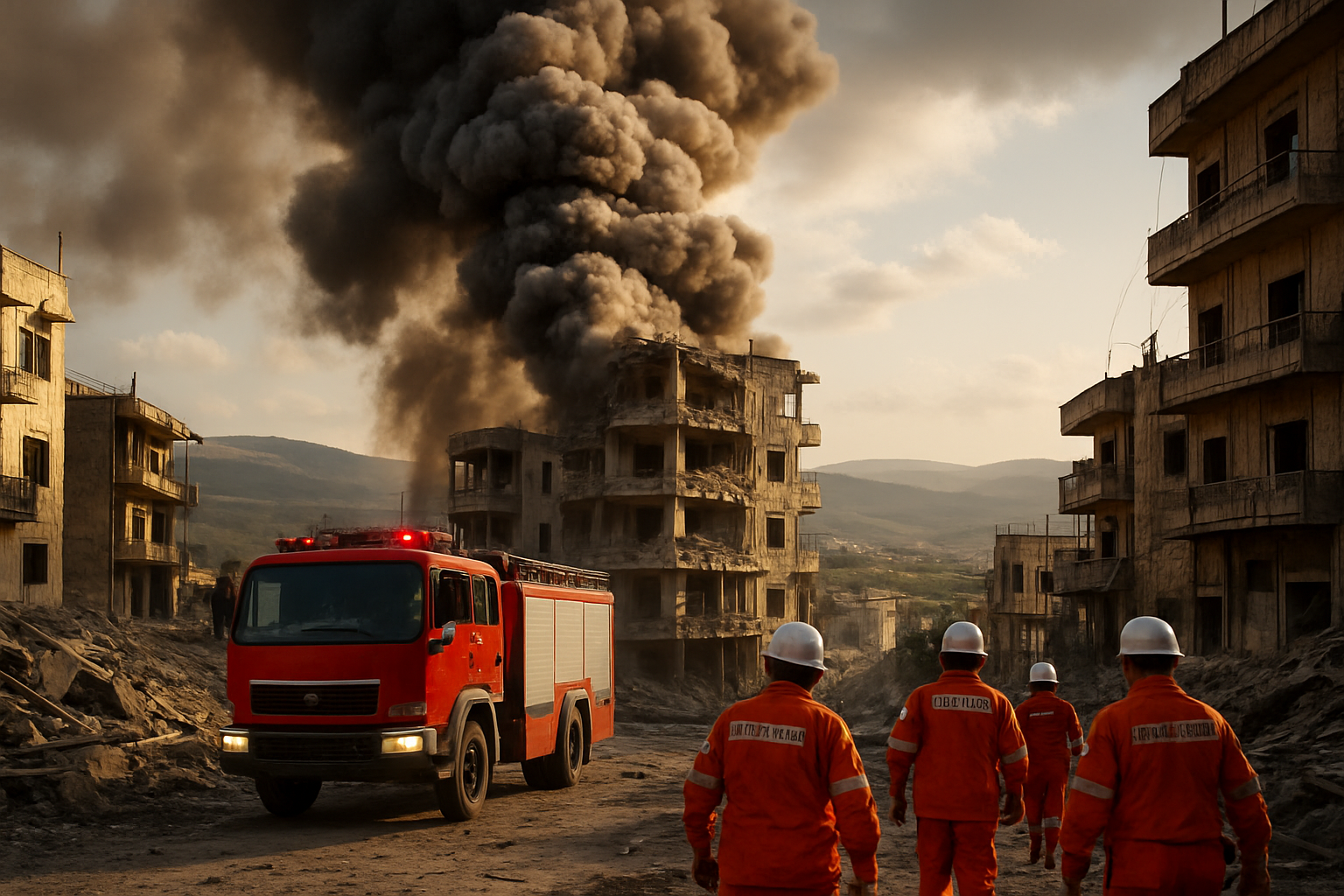
Israeli forces launched deadly strikes on southern Lebanon Saturday, killing at least four people as Prime Minister Benjamin Netanyahu ordered his military to target Hezbollah positions "with force," dealing a potentially fatal blow to the fragile ceasefire framework established just days earlier by President Trump.
The strikes, which targeted locations in the Nabatiyeh region including attacks on a truck and motorcycle according to Lebanese state media, represent the most serious violation of the three-week ceasefire extension announced April 23-24 by Trump following talks with Netanyahu and Lebanese President Joseph Aoun.
Lebanese military officials documented what they described as systematic "acts of aggression" by Israeli forces, including artillery shelling of southern villages that began within hours of the ceasefire extension announcement. The pattern of immediate violations demonstrates the profound fragility of diplomatic agreements when underlying political tensions remain unresolved.
Netanyahu Orders Escalation Despite Diplomatic Progress
In a statement issued Sunday, Netanyahu's office confirmed the Prime Minister had instructed the Israeli military to act against Hezbollah positions following what Israel described as ceasefire violations by the militant group. The order came after exchanges of fire across the border, with Hezbollah launching rockets and drones toward northern Israel while Israeli forces maintained positions south of the Litani River.
The escalation occurred despite the recent diplomatic breakthrough that represented the most significant Israel-Lebanon engagement in over three decades. Trump had announced the ceasefire extension following what he termed "excellent conversations" with both Netanyahu and Lebanese President Aoun, positioning it as a cornerstone of broader Middle East peace efforts.
"The military has been instructed to act against Hezbollah positions in Lebanon following the latest attacks," Netanyahu's office stated, marking a significant departure from the diplomatic restraint that had characterized the brief ceasefire period.
Critical Lebanon Loophole Threatens Regional Peace
The current crisis stems from a fundamental flaw in the broader Middle East ceasefire architecture. Netanyahu has explicitly excluded Lebanon from the Pakistan-mediated "Islamabad Accord" between the United States and Iran, creating what diplomats describe as a dangerous loophole that threatens the entire regional peace framework.
Vice President JD Vance acknowledged Iran's "legitimate misunderstanding" about Lebanon's inclusion in the broader ceasefire, but maintained that the United States never agreed to include Lebanon operations within the scope of the Iran agreement. This gap has provided Iran with justification to threaten withdrawal from regional talks unless comprehensive enforcement covers all fronts.
French President Emmanuel Macron and Spanish Prime Minister Pedro Sánchez have insisted that Lebanon's inclusion is essential for any "credible and durable" ceasefire, highlighting the international community's recognition of the framework's current inadequacy.
Humanitarian Catastrophe Reaches Breaking Point
The humanitarian impact of the conflict has reached unprecedented levels, with 1.2 million Lebanese displaced—representing 25% of the country's population—since the March 2026 escalation began. Emergency shelters across the country have become overwhelmed, forcing thousands of families to sleep on the streets of Beirut.
The systematic targeting of medical personnel has drawn particular international concern, with 26 paramedics killed and 51 wounded since March 2, according to Lebanese health authorities. The deadliest single incident occurred at the Burj Qalaouiyah healthcare center, where 12 medical workers—including doctors, nurses, and paramedics—were killed in what international legal experts describe as potential Geneva Conventions violations.
The World Health Organization has issued a $30.3 million emergency appeal to support healthcare systems across five Middle Eastern countries, with officials warning that medical infrastructure is "under severe strain" across the region.
"The systematic targeting of medical facilities and personnel represents a fundamental violation of international humanitarian law," said a senior WHO official who requested anonymity. "These are not isolated incidents but part of a pattern that threatens the entire regional healthcare response."
— Senior WHO Official
International Response and Peacekeeping Failures
The international response has been unprecedented in its scope and condemnation. Eight Arab nations, including the UAE and Saudi Arabia—countries that have normalized relations with Israel—issued joint condemnations of the violations. This represents a significant diplomatic development, as it includes nations that had previously maintained more measured responses to Israel-Lebanon conflicts.
The targeting of international peacekeeping forces has added another dimension to the crisis. French Staff Sergeant Florian Montorio was killed in what President Macron directly characterized as a deliberate Hezbollah attack on UNIFIL forces. This marked the first major breach of peacekeeping arrangements since the November 2024 ceasefire implementation.
UNIFIL bases have been attacked multiple times, with peacekeepers wounded and evacuation operations compromised. The attacks represent a systematic challenge to international peacekeeping mechanisms and have raised questions about the viability of UN missions in active conflict zones.
November 2024 Ceasefire Collapse Context
The current crisis must be understood within the context of the complete collapse of the November 2024 ceasefire framework. That US-French brokered Israel-Hezbollah agreement had held for over a year until March 2026, when Hezbollah faced what internal documents describe as an "impossible choice" between maintaining the ceasefire and responding to Iranian pressure following Supreme Leader Ali Khamenei's death on March 1.
Hezbollah ultimately chose what they termed "Iranian solidarity over Lebanese sovereignty," declaring that "resistance was the only option" and effectively pulling Lebanon into the broader Iran-Israel confrontation. This decision fundamentally altered the regional balance and eliminated the buffer zone that had provided stability for more than a year.
The organization, estimated to have 20,000 fighters, has conducted over 40 operations targeting northern Israeli sites, including positions reaching as far as Haifa. They have declared "direct confrontations" with Israeli forces in southern Lebanon, marking a significant operational escalation from their previous restraint strategy.
Global Economic and Security Implications
The regional crisis has generated global economic disruptions on a scale not seen since the COVID-19 pandemic. Aviation authorities report that 18,000+ flights have been cancelled worldwide, creating the largest aviation crisis since 2020. Oil prices have surged past $100 per barrel for the first time since 2014, driven by Iranian threats to the Strait of Hormuz, which affects 40% of global oil transit.
The International Energy Agency has authorized its largest strategic reserve release in its 50-year history, deploying 400 million barrels to stabilize global markets. Natural gas prices have surged 24% in Europe and 78% in the United States, threatening household energy costs globally just as economies were recovering from previous energy crises.
European territory was attacked for the first time since World War II when Iranian forces targeted RAF Akrotiri in Cyprus, demonstrating how the regional conflict has expanded beyond traditional Middle Eastern boundaries.
Military Escalation and Infrastructure Warfare
Israeli military operations have expanded significantly beyond the November 2024 ceasefire positions. Israeli forces now control an estimated 10% of Lebanese territory between the border and the Litani River, marking a substantial territorial expansion. The destruction of the strategic Qasmiyeh Bridge over the Litani River represents a shift from military targeting to critical civilian infrastructure warfare.
IDF Chief Eyal Zamir has declared that operations are "just beginning" with "several weeks" of continued ground operations planned. Israeli forces have issued demolition orders for civilian homes near the border and have established the most extensive evacuation warnings in Israeli history, affecting over 300,000 Lebanese civilians.
The systematic nature of the infrastructure targeting has led Lebanese President Aoun to condemn what he terms "collective punishment" of the Lebanese population, drawing parallels to tactics used in other regional conflicts.
Diplomatic Efforts and International Mediation
Despite the military escalation, diplomatic efforts continue at multiple levels. French President Macron has offered to host direct Israel-Lebanon talks in Paris—the first such negotiations since the ceasefire collapse. The proposal represents France's most significant Middle East diplomatic initiative in recent years and reflects European concern about the conflict's expansion.
UN Secretary-General António Guterres has characterized the current crisis as "the greatest test of multilateral cooperation in the modern era," emphasizing the template-setting nature of the conflict for future international relations. His office has warned that success or failure in containing the crisis will establish precedents for 21st-century conflict resolution approaches globally.
Pakistan's successful mediation of the US-Iran "Islamabad Accord," achieved just 88 minutes before President Trump's "whole civilization die" deadline, demonstrated the potential for middle power diplomacy to bridge major adversaries. However, the Lebanon loophole threatens to undermine this historic achievement and could force Iran to withdraw from broader regional talks.
Template-Setting Implications for Global Governance
The current crisis represents far more than a regional conflict between Israel and Lebanon. International relations experts describe it as a template-setting moment that will determine approaches to conflict resolution, humanitarian protection, and international law enforcement for decades to come.
The rapid transition from diplomatic breakthrough to military escalation demonstrates the fragility of negotiated agreements when fundamental political tensions remain unaddressed. The pattern of systematic ceasefire violations—over 1,600 documented cases in Gaza alone since October 2025—suggests a broader challenge to the international legal framework governing armed conflict.
The stakes extend beyond the immediate humanitarian crisis to encompass regional war prevention, global energy security, nuclear governance credibility, and the effectiveness of international law enforcement mechanisms. The crisis occurs at a time when traditional diplomatic institutions face unprecedented challenges in a multipolar global environment.
Looking Ahead: Critical Juncture for Regional Stability
The coming days will likely determine whether diplomatic intervention can prevent the crisis from expanding into the most dangerous regional war since the Cold War's end. The framework for sustainable peace must address immediate ceasefire establishment, force withdrawal to create buffer zones, deployment of Lebanese army and UN peacekeeping forces, and long-term security guarantees for all parties.
However, any lasting agreement must also address the enforcement mechanisms that failed in the November 2024 framework. The challenge lies in preventing external actors from undermining agreements while ensuring that underlying political dynamics driving the conflict are addressed through negotiated solutions rather than military force.
The international community faces a critical choice between supporting diplomatic innovation that could establish new precedents for peaceful conflict resolution or allowing the trajectory toward broader military confrontation to continue. With global governance credibility at stake and millions of civilians affected, the decisions made in the coming weeks will resonate far beyond the current crisis.
As Netanyahu's latest orders for "forceful attacks" take effect and Hezbollah maintains its position of "Iranian solidarity," the fragile ceasefire framework that represented the most significant Israel-Lebanon diplomatic engagement in over three decades hangs by an increasingly thin thread. The humanitarian cost continues to mount, while the international community struggles to address the fundamental contradictions that have made sustainable peace so elusive in one of the world's most volatile regions.