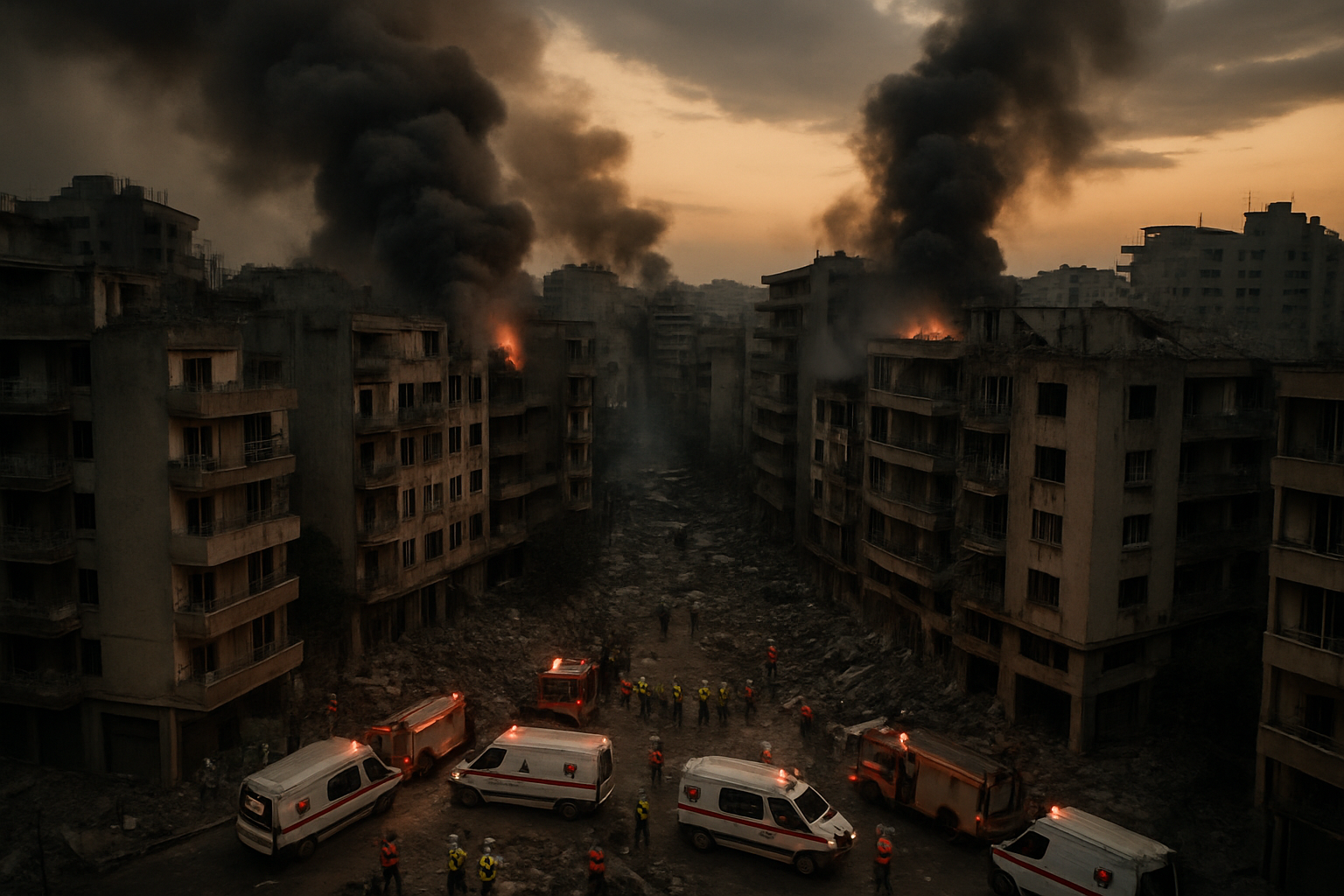
Israeli warplanes conducted what military officials described as their "largest coordinated wave of strikes" against Hezbollah positions across Lebanon on Wednesday, killing dozens of civilians and sparking international condemnation just hours after the United States and Iran announced a breakthrough ceasefire agreement.
The strikes, which targeted densely populated residential and commercial neighborhoods in Beirut without prior warning, represent the most violent assault on Lebanon's capital since the latest phase of regional conflict began in March. Lebanese health authorities report over 100 people killed and hundreds wounded across multiple locations, including the Corniche al Mazraa area of central Beirut.
Ceasefire Dispute Emerges
The bombardment occurred within hours of the announcement of a two-week ceasefire between the United States and Iran, brokered through Pakistani mediation and described as the "Islamabad Accord." However, a fundamental dispute has emerged over whether Lebanon and Hezbollah operations fall under the agreement's scope.
"The ceasefire covers all fronts including Lebanon with immediate effect,"
— Prime Minister Shehbaz Sharif, Pakistan
Israeli Prime Minister Benjamin Netanyahu explicitly rejected this interpretation, stating that the agreement does not apply to Israel's operations against Hezbollah in Lebanon. The White House later confirmed through Axios that "Lebanon is not part of the ceasefire agreement," creating a dangerous loophole in what was hailed as a diplomatic breakthrough.
Scale of Israeli Operations
According to Israeli military statements, the operation hit more than 100 sites "within 10 minutes," targeting what they described as Hezbollah command-and-control centers and weapons storage facilities across Beirut, the Beqaa Valley, and southern Lebanon. The strikes represent the most intensive Israeli campaign since the November 2024 ceasefire completely collapsed in March.
The Israeli military claimed the attacks targeted infrastructure used to launch attacks against Israeli positions, though Hezbollah has largely adhered to the previous ceasefire despite continued Israeli strikes. Lebanese President Joseph Aoun condemned the strikes as "barbaric" and described them as a "new massacre" by Israeli forces.
Humanitarian Crisis Deepens
The latest escalation adds to what has become an unprecedented humanitarian catastrophe in Lebanon. Over 800,000 Lebanese civilians have been displaced since fighting intensified in March—representing nearly 20% of the country's population. Emergency shelters across the country are overwhelmed, forcing thousands to sleep in the streets of Beirut.
Particularly concerning is the systematic targeting of medical personnel. Since March 2, Israeli strikes have killed 26 paramedics and wounded 51 others, according to Lebanese health authorities. The deadliest single attack occurred at the Burj Qalaouiyah healthcare center, where 12 medical workers—including doctors, nurses, and paramedics—were killed in what international legal experts describe as potential Geneva Conventions violations.
"This represents a systematic targeting of protected humanitarian assets. Medical facilities and personnel are explicitly protected under international humanitarian law,"
— International Legal Expert
Pattern of Medical Targeting
Israeli military spokesman Avichai Adraee has threatened strikes against ambulances and medical facilities, claiming Hezbollah uses them for military purposes—allegations that Hezbollah categorically denies. This systematic approach to targeting healthcare infrastructure has compromised Lebanon's emergency response capabilities during the worst crisis in the country's modern history.
Regional Context and Escalation
The current crisis stems from the complete collapse of the November 2024 US-French brokered ceasefire between Israel and Hezbollah, which had held for over a year. The agreement required Israeli forces and Hezbollah to withdraw from southern Lebanon, with Lebanese army and UN peacekeepers creating a buffer zone.
Everything changed on March 1, 2026, when Iran's Supreme Leader Ali Khamenei died during US-Israeli "Operation Epic Fury." Hezbollah faced what officials described as an "impossible choice" between maintaining the ceasefire and responding to Iranian pressure for retaliation. The organization ultimately chose what it called "Iranian solidarity," declaring that "resistance is the only option."
International Response
The international community has struggled to respond effectively to the crisis. French President Emmanuel Macron has offered to host direct Israel-Lebanon talks in Paris—the first such negotiations since the ceasefire collapse. However, these diplomatic initiatives have been overshadowed by the scale of military escalation.
UN Secretary-General António Guterres has called the regional situation the "greatest test of multilateral cooperation in the modern era." Turkey has warned that Israel is committing a "new genocide" under the pretext of fighting Hezbollah, while Sweden has provided 65 million kronor in humanitarian aid.
Even UN peacekeepers have not been spared from the violence. UNIFIL forces near Mais al-Jabal have been attacked, with one peacekeeper wounded, representing the first major breach of peacekeeping arrangements since the original ceasefire was implemented.
Global Economic Impact
The broader Middle East crisis has created unprecedented global disruptions. Over 18,000 flights have been cancelled worldwide—the most severe aviation crisis since COVID-19. Dubai International Airport, the world's busiest, remains completely shut down due to missile damage.
Oil prices have surged past $100 per barrel for the first time since 2014, with Iran's closure of the Strait of Hormuz affecting 40% of global oil transit. The International Energy Agency has released a record 400 million barrels from strategic reserves—the largest intervention in the agency's 50-year history.
Military Expansion
Israeli Defense Minister Israel Katz has announced plans for the demolition of "all residential buildings" in Lebanese border villages, implementing what he calls the "Gaza model." Israeli forces now control approximately 10% of Lebanese territory from the border to the Litani River, with officials warning that Lebanese displaced persons will not be allowed to return until Israeli security is guaranteed.
IDF Chief of Staff Eyal Zamir has declared that operations are "just beginning," with "several weeks" of continued ground operations planned. The destruction of strategic infrastructure, including the Qasmiyeh Bridge over the Litani River, represents a shift from military targets to critical civilian infrastructure.
Hezbollah's Response
Despite the overwhelming Israeli military advantage, Hezbollah has maintained significant resistance capabilities. The organization, estimated to have 20,000 fighters, has conducted over 40 operations targeting northern Israeli military sites, with rockets reaching as far as Haifa.
Hezbollah has declared "direct confrontations" with Israeli forces in southern Lebanon, marking a significant escalation from its previous restraint strategy. However, the organization faces mounting pressure as its leadership structure has been systematically targeted, with several senior commanders eliminated in recent strikes.
Diplomatic Challenges
The fundamental challenge facing peace efforts is the scope of any agreement. While the US-Iran ceasefire creates a framework for broader regional de-escalation, Israel's exclusion of Lebanon operations threatens to undermine the entire diplomatic process.
Pakistani Foreign Minister Ishaq Dar has been working with Turkey, Egypt, and Saudi Arabia on multilateral mediation efforts, but the immediate violence makes any near-term diplomatic breakthrough unlikely. The international community faces the challenge of bridging not only US-Iran differences but also the complex web of proxy relationships that define Middle Eastern geopolitics.
Looking Forward
The coming days will be crucial in determining whether the region can step back from the brink of broader warfare. The US-Iran ceasefire, while significant, represents only one element of a complex regional crisis that has drawn in multiple countries and threatens to destabilize the entire Middle East.
With oil markets in turmoil, global aviation networks disrupted, and humanitarian conditions deteriorating rapidly, the international community faces what UN officials describe as the most dangerous crisis since the end of the Cold War. The stakes extend far beyond the immediate conflict, potentially setting precedents for how international law is enforced and diplomatic solutions are pursued in the 21st century.
The tragedy of Lebanon—caught between Israeli military operations and Iranian proxy obligations—exemplifies the broader challenges facing smaller states in an increasingly multipolar world where great power competition plays out on their territories, often at devastating human cost.