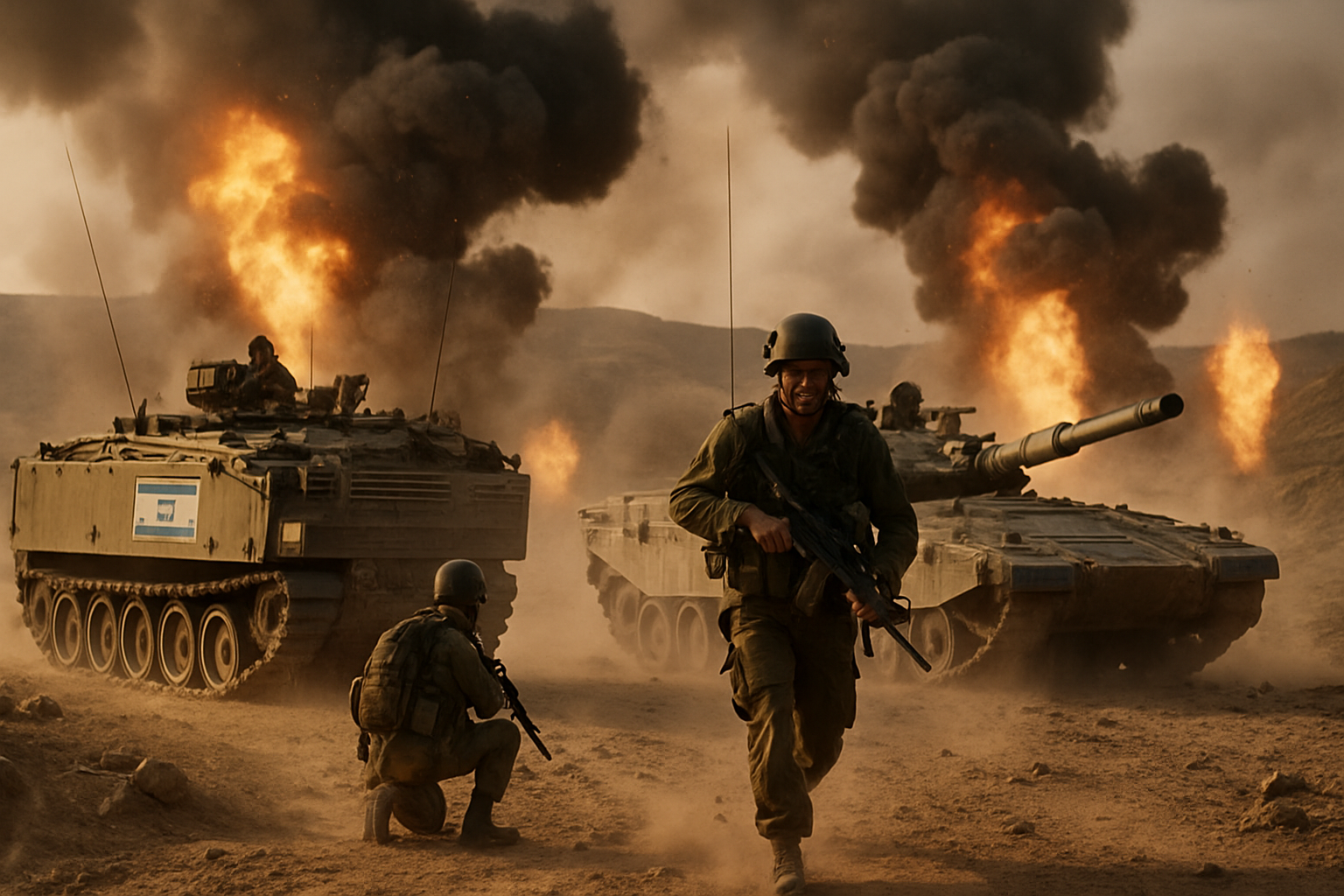
Israeli military forces launched a wide-scale wave of attacks against Tehran while simultaneously announcing the expansion of ground operations in southern Lebanon, marking the most dangerous escalation in what has become the deadliest Middle East conflict since the Cold War ended.
The Israeli Defense Forces (IDF) confirmed conducting systematic strikes against Iranian infrastructure within the capital city, while Defense Minister Israel Katz announced ground operations targeting Hezbollah positions across multiple locations in southern Lebanon. The dual-front escalation comes as the regional war enters its fourth week, with casualty tolls mounting and global implications deepening.
Tehran Under Fire
According to Egyptian media sources, the Israeli military executed what it described as "a wide wave of attacks" targeting infrastructure within Tehran. The strikes represent a significant escalation in the ongoing conflict that began with Operation Epic Fury in early March, following the confirmed death of Iranian Supreme Leader Ali Khamenei on March 1.
Iranian state television reported damage from cluster missile impacts in central Israel, though officials stated there were no injuries from Iran's retaliatory strikes. The exchange highlights the increasingly dangerous tit-for-tat nature of the conflict, with both sides demonstrating expanded capabilities and willingness to target each other's heartlands.
Ground Operations in Lebanon Expand
Israeli forces have officially announced the expansion of ground operations in southern Lebanon, moving beyond the limited positions held since the November 2024 ceasefire to target new Hezbollah strongholds. The IDF destroyed the strategic Qasmiyeh bridge over the Litani River and issued demolition orders for civilian homes near the Lebanese border.
The Lebanese Health Ministry reports over 800 killed and more than 800,000 displaced since the conflict expanded to Lebanese territory. Of particular concern is the systematic targeting of medical personnel, with 26 paramedics killed and 51 wounded since March 2, raising serious questions about compliance with international humanitarian law.
"The Israeli military spokesperson threatened strikes against ambulances and medical facilities claiming Hezbollah use without evidence. This represents a serious escalation in targeting protected humanitarian assets under Geneva Conventions."
— International Legal Observer
The November 2024 US-French brokered ceasefire between Israel and Hezbollah has completely collapsed. The agreement, which had held for over a year despite minor violations, required Israeli forces and Hezbollah to withdraw from southern Lebanon with Lebanese army and UN peacekeepers maintaining a buffer zone.
Humanitarian Crisis Deepening
The expansion of ground operations has created an unprecedented humanitarian crisis in Lebanon. Emergency shelters are overwhelmed, with thousands of Lebanese civilians forced to sleep on Beirut's streets and in cars as traditional support systems reach capacity.
The systematic targeting of medical infrastructure has severely compromised Lebanon's emergency response capabilities. The deadliest single attack occurred at the Burj Qalaouiyah healthcare center, where 12 medical workers including doctors, nurses, and paramedics were killed in what international observers describe as potential war crimes.
Global Implications
The conflict has created unprecedented global disruptions. Over 18,000 flights have been cancelled worldwide—the most severe aviation crisis since COVID-19. Eight Middle Eastern countries have closed their airspace simultaneously, while Dubai International Airport, the world's busiest, remains shut due to missile damage.
Oil prices have surged past $100 per barrel for the first time since 2014, with Iran's closure of the Strait of Hormuz affecting 40% of global oil transit. The International Energy Agency has released a record 400 million barrels from strategic reserves—the largest intervention in the agency's 50-year history.
International Diplomatic Response
French President Emmanuel Macron has offered to host direct Israel-Lebanon talks in Paris, marking the first such negotiations since the ceasefire collapse. UN Secretary-General António Guterres visited Beirut, calling the situation "the greatest test of multilateral cooperation in the modern era."
The crisis has severely strained regional coalitions, with Egypt's President Abdel Fattah el-Sisi condemning attacks on "sisterly Arab countries" and warning of "comprehensive chaos" spreading across the region. Kuwait has relocated airline operations to Saudi Arabia due to repeated drone attacks.
Nuclear Dimensions
The conflict emerged from the complete collapse of nuclear diplomacy, despite Geneva talks achieving what negotiators called "broad agreement on guiding principles"—the most progress since the 2018 JCPOA breakdown. Iran continues uranium enrichment at 60% purity with over 400kg of material, approaching weapons-grade levels.
The nuclear crisis occurs against the backdrop of the New START treaty's expiration on February 5—the first time in over 50 years that no nuclear constraints exist between the US and Russia, creating what experts call a "nuclear governance crisis."
Congressional and International Scrutiny
In Washington, bipartisan lawmakers are demanding answers about strategy, costs, and the potential for ground troop deployment. Senator Richard Blumenthal stated he is "more concerned than ever" about boots on the ground, with the conflict showing unprecedented unpopularity at just 25% public support.
Operation Epic Fury has cost $11.3 billion in its first week alone, with Pentagon operations now planned through September—far beyond the initial 4-6 week timeline. The financial markets have become what analysts call the "ultimate constraint" on further escalation.
Iranian Succession Crisis
Following Ali Khamenei's death on March 1, Iran faces its first hereditary succession in the Islamic Republic's 47-year history. Mojtaba Khamenei, the former Supreme Leader's son, has been appointed as successor, representing a shift from clerical to military governance under Revolutionary Guards control.
The succession crisis has complicated Iran's war strategy, with hardline military elements gaining unprecedented influence over governance during the most dangerous period since the 1979 revolution.
Regional Power Balance Shifts
The conflict has fundamentally altered Middle Eastern power dynamics. Traditional allies are questioning their relationships as Iranian retaliation has directly targeted Gulf states, while European territory was attacked for the first time since World War II when Iranian drones struck RAF Akrotiri in Cyprus.
The targeting of civilian infrastructure, including energy facilities and medical centers, has established dangerous new precedents for modern warfare, raising questions about the future of international humanitarian law enforcement.
Looking Ahead
As the conflict enters its fourth week, international mediators face the challenge of managing an expanding crisis that has already surpassed most experts' worst-case scenarios. The combination of ground operations in Lebanon, systematic strikes on Tehran, and the collapse of diplomatic frameworks suggests the region is entering uncharted territory.
The stakes extend far beyond the Middle East, affecting global energy security, nuclear governance credibility, international law enforcement, and the post-World War II order's fundamental principles. Success or failure in containing this crisis will establish precedents for 21st-century conflict resolution that could influence international relations for decades.
"This represents the most dangerous international crisis since the Cold War ended, testing every mechanism of global governance and cooperation we have built over decades."
— UN Secretary-General António Guterres
The coming days and weeks will be crucial in determining whether diplomatic intervention can arrest the escalating violence or if the Middle East is headed toward a broader regional war with implications that extend far beyond current boundaries.