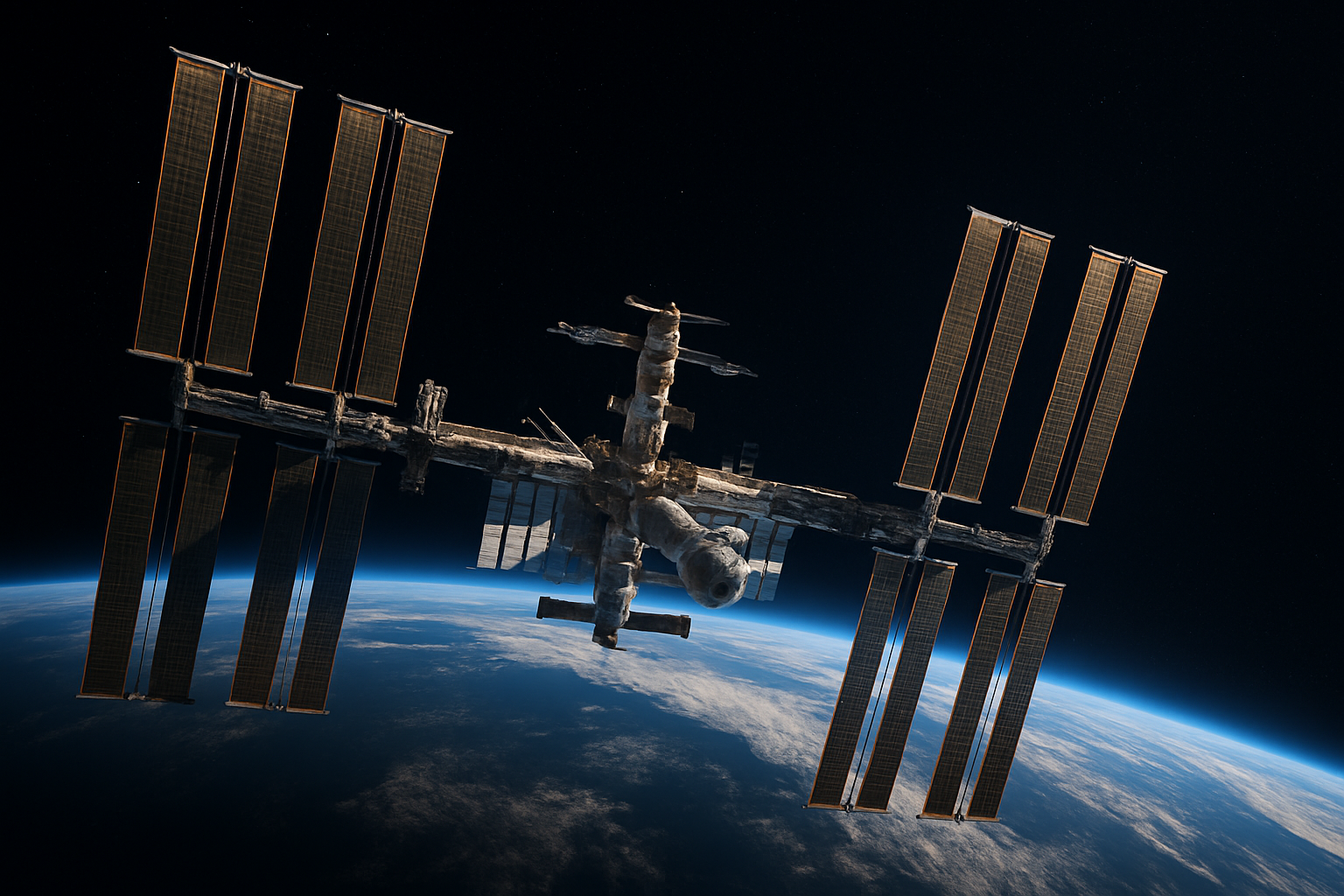
The International Space Station reached a new orbital altitude of 421.54 kilometers above Earth's surface following a successful 1.1-kilometer orbital adjustment by Roscosmos, while NASA simultaneously tracked asteroid 2026 EG1 during its closest approach to Earth, demonstrating the sophisticated coordination required for modern space operations.
The orbital maneuver, announced by the Russian space agency on March 14, 2026, represents routine but critical maintenance of humanity's most important orbital laboratory. The ISS operates within a carefully managed altitude range to balance atmospheric drag against operational efficiency, requiring periodic adjustments to maintain optimal positioning for scientific research and crew operations.
Precision Orbital Mechanics in the Space Age
The 1.1-kilometer altitude increase brings the ISS to its new operational height of 421.54 kilometers, positioning the station within its optimal operational envelope. This adjustment reflects the ongoing collaboration between international partners, including NASA, ESA, and Roscosmos, despite terrestrial geopolitical tensions that have tested but not broken space cooperation frameworks.
According to space operations experts, orbital adjustments of this magnitude require precise calculation of fuel consumption, timing, and trajectory modifications. The maneuver supports the station's current seven-person crew capacity, restored in February 2026 through the successful Crew-12 mission featuring French astronaut Sophie Adenot, who is conducting groundbreaking lung tissue cultivation and Space-Associated Neuro-Ocular Syndrome (SANS) research essential for future lunar settlements and Mars exploration.
Asteroid Surveillance During Golden Age of Space Observation
Concurrent with the ISS orbital adjustment, NASA's planetary defense systems tracked asteroid 2026 EG1, a 12-meter diameter space rock that made its closest approach to Earth on March 13, passing within 198,000 miles—closer than the Moon's average distance of 239,000 miles. The asteroid monitoring, conducted by NASA's Jet Propulsion Laboratory (JPL), exemplifies the sophisticated surveillance capabilities developed during what space policy experts term the "golden age of space observation."
The asteroid, roughly the size of a bus, posed no threat to Earth but provided valuable data for planetary defense protocols. NASA has repeatedly warned that approximately 15,000 undetected "city-killer" asteroids over 140 meters in diameter remain untracked, highlighting the critical importance of enhanced detection capabilities during an era of intensifying space activities.
"This dual operation—ISS orbital maintenance and asteroid tracking—demonstrates the maturation of space operations from experimental activities to essential infrastructure supporting both human presence and planetary security."
— Space Policy Institute Analysis
International Cooperation Amid Commercial Space Revolution
The seamless coordination between Russian orbital adjustments and American asteroid monitoring occurs during a transformative period for human space exploration. The space industry is transitioning from what analysts describe as the "AI revolution" (2020-2025) to the "space economy golden age," characterized by unprecedented commercial investment and international cooperation.
SpaceX is preparing for a potential trillion-dollar IPO in June 2026, while NASA's Artemis II mission faces ongoing delays due to hydrogen leak issues and helium system failures. The four-astronaut crew—including Canadian Jeremy Hansen, who will become the first Canadian to travel beyond Earth orbit—awaits the 10-day lunar flyby that would mark humanity's return to deep space after a 54-year gap since Apollo 17.
This period of space expansion includes emerging nations gaining independent capabilities: Pakistan has selected astronaut candidates for China's Tiangong station missions in October-November 2026, Thailand chairs the UN space governance committee, and European nations are advancing launch independence through facilities in Sweden and Germany.
Scientific Research Driving Space Medicine Advances
The ISS continues serving as humanity's primary orbital laboratory, with current research focusing on challenges that will determine the success of permanent lunar settlements and Mars missions. Sophie Adenot's record eight-month mission represents the longest European astronaut deployment, enabling comprehensive studies of microgravity effects on human biology.
Critical research includes lung tissue cultivation experiments that could revolutionize understanding of respiratory function in space environments, and SANS (Space-Associated Neuro-Ocular Syndrome) studies addressing vision problems that affect astronauts during extended missions. Portuguese scientists are leading breakthrough research in this field, essential for medical protocols supporting future deep space exploration.
The station's research also includes validation of life support systems, radiation protection measures, and psychological adaptation protocols that will be crucial for lunar bases and Mars missions. The February 2026 medical evacuation of astronaut Mike Fincke—the first in ISS history—provided valuable emergency protocol data for missions where Earth evacuation would be impossible.
Technological Integration and AI Revolution
Modern space operations increasingly rely on artificial intelligence integration, demonstrated by NASA's fully AI-planned Mars rover missions in December 2025 that achieved autonomous navigation across cosmic distances. This technological advancement enables real-time decision-making without Earth-based control dependence, crucial for future lunar settlements and Mars exploration.
The space-based infrastructure is also addressing Earth's memory crisis, with semiconductor price increases reaching sixfold levels affecting companies like Samsung, SK Hynix, and Micron. Space-based data centers offer unlimited expansion potential with continuous solar power and no cooling requirements, representing practical applications of orbital infrastructure beyond scientific research.
Planetary Defense and Future Challenges
The asteroid monitoring capabilities demonstrated with 2026 EG1 build on the success of NASA's DART mission, which successfully altered the orbit of asteroid Dimorphos in 2022, proving kinetic impactor techniques work in practice. This achievement represents a historic milestone demonstrating humanity's capability to prevent extinction-level impacts.
However, current detection systems have identified only a fraction of potentially hazardous near-Earth asteroids. The challenge is magnified by proposals for massive satellite constellations—including SpaceX's plan for up to one million satellites—which could complicate detection and deflection missions while creating unprecedented space debris challenges.
Environmental considerations are emerging as space activities expand. Austrian researchers documented the first atmospheric pollution measurements from rocket debris, showing lithium concentrations tenfold above normal levels. With over 34,000 tracked orbital objects and millions of smaller debris pieces, space debris management requires international cooperation to prevent cascade effects that could render orbital regions unusable.
Strategic Implications for Spacefaring Civilization
The routine orbital adjustment of the ISS and concurrent asteroid monitoring represent more than technical achievements—they symbolize humanity's evolution toward a true spacefaring civilization. The convergence of international cooperation, commercial innovation, and advanced technology creates unprecedented opportunities for expanding human presence beyond Earth.
Multi-billion dollar space infrastructure investments position nations for leadership in an emerging space economy projected to exceed $1 trillion by 2030. Success in establishing sustainable lunar presence and Mars exploration capabilities will determine long-term access to resources, scientific discovery, and technological development that could define humanity's cosmic future.
The ISS, originally conceived as a stepping stone to deeper space exploration, continues fulfilling this role through research that directly informs lunar base construction and Mars mission planning. The station's orbital adjustment ensures continued operations during this critical transition period, while asteroid monitoring capabilities protect Earth's surface and orbital infrastructure.
Looking Toward April and Beyond
As the ISS maintains its new orbital altitude of 421.54 kilometers, space agencies prepare for the next phase of human exploration. NASA Administrator Jared Isaacman has confirmed Artemis II is targeting an April 1, 2026 launch window after resolving technical challenges, marking humanity's renewed commitment to cosmic exploration.
The success of coordinated space operations—from routine orbital maintenance to planetary defense monitoring—establishes confidence for ambitious future missions. Whether tracking near-Earth asteroids or adjusting humanity's orbital outpost, these activities represent the methodical, safety-first approach that will enable sustainable expansion into the solar system.
March 2026 represents a watershed moment where space exploration strategy has matured toward pragmatic objectives while breakthrough technologies enable capabilities once considered science fiction. The routine nature of these complex operations signals that humanity has successfully established space as an extension of terrestrial civilization, setting the foundation for permanent lunar settlements and eventual interplanetary expansion.