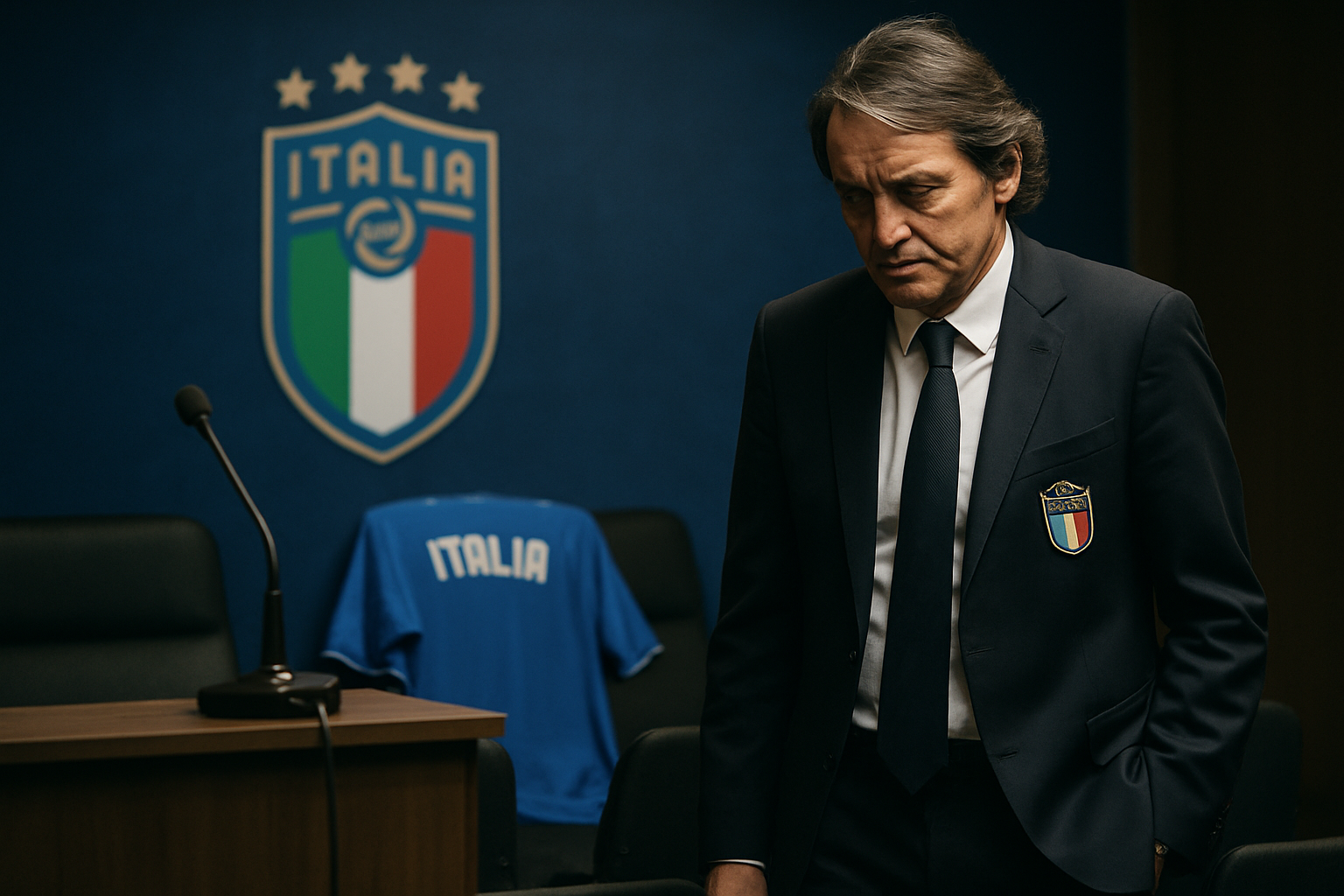
Italy's national football coach Gennaro Gattuso resigned on Friday, just three days after the defending European champions suffered their most humiliating defeat in decades—a 4-1 penalty loss to Bosnia Herzegovina that condemned the Azzurri to miss their third consecutive World Cup.
The resignation, announced by the Italian Football Federation (FIGC) on Friday afternoon, caps a week of unprecedented turmoil for Italian football. Gattuso's departure follows the Thursday resignation of FIGC President Gabriele Gravina and delegation chief Gianluigi Buffon, creating a complete leadership vacuum at the heart of Italian football.
A Dynasty in Ruins
Italy's failure to qualify for the 2026 World Cup represents more than just another sporting disappointment—it signals the potential end of one of football's greatest dynasties. The four-time World Cup winners have now missed three consecutive tournaments (2018, 2022, 2026), an unthinkable scenario just five years ago when they lifted the European Championship trophy at Wembley.
The arithmetic is stark and damning: Italy has won just one World Cup match since their 2006 triumph in Germany, when they defeated France on penalties. Their last World Cup appearance in 2014 ended in group-stage elimination, and since then, they have systematically failed to navigate qualification campaigns that should have been routine for a nation of their footballing pedigree.
"This is the most painful moment in my career," Gattuso said in his resignation statement.
— Gennaro Gattuso, Former Italy Coach
The Bosnia Herzegovina Nightmare
The final humiliation came at Zenica's Bilino Polje Stadium on March 31, where Italy faced Bosnia Herzegovina knowing that victory would secure their place at the 2026 World Cup. What followed was a masterclass in how not to handle pressure at the highest level.
After taking an early lead through a goalkeeping error, Italy seemed destined for qualification. But when Alessandro Bastoni received a red card in the 44th minute, the wheels began to fall off. Haris Tabaković's equalizer sent the match to penalties, where Italy's mental fragility was exposed for all to see.
Only Sandro Tonali converted from the spot for Italy. Pio Esposito sent his attempt soaring over the crossbar, while Bryan Cristante struck the woodwork. Meanwhile, Bosnia's penalty heroes—Benjamin Tahirović, Haris Tabaković, Kerim Alajbegović, and Esmir Bajraktarević—kept their nerve to secure their nation's second-ever World Cup qualification.
The Gattuso Experiment
Gattuso was appointed in June 2025 as the supposed savior who would guide Italy back to the World Cup stage. The former AC Milan midfielder, known for his warrior mentality as a player, was tasked with ending Italy's 12-year World Cup absence and restoring pride to the Azzurri shirt.
His tenure lasted just 10 months, but it was marked by tactical confusion and an inability to maximize the talent at his disposal. Despite having players like Gianluigi Donnarumma, Nicolo Barella, and Federico Chiesa at his disposal, Gattuso never found a consistent system or identity for his team.
Systematic Failures
The problems plaguing Italian football extend far beyond any single coach or administrator. The nation's youth development system, once the envy of Europe, has failed to produce the quality and quantity of players needed to compete at the highest level. Serie A's decline in European competition has also played a role, with Italian teams struggling to match the intensity and tactical sophistication of their English, Spanish, and German counterparts.
The financial implications are equally devastating. Italy's elimination has cost the federation an estimated 30 million euros in FIFA prize money and sponsorship bonuses—funds that could have been invested in grassroots development and infrastructure improvements.
A Broader Crisis in European Football
Italy's struggles reflect a broader shift in international football, where traditional powerhouses can no longer take qualification for granted. The expanded 48-team format for the 2026 World Cup was supposed to provide more opportunities, yet Italy has still fallen short while emerging nations like Bosnia Herzegovina, Iraq, and DR Congo have secured their places.
This democratization of football has been accelerated by improved coaching education, systematic youth development programs, and increased investment in football infrastructure across previously peripheral nations. Countries that once viewed World Cup qualification as an impossible dream are now implementing long-term strategies that challenge established hierarchies.
The Search for Redemption
The FIGC now faces the monumental task of rebuilding from ground zero. An extraordinary assembly has been scheduled for June 22 to elect a new president, but the deeper problems require more than cosmetic changes. Italy needs a comprehensive review of its football structure, from youth academies to coaching education and tactical development.
Potential coaching candidates being discussed include Roberto Mancini, who led Italy to Euro 2020 glory but left to coach Saudi Arabia, and rising stars like Roberto De Zerbi and Simone Inzaghi. However, any new appointment must come with a clear mandate and the resources necessary to implement systematic change.
Learning from Success Stories
Bosnia Herzegovina's qualification campaign offers a template for how smaller nations can achieve remarkable results through strategic planning and tactical discipline. Coach Sergej Barbarez's systematic approach, built around defensive solidity and clinical counter-attacking, proved that smart coaching can overcome resource disadvantages.
Similarly, countries like Iraq and DR Congo have demonstrated that consistent investment in coaching education and youth development can produce results even in challenging circumstances. These success stories highlight the changing landscape of international football, where traditional advantages no longer guarantee success.
The Road Ahead
As Italy contemplates four more years without World Cup football, the nation must confront some uncomfortable truths. The days of relying purely on tactical sophistication and individual brilliance are over. Modern international football requires systematic development, mental resilience, and the ability to perform under extreme pressure—qualities that have been conspicuously absent from recent Italian performances.
The 2026 World Cup will proceed without Italy for the third consecutive tournament, taking place across the United States, Canada, and Mexico from June 11 to July 19. While 48 teams celebrate their participation in football's greatest spectacle, Italy will watch from home, forced to confront the magnitude of their fall from grace.
"We must rebuild from the foundations," said Leonardo Spinazzola, one of few players willing to speak after the Bosnia defeat.
— Leonardo Spinazzola, Italy Defender
The resignation of Gennaro Gattuso marks the end of another failed chapter in Italy's recent history. But it also presents an opportunity for genuine reform and renewal. Whether Italian football possesses the vision and determination to seize that opportunity remains to be seen. What is certain is that without fundamental change, Italy risks becoming a permanent exile from football's top table—a fate unthinkable for a nation that has given the world some of the game's greatest moments and most enduring legends.