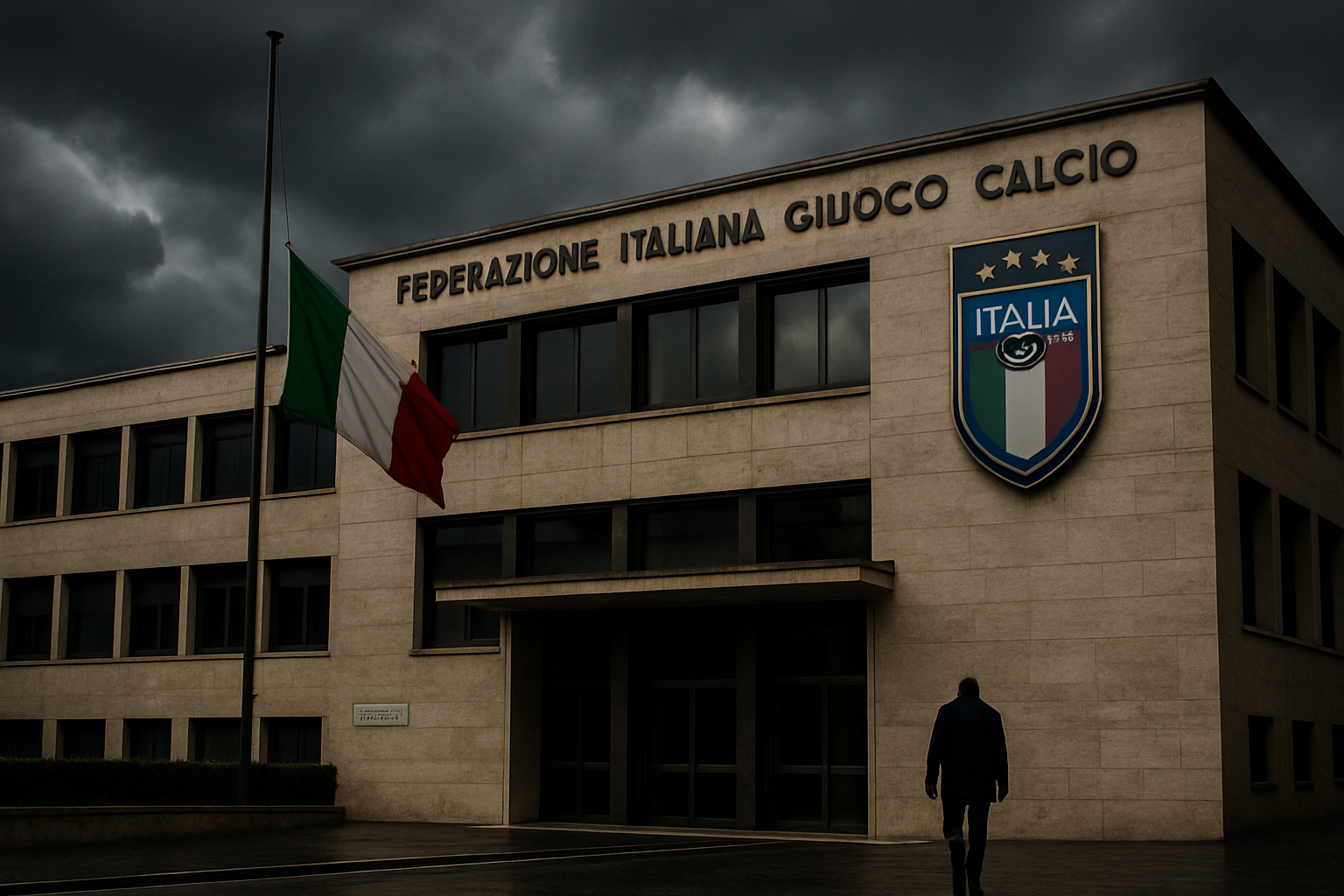
Italian football federation president Gabriele Gravina resigned on Thursday, April 2, 2026, followed by legendary goalkeeper Gianluigi Buffon stepping down as delegation chief, after Italy's devastating elimination from World Cup 2026 qualification marked the Azzurri's third consecutive absence from football's premier tournament.
The shocking resignations came just two days after Italy's heart-breaking defeat to Bosnia and Herzegovina on penalties at Zenica's Bilino Polje Stadium, where the four-time World Cup winners fell 4-1 in the penalty shootout following a 1-1 draw. The defeat eliminated defending European champions from their third straight World Cup, following failures to qualify for Russia 2018 and Qatar 2022.
Gravina's Eight-Year Tenure Ends in Disappointment
Gravina, 72, had been at the helm of the Italian Football Federation (FIGC) since October 2018, ironically taking charge just after Italy's failure to reach the 2018 World Cup in Russia. Despite overseeing Italy's triumphant Euro 2020 campaign, his tenure will be remembered for the national team's consistent World Cup failures.
"The president of the Italian Football Federation presented his resignation following the team's failure to qualify for the 2026 World Cup," the FIGC announced in an official statement. The federation confirmed that an extraordinary assembly will be held on June 22 to elect Gravina's successor.
"The decision comes after mounting pressure from both the government and Italian football community following our elimination against Bosnia and Herzegovina."
— FIGC Official Statement
Gravina had offered to appear before a parliamentary committee on April 8 "to report on the state of health of Italian soccer," demonstrating the political ramifications of Italy's sporting failure. The Italian government had been urging his resignation since the penalty shootout defeat in Zenica.
Buffon's "Spontaneous" Decision
The resignation tsunami continued with Gianluigi Buffon, the legendary former goalkeeper who served as head of delegation for the national team, announcing his departure in an emotional statement. The 48-year-old icon, who earned 176 caps for Italy and won the 2006 World Cup, described his decision as "spontaneous as tears and pain in the heart."
Buffon's resignation represented not just an administrative loss but a symbolic blow to Italian football. The former Juventus and Paris Saint-Germain goalkeeper had been instrumental in bridging the gap between the team's glorious past and its struggling present, making his departure particularly poignant for Italian football supporters.
Multiple sources across European media confirmed that Buffon's decision came immediately following the Bosnia defeat, with the former captain unable to continue in his role after witnessing another World Cup dream shattered.
The Bosnia Heartbreak
Italy's elimination in Zenica represented one of the most shocking results in World Cup qualification history. Despite taking an early lead through a goalkeeping error from Bosnia's Nikola Vasilj, the Azzurri were pegged back by Haris Tabaković's equalizer. The match went to penalties, where Bosnia's penalty heroes Benjamin Tahirović, Haris Tabaković, Kerim Alajbegović, and Esmir Bajraktarević all converted their spot-kicks.
Italy's penalty nightmare saw Pio Esposito send his effort over the crossbar and Bryan Cristante hit the crossbar, with only Sandro Tonali finding the net. The defeat was particularly painful as Italy played the majority of extra time and penalties with ten men following Alessandro Bastoni's red card.
For Bosnia and Herzegovina, it marked their second-ever World Cup qualification and first since 2014, while for Italy, it represented the continuation of a shocking decline from their European Championship triumph just three years earlier.
A Decade of World Cup Despair
Italy's absence from three consecutive World Cups represents an unprecedented crisis for a nation that has traditionally been among football's elite powers. The Azzurri last appeared at a World Cup in 2014 in Brazil, and since lifting their fourth World Cup trophy in 2006, they have won just one match at the finals.
The failure to reach the 2026 World Cup in North America is particularly damaging given the tournament's expansion to 48 teams, theoretically providing more qualification opportunities. Italy's elimination alongside traditional powers like the Netherlands demonstrates how competitive international football has become.
Under Gravina's leadership, Italy did achieve notable success, including the Euro 2020 victory and Nations League triumph, but these achievements have been overshadowed by three consecutive World Cup failures. The contrast between European success and World Cup qualification struggles has become a defining characteristic of recent Italian football.
Government and Media Reaction
The political ramifications of Italy's World Cup failure extended far beyond football circles. Italian government officials had been applying pressure for resignations since the Bosnia defeat, with sports minister representatives calling for institutional accountability.
Italian media coverage has been merciless, with major outlets describing the situation as a "nightmare without end" and questioning fundamental aspects of the federation's approach to international competition. The estimated financial loss of 30 million euros from missing the World Cup has added economic pressure to the sporting disappointment.
European media have also taken notice, with French outlets calling the situation a "joke of the century" and Swedish media describing it as an "unprecedented story" in international football.
Transition Period and Future Challenges
The FIGC now faces a critical transition period as it prepares for the extraordinary assembly on June 22. The new leadership will inherit a national team program in crisis, with questions about coach Gennaro Gattuso's future also remaining unresolved.
Italy's failure comes at a time when international football is experiencing unprecedented competitive balance. The 2026 World Cup will feature breakthrough nations like Iraq (ending a 40-year absence), Democratic Republic of Congo (first qualification since 1974), and Bosnia and Herzegovina, while traditional powers struggle to adapt to new realities.
The Italian football federation must now rebuild its international program while addressing systemic issues that have prevented World Cup qualification despite domestic league strength and periodic European success.
Historical Context and Broader Implications
Italy's World Cup struggles coincide with a period of significant change in international football. The expanded 48-team format for 2026 was designed to provide more opportunities for traditional powers while enabling breakthrough nations to compete at the highest level.
However, Italy's elimination demonstrates that qualification remains intensely competitive despite the expanded format. The systematic development programs implemented by emerging football nations have challenged traditional hierarchies, creating a more democratic international football landscape.
For Italian football, the crisis extends beyond individual failures to encompass questions about youth development, coaching education, and the relationship between domestic and international success. The federation's new leadership will need to address these fundamental challenges while restoring credibility both domestically and internationally.
The resignations of Gravina and Buffon mark the end of an era in Italian football administration, setting the stage for comprehensive reform as the nation attempts to rebuild its international program and restore its position among football's elite powers.