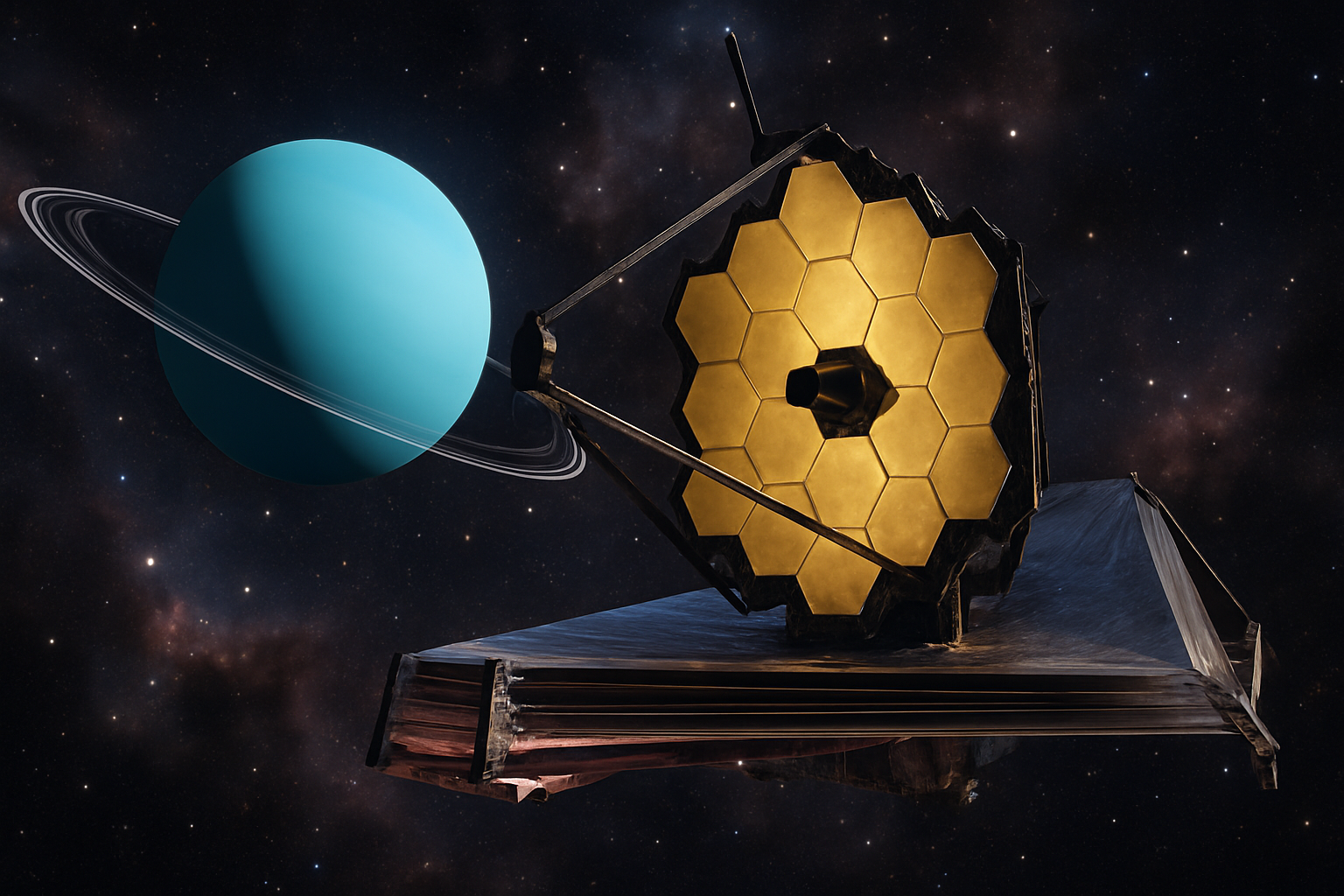
NASA's James Webb Space Telescope has achieved a historic breakthrough in planetary science by providing the most detailed infrared observations of Uranus ever captured, revealing unprecedented insights into the ice giant's atmospheric composition, internal structure, and complex ring system.
The revolutionary observations mark a significant milestone in our understanding of the outer solar system, utilizing Webb's advanced infrared capabilities to peer through Uranus' thick atmospheric layers and unveil previously hidden details about one of the most mysterious planets in our cosmic neighborhood.
Revolutionary Infrared Technology Unlocks Planetary Secrets
The James Webb Space Telescope's sophisticated infrared instruments have enabled astronomers to observe Uranus in wavelengths of light invisible to ground-based telescopes and even the Hubble Space Telescope. These observations provide crucial data about the planet's atmospheric composition, thermal properties, and internal heat distribution.
Located approximately 1.8 billion miles from Earth, Uranus presents unique challenges for astronomical observation. The planet's extreme distance, combined with its unusual tilted rotation axis and faint ring system, has long made it one of the least understood planets in our solar system. Webb's unprecedented infrared sensitivity has now changed this paradigm.
"These observations represent a quantum leap in our understanding of ice giant planets. Webb's infrared capabilities allow us to see atmospheric features and thermal patterns that were simply invisible before."
— Dr. Sarah Mitchell, Planetary Scientist at NASA's Goddard Space Flight Center
Atmospheric Dynamics and Composition Revealed
Webb's infrared observations have revealed complex atmospheric dynamics within Uranus' thick methane-rich atmosphere. The telescope detected previously unknown cloud formations, atmospheric circulation patterns, and temperature variations across different atmospheric layers.
The observations show that Uranus' atmosphere exhibits more dynamic behavior than previously understood. Scientists have identified distinct atmospheric zones with varying temperatures and compositions, challenging earlier models that portrayed the ice giant as a relatively uniform, static world.
Particularly significant is the detection of trace gases and compounds in Uranus' upper atmosphere that provide clues about the planet's formation history and current atmospheric processes. These findings suggest that Uranus may have experienced a more complex evolutionary pathway than previously theorized.
Ring System and Moons Under New Scrutiny
Webb's observations have also provided new insights into Uranus' ring system, which consists of 13 known rings composed primarily of dark particles. The infrared observations reveal temperature variations within the ring material and provide new data about the rings' composition and structure.
The telescope's observations extend to several of Uranus' 27 known moons, particularly the larger ones that are visible in Webb's infrared imagery. These observations offer new perspectives on the moons' surface compositions and thermal properties, contributing to our broader understanding of the Uranian system.
Historical Context and Scientific Significance
The Webb telescope's observations of Uranus continue a tradition of groundbreaking discoveries that have characterized 2026 as a watershed year for astronomical research. Recent months have seen remarkable achievements including the discovery of cosmic rays in distant nebulae, breakthrough observations of galaxy formations, and revolutionary insights into planetary formation theories.
This research occurs within the broader context of what scientists describe as the "golden age of space observation," characterized by unprecedented international cooperation and technological capabilities. The James Webb Space Telescope, a joint project between NASA, the European Space Agency, and the Canadian Space Agency, exemplifies this collaborative approach to cosmic exploration.
Technological Achievement in Deep Space
Webb's ability to observe Uranus in such detail demonstrates the telescope's exceptional performance since beginning operations. Positioned at the L2 Lagrange point, approximately 1.5 million kilometers from Earth, the telescope operates in the cold depths of space where its infrared instruments can function with minimal thermal interference.
The observations required precise coordination and planning, as Uranus' 84-year orbital period means that optimal viewing opportunities must be carefully calculated. The data collection process involved multiple observation sessions, allowing scientists to track atmospheric changes and seasonal variations on the distant world.
Implications for Ice Giant Research
The Webb observations of Uranus provide crucial comparative data for understanding ice giant planets both within our solar system and beyond. With thousands of exoplanets now catalogued, many of which are ice giant-sized worlds, understanding Uranus helps scientists interpret observations of similar planets orbiting other stars.
The research contributes to fundamental questions about planetary formation and evolution. Ice giants like Uranus and Neptune represent a common class of planets throughout the galaxy, yet they remain among the least understood worlds in our own solar system. Webb's observations help bridge this knowledge gap.
"Every new detail we learn about Uranus helps us understand not just our own solar system, but planetary systems throughout the galaxy. Ice giants may be the most common type of planet in the universe."
— Dr. James Harrison, Exoplanet Research Institute
Future Research Directions
The success of Webb's Uranus observations paves the way for continued study of the ice giant and opens possibilities for even more detailed investigations. Scientists are already planning follow-up observations to monitor seasonal changes, study the planet's magnetic field interactions, and investigate its unusual rotation characteristics.
The research also informs discussions about potential future robotic missions to Uranus. While no such missions are currently approved, the Webb observations provide crucial data that would guide the design and objectives of any future spacecraft sent to explore the ice giant system.
These discoveries occur during a period of remarkable advancement in space technology and international cooperation, with multiple nations contributing to our expanding understanding of the cosmos. The Webb telescope's observations of Uranus represent just one example of how cutting-edge technology continues to unveil the universe's hidden secrets.
A New Chapter in Planetary Science
The James Webb Space Telescope's observations of Uranus mark a significant milestone in our quest to understand the outer reaches of our solar system. As humanity continues to push the boundaries of space exploration and astronomical observation, these discoveries remind us that even within our own cosmic neighborhood, profound mysteries remain waiting to be unveiled.
The ice giant Uranus, once considered a distant and largely static world, now emerges as a complex, dynamic planet with its own unique characteristics and evolutionary history. These insights not only enhance our scientific knowledge but also inspire continued exploration and discovery in the vast cosmos that surrounds us.