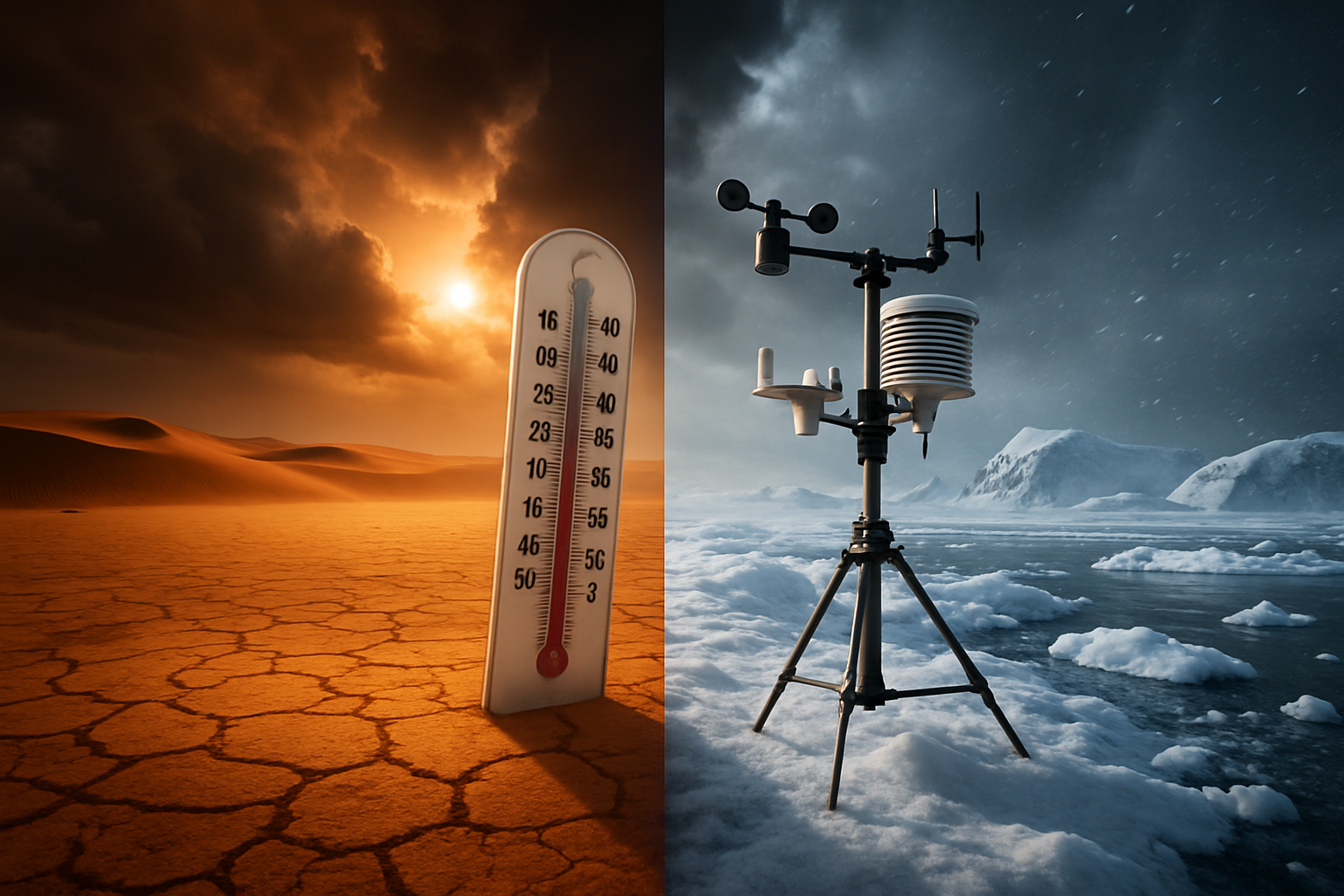
January 2026 has been recorded as the fifth warmest month in global history, according to the European Union's Copernicus Climate Change Service, despite devastating cold waves that swept across the United States and Europe, killing hundreds and causing widespread infrastructure disruption.
The paradoxical findings highlight the complex nature of climate change, where global warming trends continue to dominate despite regional extreme cold events. The announcement comes as rescue operations continue across multiple continents dealing with the aftermath of severe winter storms and unprecedented weather patterns.
Global Temperature Records Amid Regional Extremes
Copernicus data reveals that January 2026 marked the 18th consecutive month out of the past 19 to exceed 1.5°C above pre-industrial levels, demonstrating how climate warming is now overriding natural variability patterns, including La Niña cooling effects that traditionally moderate global temperatures.
The global temperature milestone occurred simultaneously with some of the most extreme regional weather events in recent history. Northern European countries experienced their harshest winter in decades, while the United States faced a "bomb cyclone" and polar vortex disruption that claimed over 140 lives since late January.
"The planet experienced the fifth warmest January ever recorded, despite the cold wave that swept the United States and Europe," confirmed Copernicus in their official announcement, underscoring the distinction between global climate trends and regional weather patterns.
Devastating Cold Wave Impacts Across Continents
Despite the global warming trend, regional impacts proved catastrophic. In New York City, Mayor Zohran Mamdani activated over 1,200 warming center beds as temperatures dropped to -13°C with wind chills reaching -20°C, marking the city's most severe cold period in nearly a decade.
European nations faced unprecedented challenges. Estonia recorded its coldest winter in 25 years, with electricity consumption hitting a record 1,723 megawatts. Poland experienced -28°C temperatures with IMGW warnings across 13 provinces, while Denmark implemented emergency protocols including nationwide school closures due to "extremely treacherous" black ice conditions.
Even regions typically immune to severe cold were affected. Guatemala recorded unprecedented -2°C temperatures in mountainous areas, while Mexico City activated cold alerts for seven boroughs as temperatures forecast dropped to 1-3°C.
"This demonstrates the climate system's increasing volatility, where global warming enables both unprecedented heat records and extreme regional cold events simultaneously."
— Climate researchers, as noted in multiple European weather services
Infrastructure and Emergency Response Under Strain
The extreme weather conditions pushed emergency services to capacity limits across multiple nations. Berlin Brandenburg Airport remained closed for consecutive days due to black ice, while Polish railways were partially paralyzed with trains frozen to tracks in Lower Silesia.
Portugal faced a different extreme, deploying 26,500 rescue personnel including 1,975 military staff and 30 naval vessels in their largest peacetime rescue operation as Storm Marta brought 120 km/h winds and catastrophic flooding following consecutive Atlantic storms.
Transportation networks across continents experienced severe disruption. Sweden's SMHI issued orange warnings for Skåne province, advising residents to stay home, while in Spain, high-speed rail services between Sevilla-Córdoba and Málaga-Granada remained suspended due to flooding from Storm Leonardo.
Climate Science Implications
The January 2026 data provides crucial evidence for climate scientists studying the relationship between global warming and extreme weather patterns. The month's ranking as fifth warmest globally, despite widespread regional cold, demonstrates how climate change is fundamentally altering atmospheric circulation patterns.
Research indicates that warming Arctic conditions can disrupt the polar vortex, allowing frigid air masses to plunge southward into typically temperate regions. This phenomenon explains how global warming can paradoxically contribute to more intense regional cold events.
The 18-month streak of temperatures exceeding 1.5°C above pre-industrial levels is particularly significant, as it approaches the threshold established in the Paris Climate Agreement as a critical limit for global warming.
Regional Records and Unprecedented Events
Multiple regions set new temperature records during January 2026. Latvia recorded its coldest January ever at -8.7°C, representing a 5.7-degree departure from the 1991-2020 average. Finland reported Greenland experiencing positive temperatures - unprecedented Arctic warming as Greenland's climate heats faster than the global average.
The southern hemisphere also experienced extremes, with Australia battling out-of-control bushfires on the Fleurieu Peninsula while 260+ firefighters responded to extreme fire danger conditions. This demonstrates how global climate volatility affects both hemispheres simultaneously during their respective seasons.
Economic and Social Impacts
The extreme weather events generated massive economic costs across multiple sectors. Natural gas prices surged 24% in Europe and 78% in the United States due to extreme heating demands. Agricultural sectors faced devastating losses, particularly in Spain where olive groves and citrus farms were severely damaged by flooding.
Tourism industries across affected regions suspended operations, with ski resorts closing due to dangerous conditions despite heavy snowfall. Supply chains experienced significant disruption as transportation networks struggled to maintain operations under extreme conditions.
Recovery efforts are expected to continue for weeks or months in the most severely affected areas, with damage assessments still ongoing in multiple countries.
International Cooperation and Response
The crisis prompted unprecedented international cooperation. Sweden and Denmark announced a €246 million emergency assistance package for affected European nations. The EU Civil Protection Mechanism was activated to coordinate cross-border emergency response efforts.
Emergency services across multiple continents worked at capacity limits, highlighting the need for enhanced climate adaptation infrastructure. The simultaneous nature of the disasters prevented traditional regional compensation mechanisms, requiring fundamental approaches to emergency preparedness.
Looking Forward: Climate Adaptation Urgency
The January 2026 weather events provide a template for understanding how climate change will increasingly disrupt traditional weather patterns. Scientists emphasize that the frequency and intensity of such events are expected to increase as global warming continues.
The contrast between global temperature records and regional extremes underscores the urgent need for climate-adaptive infrastructure and enhanced international cooperation. Current emergency response systems, while functional, proved strained by the scope and simultaneity of the disasters.
As climate volatility becomes the new norm, governments and international organizations must prepare for scenarios where record global warmth coexists with devastating regional extremes, requiring fundamentally new approaches to climate adaptation and emergency response.
The January 2026 events mark a critical juncture in climate science understanding, demonstrating that global warming's impacts extend far beyond simple temperature increases to encompass fundamental changes in weather pattern stability and extreme event frequency worldwide.