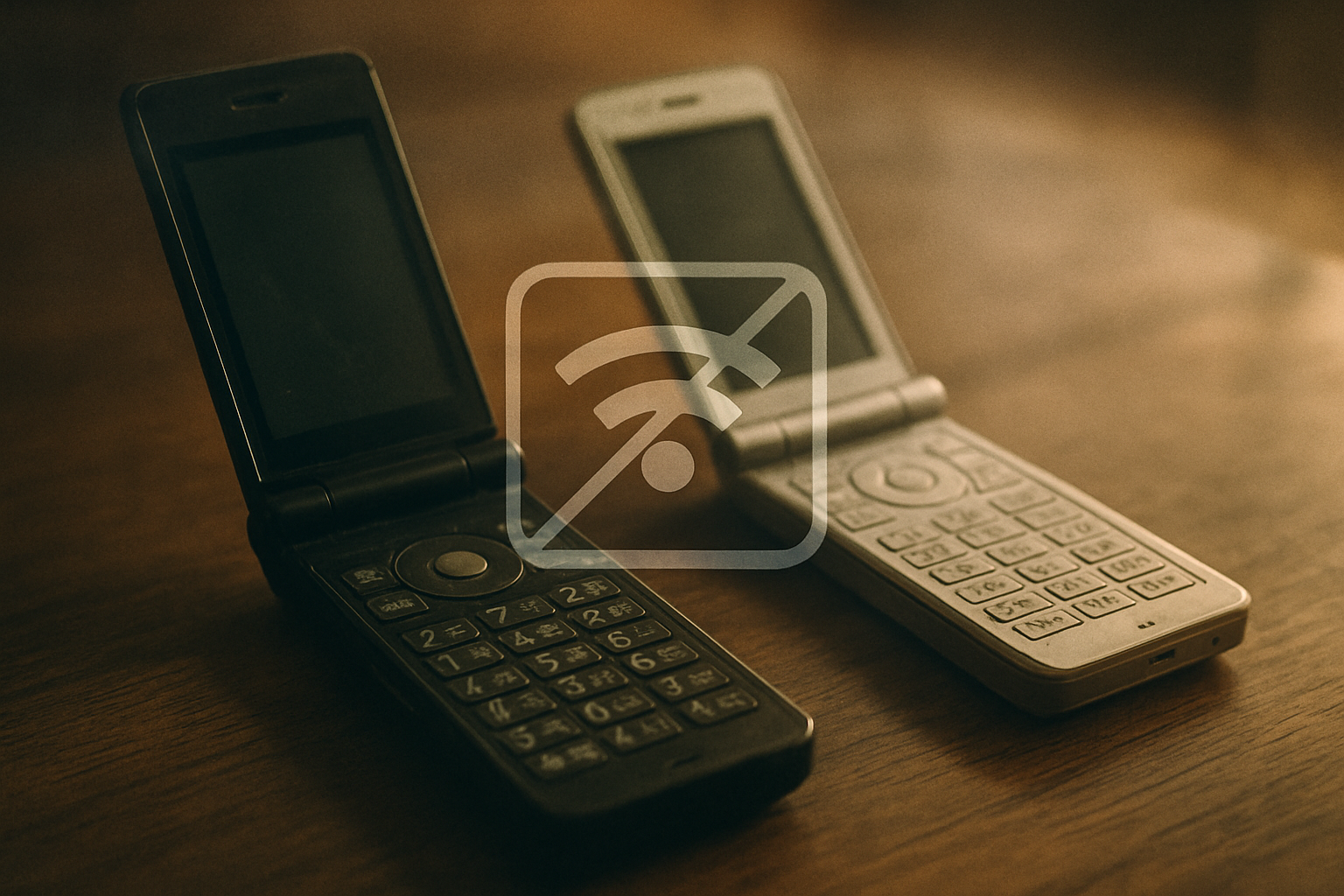
More than 500,000 Japanese users and their cherished flip phones lost access to mobile networks on March 31, 2026, as Japan officially ended its 3G telecommunications service, closing a significant chapter in the nation's mobile technology history.
The shutdown, long anticipated by industry observers, represents far more than a simple technological transition. It marks the end of Japan's unique "keitai" culture—a phenomenon that saw flip phones (known locally as "garakei," a portmanteau of "Galápagos" and "keitai") become deeply embedded in Japanese society for over two decades.
The Last Holdouts of a Digital Revolution
While smartphones have dominated global markets for more than a decade, Japan's flip phone community remained remarkably resilient. These devices, originally dismissed by international observers as technological relics, maintained a devoted user base who valued their simplicity, durability, and unique Japanese features that never quite translated to smartphone platforms.
The affected half-million users represent a cross-section of Japanese society that transcends simple generational boundaries. While many are elderly users who found flip phones more intuitive than touch-screen devices, the community also includes younger Japanese who deliberately chose these phones for their minimalist approach to digital communication.
"For many users, these phones represented a different relationship with technology—one that prioritized essential communication without the constant connectivity demands of modern smartphones."
— Technology analyst at Tokyo Institute of Technology
A Cultural Phenomenon Beyond Technology
Japan's flip phone culture developed unique characteristics that made it distinct from mobile phone usage elsewhere. The devices featured sophisticated functionality despite their seemingly simple appearance, including advanced camera capabilities, mobile internet access, and even early social networking features—all packaged in compact, durable designs that could withstand Japan's demanding urban lifestyle.
The phones became cultural symbols, featured in countless Japanese dramas, manga, and films as representations of personal connection and communication. Their distinctive opening sound, the satisfying snap of closure, and the tactile experience of physical buttons created an emotional attachment that proved difficult for smartphones to replicate.
Japanese manufacturers had developed these devices into highly sophisticated tools that were, in many ways, ahead of their time. Features like mobile payments, QR code scanning, and location-based services were standard on Japanese flip phones years before they became common on smartphones globally.
The Inevitable March of Progress
The 3G network shutdown didn't happen overnight. Japanese telecommunications companies had been warning users for years about the eventual termination of service, offering upgrade incentives and transition programs to encourage migration to newer technologies.
However, the conversion process faced unique challenges. Unlike simple device replacements, the shift required users to fundamentally change their relationship with mobile technology. Many flip phone users had developed highly efficient text input methods using physical keypads, mastered the devices' unique menu systems, and appreciated the week-long battery life that newer smartphones couldn't match.
The timing of Japan's 3G shutdown aligns with global trends toward network modernization. Telecommunications companies worldwide are decommissioning older infrastructure to reallocate spectrum for more efficient 4G and 5G services. The maintenance costs of supporting legacy networks, combined with declining user numbers, made the shutdown economically inevitable.
Economic and Social Implications
The 3G shutdown carries implications beyond individual inconvenience. Japan's flip phone ecosystem supported numerous small businesses, from accessory manufacturers to specialized repair services. The end of 3G service effectively eliminates an entire segment of the domestic technology market.
From a social perspective, the shutdown may disproportionately affect older Japanese citizens and those in rural areas who relied on these simple, reliable devices. While government and industry programs exist to facilitate transitions to smartphones, concerns remain about digital exclusion for those unable or unwilling to adapt to more complex technologies.
The economic impact extends to Japan's position in global mobile technology. The country that once led mobile innovation through its flip phone development now faces questions about its ability to compete in the smartphone and 5G era, particularly against Chinese and South Korean manufacturers who have dominated recent market developments.
Lessons from Japan's Mobile Evolution
Japan's 3G shutdown offers broader lessons about technology transitions and cultural adaptation. The country's experience demonstrates how deeply embedded technologies can persist far longer than industry predictions suggest, sustained by user loyalty and cultural significance that transcends purely functional considerations.
The transition also highlights challenges that other nations may face as they modernize telecommunications infrastructure. Balancing technological advancement with social inclusion requires careful planning and support systems for users who may struggle with rapid technological change.
Industry observers note that some features pioneered by Japanese flip phones—such as long battery life, physical durability, and simplified interfaces—have influenced recent smartphone development, suggesting that innovation often moves in cycles rather than purely linear progression.
Looking Forward: The Post-3G Landscape
As Japan's telecommunications landscape fully transitions to 4G and 5G networks, the country faces opportunities to leverage its advanced infrastructure for new innovations. The spectrum previously allocated to 3G services can now support more efficient data transmission, potentially enabling new applications in areas like IoT, autonomous vehicles, and smart city development.
For the 500,000 users affected by the shutdown, the transition represents both an ending and a beginning. While their beloved flip phones have fallen silent, Japan's telecommunications industry continues evolving, driven by the same innovative spirit that once made the country a global mobile technology leader.
The March 31 shutdown date will likely be remembered as a symbolic moment when Japan fully embraced the smartphone era, leaving behind a unique chapter of mobile technology history that influenced global development far beyond the archipelago's shores.
As the last 3G signals faded across Japan, they carried with them not just data packets, but the echo of millions of conversations, text messages, and digital connections that shaped a generation's relationship with technology. The flip phones may be silent, but their impact on Japan's digital culture—and their influence on global mobile technology—remains a lasting legacy of the 3G era.