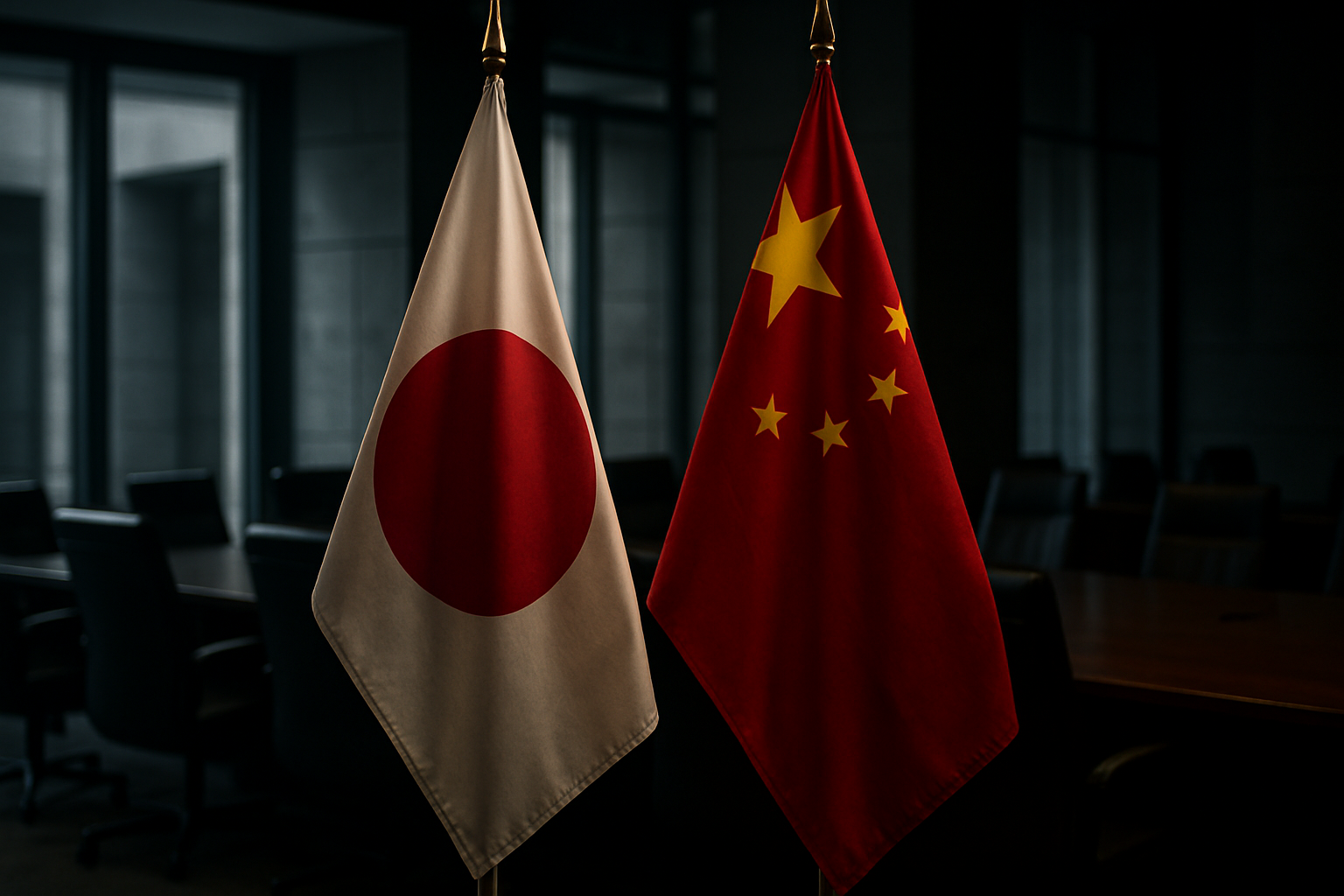
Japan will downgrade its description of ties with China in its 2026 diplomatic bluebook, dropping the designation of Beijing as "most important" partner while China blames Prime Minister Sanae Takaichi's "erroneous remarks on Taiwan" as the root cause of deteriorating relations.
The diplomatic row intensified Tuesday when an individual claiming to be a Japan Self-Defense Forces officer scaled the wall and forcibly entered the Chinese Embassy in Tokyo, prompting strong protests from Beijing and adding a security dimension to already strained bilateral ties.
According to diplomatic sources, Japan's 2026 diplomatic bluebook will describe China merely as an "important neighbor" with the relationship characterized as "strategic" and "mutually beneficial," representing a significant downgrade from previous characterizations that elevated China to "most important" partner status.
Embassy Security Incident Escalates Tensions
The embassy break-in Tuesday morning has become a focal point of bilateral friction, with China lodging formal protests through diplomatic channels. The incident involved an unidentified individual who claimed affiliation with Japan's Self-Defense Forces, though authorities have not confirmed this claim.
Chinese officials characterized the breach as a serious violation of diplomatic protocol and embassy security, demanding that Tokyo ensure the safety of Chinese diplomatic personnel and facilities. The timing of the incident, coinciding with broader diplomatic tensions, has complicated efforts to manage the relationship between Asia's two largest economies.
Taiwan Remarks Drive Diplomatic Rift
The current crisis stems from Prime Minister Takaichi's controversial statements on Taiwan made in November 2025, which Beijing has characterized as crossing a "red line" in China-Japan relations. China's foreign ministry said Tuesday that Takaichi's comments had "sparked anger in China" and breached fundamental diplomatic principles.
Takaichi, who achieved a historic electoral landslide in February 2026 with 316 of 465 Diet seats, has taken an increasingly assertive stance on regional security issues. Her Taiwan comments came during a period when Chinese military activity around Taiwan increased by 23% in 2025, with daily aircraft and naval deployments designed to pressure the island.
The diplomatic fallout reflects the broader challenge facing Japan as it navigates between economic interdependence with China and security concerns about Beijing's growing assertiveness in the region.
Regional Security Implications
The deteriorating Japan-China relationship carries significant implications for regional stability and global supply chains. Taiwan Strait tensions have intensified with China pursuing what analysts describe as a systematic pressure campaign combining military exercises, cyber attacks, and psychological warfare.
Japan's position has been strengthened by unprecedented support from the Trump administration, including a personal endorsement of Takaichi ahead of her February electoral victory and planned summit meetings. This has complicated China's regional objectives and highlighted the alignment of U.S.-Japan security interests.
The diplomatic downgrade comes as Japan has also achieved breakthroughs in deep-sea rare earth mining, potentially reducing dependency on Chinese supplies. Japan currently relies on China for 60% of rare earth production and 85% of processing, making supply chain diversification a strategic priority.
Failed Chinese Diplomatic Campaign
Beijing's efforts to rally international support against Japan have largely failed, with China's late 2025 campaign to mobilize Southeast Asian ambassadors gaining minimal traction. ASEAN nations demonstrated preference for multilateral approaches over bilateral confrontation, reflecting institutional culture and strategic choices to maintain diplomatic flexibility amid great power competition.
This diplomatic setback for China highlights the limits of economic leverage on security issues, even though Beijing remains the largest trading partner for most Southeast Asian countries. Regional states are increasingly sophisticated in separating economic cooperation from political alignment on sensitive territorial issues.
Economic Interdependence vs. Strategic Competition
Despite the diplomatic tensions, Japan and China maintain substantial economic ties that complicate complete decoupling efforts. China remains Japan's largest trading partner in many sectors, while Japan provides significant technology transfer and development assistance.
The challenge for both governments lies in managing this interdependence while addressing fundamental disagreements over security architecture in the Indo-Pacific. Taiwan's strategic position as a critical node in global semiconductor supply chains adds an economic dimension to the territorial dispute.
Japanese businesses operating in China face increasing uncertainty as diplomatic relations deteriorate, while Chinese companies in Japan must navigate growing scrutiny over security concerns and technology transfer.
Historical Context and Future Trajectory
The current tensions represent the most serious deterioration in Japan-China relations since the 2012 dispute over the Senkaku/Diaoyu Islands. However, the current crisis differs in its systematic nature, involving not just territorial disputes but broader questions about regional order and alliance relationships.
Prime Minister Takaichi's strengthened domestic position following her supermajority victory provides her with unprecedented authority to pursue constitutional reforms and enhanced defense capabilities. This includes potential changes to Japan's pacifist constitution that could fundamentally alter its security posture.
The diplomatic bluebook downgrade, while symbolic, reflects Japan's strategic reassessment of China as having evolved from a cooperative partner to a strategic competitor. This shift aligns with broader international recognition of China's challenge to existing international norms and institutions.
International Response and Mediation Efforts
The international community has watched the Japan-China tensions with concern, given both countries' central roles in global economic and security affairs. The United States has clearly aligned with Japan, while European partners have called for diplomatic dialogue to prevent further escalation.
Regional organizations including ASEAN have emphasized the importance of maintaining stability and peaceful resolution of disputes, though they have avoided taking sides in the specific Japan-China disagreements. This neutrality reflects the complex balancing act required in an increasingly multipolar regional order.
The embassy security incident has added urgency to calls for diplomatic engagement, with international observers noting that such breaches could easily escalate if not properly managed through established diplomatic channels.
As both countries navigate this challenging period, the fundamental question remains whether economic interdependence can provide sufficient ballast to prevent complete strategic decoupling, or whether security considerations will ultimately override commercial interests in shaping the future of this critical bilateral relationship.