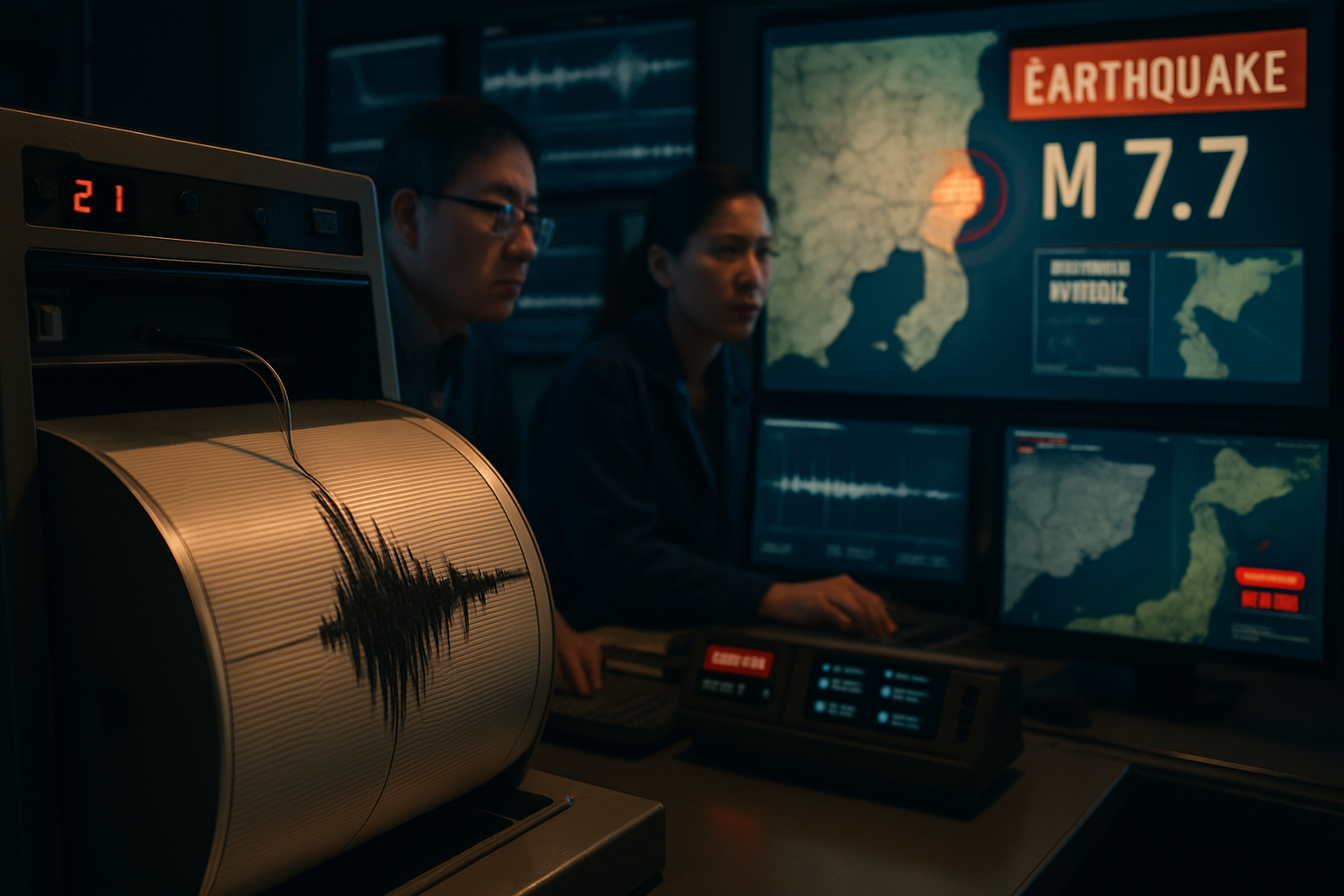
Japan's northeastern coast was struck by a powerful magnitude 7.7 earthquake on Monday afternoon, triggering tsunami warnings and prompting officials to issue an unprecedented alert warning of elevated risks for an even larger earthquake in the coming days.
The earthquake, which occurred at approximately 4:53 PM local time off the coast of Iwate Prefecture, registered as the strongest tremor to hit the region in over a decade. The Japan Meteorological Agency (JMA) quickly issued tsunami warnings for coastal areas, with waves reaching up to 3 meters threatening Hokkaido, Aomori, and Iwate prefectures.
Unprecedented Mega-Quake Warning Issued
In a rare move that underscores the gravity of the situation, the Japan Meteorological Agency has issued a special advisory warning of a "slightly elevated risk" of a magnitude 8.0 or stronger earthquake occurring within the next week. Officials estimate there is approximately a 1 percent chance of a mega-quake striking the region, significantly higher than normal conditions.
The alert, affecting 182 municipalities across seven prefectures—Hokkaido, Aomori, Iwate, Miyagi, Fukushima, Ibaraki, and Chiba—will remain in effect until 5 PM on Monday, April 27. Government spokesperson Minoru Kihara has urged residents to stay prepared for the possibility of additional seismic activity.
"The probability of another major earthquake occurring is relatively higher than in normal times,"
— Japan Meteorological Agency, Official Statement
This marks only the second time such a mega-quake warning has been issued since the advisory system was established, highlighting the unprecedented nature of the current seismic threat.
Immediate Impact and Damage Assessment
Northeast Japan has largely escaped the worst-case scenarios initially feared, with preliminary reports indicating six people injured and several roads damaged but no major casualties or catastrophic infrastructure failures. The earthquake measured "upper 5" on Japan's 0-7 seismic intensity scale, strong enough to shake buildings hundreds of kilometers away in Tokyo.
Tsunami waves of 80 centimeters were confirmed to have reached Kuji port in Iwate Prefecture at 5:34 PM, with earlier 70-centimeter waves recorded at 5:32 PM. While these wave heights were lower than initially projected, the rapid response demonstrated the effectiveness of Japan's enhanced warning systems.
Venezuelan media reported six injuries and damaged roadways, while several international news outlets noted the disruption to coastal communities that had been urged to evacuate to higher ground as a precautionary measure.
Historical Context and Regional Vulnerability
The earthquake struck the same region devastated by the magnitude 9.0 Great East Japan Earthquake on March 11, 2011, which killed over 15,000 people and triggered the Fukushima nuclear crisis. The location in the Pacific Ring of Fire, where the Pacific Plate meets the North American Plate, has historically been one of Japan's most seismically active areas.
Prime Minister Sanae Takaichi quickly established an emergency task force, implementing protocols developed and refined since the 2011 disaster. The swift response reflects Japan's massive investment in reconstruction, advanced warning systems, enhanced building codes, and comprehensive disaster preparedness following the Fukushima tragedy.
Emergency Response and Preparedness Measures
Officials are not calling for advance evacuations but have issued detailed preparedness guidelines for residents in affected areas. Citizens are urged to:
- Keep emergency evacuation kits readily available
- Secure home furniture and appliances
- Confirm backup supplies of food, water, and portable toilets
- Avoid spreading misinformation and rely on official sources
- Remain alert for emergency broadcasts and updates
The emergency response has demonstrated the effectiveness of international cooperation frameworks developed since the 2004 Indian Ocean tsunami. Australia has confirmed it is monitoring 115,000 nationals in Japan, while Pacific nations have activated regional tsunami warning networks.
Geological Assessment and Scientific Analysis
Seismologists note that the earthquake occurred at a relatively shallow depth of 19-20 kilometers in the Pacific Ocean, approximately 120 kilometers from Iwate Prefecture's coast. This shallow depth increased both the intensity of ground shaking and tsunami generation potential, requiring continued vigilance from monitoring agencies.
The Sanriku coast region has a well-documented history of tsunami generation, making it a critical area for ongoing seismic surveillance. Enhanced monitoring systems deployed since 2011 have enabled rapid detection and warning dissemination, providing crucial minutes that can save thousands of lives.
"This area requires sustained vigilance due to its position in one of the world's most geologically active zones. Our enhanced monitoring capabilities have proven their value today."
— Regional Seismology Expert
International Response and Cooperation
The earthquake has triggered coordinated international monitoring through Pacific tsunami warning systems that have been enhanced dramatically since the 2004 Indian Ocean disaster. Multiple countries have activated their emergency protocols, demonstrating the sophisticated cooperation mechanisms now in place for Pacific Rim seismic events.
Hong Kong's EGL Tours confirmed that all 40 tour groups currently in Japan, including three in the northeast region and four in Hokkaido, are safe. Tourism operators have activated emergency protocols while maintaining close contact with group leaders, showcasing the improved international tourism safety frameworks.
Economic and Infrastructure Implications
While early assessments suggest minimal major infrastructure damage, the earthquake serves as a critical test of Japan's disaster preparedness investments totaling billions of dollars since 2011. The enhanced seismic networks, automatic alert systems, and coordinated government response represent a significant advancement in earthquake early warning technology.
The tourism industry, still recovering from various global challenges, faces potential disruptions during a critical period. However, the swift response and effective warning systems may actually reinforce confidence in Japan's safety infrastructure among international visitors.
Looking Ahead: Sustained Vigilance Required
As Japan maintains its elevated alert status through the end of April, the focus remains on continuous monitoring for aftershocks and potential additional seismic activity. The rare mega-quake warning reflects both the serious nature of the current geological conditions and the sophistication of Japan's risk assessment capabilities.
The successful implementation of disaster preparedness protocols, combined with minimal casualties despite the earthquake's significant magnitude, validates the extensive investments made in Japan's emergency response infrastructure. However, officials stress that the elevated risk period requires continued vigilance from both authorities and residents.
This event occurs during a period of heightened geological activity across the Pacific Ring of Fire, emphasizing the importance of continued international cooperation in seismic monitoring and emergency response. As Japan navigates this critical period, the effectiveness of its disaster preparedness serves as a model for other seismically active regions worldwide.