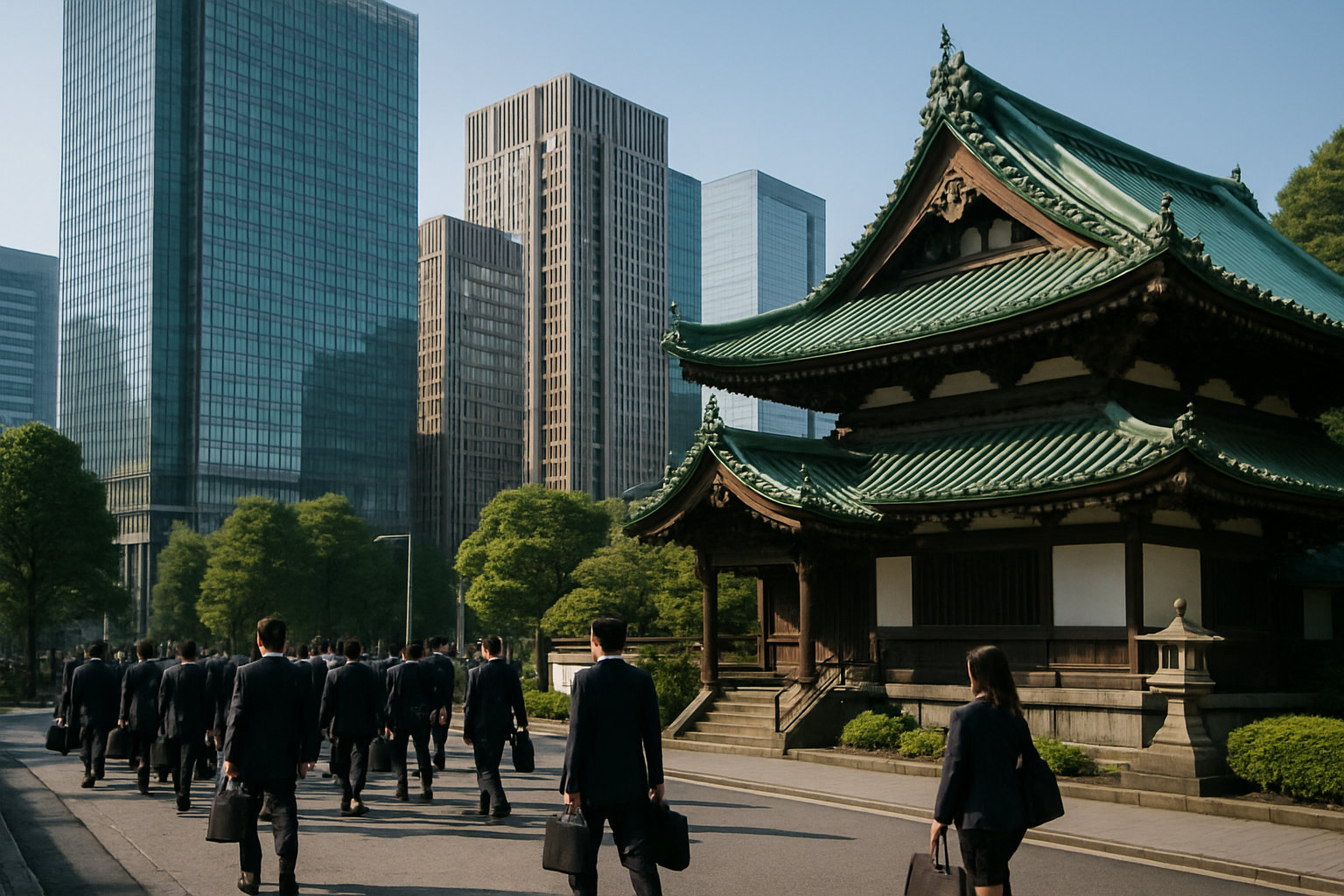
Japan demonstrated resilient economic fundamentals in March 2026 with 92% of university graduates securing job offers by February 1st, while land prices continued their fifth consecutive year of growth, even as the nation grappled with controversial social policy decisions and global market uncertainties.
The latest employment data, released by Japan's education ministry, revealed that 92% of job-seeking university students had secured employment offers as of February 1, 2026. While this represents a slight decline from the previous year—marking the first decrease in five years—the figure remains substantially high due to persistent labor shortages across multiple sectors.
Employment Market Resilience Despite Demographic Pressures
The strong graduate employment rate occurs against the backdrop of Japan's unprecedented demographic challenges. With approximately 30% of the population over 65 years old, Japan faces the world's most rapidly aging society while simultaneously experiencing its ninth consecutive year of birth rate decline through 2024.
This demographic reality has created acute labor shortages that paradoxically benefit new graduates. Industries ranging from construction to healthcare are actively recruiting, with companies adapting traditional hiring practices to secure talent. The employment success reflects broader economic adaptations that have seen Japanese workers now working fewer hours than their American, Canadian, and Italian counterparts—a significant achievement in workplace reform.
The government's anti-karoshi (death by overwork) campaigns have achieved measurable progress, contributing to Japan's attractiveness as a destination for both domestic graduates and international workers. Vietnamese migrants, traditionally temporary workers, are increasingly viewing Japan as a permanent settlement destination through home ownership and family establishment.
Real Estate Market Momentum Continues
Japan's land price data from January 1, 2026, showed a 2.8% increase from the previous year, marking the fifth straight year of growth according to the land ministry. This sustained upward trend reflects economic confidence and urban development pressures, particularly in metropolitan areas.
The continued land price appreciation occurs within a complex economic environment where the government has successfully implemented policy interventions to moderate inflationary pressures. The abolition of provisional gasoline tax rates helped ease energy costs for consumers, providing meaningful relief amid broader cost-of-living concerns.
However, the real estate gains must be viewed against global supply chain disruptions affecting Japan's technology sector. Memory chip prices have surged sixfold, affecting everything from consumer electronics to automotive manufacturing—sectors critical to Japan's export economy.
Social Policy Setbacks and Legal Controversies
While economic indicators showed positive trends, Japan faced significant criticism over social policy developments. A Tokyo court ruling against women's right to voluntary sterilization highlighted ongoing restrictions in reproductive autonomy. Under current Japanese law, sterilization surgery for women can only be performed when specific health risks are present, a policy that women's rights advocates argue is outdated and discriminatory.
This legal setback occurs as Japan grapples with complex questions about individual choice, medical ethics, and governmental authority over personal health decisions. The ruling has sparked renewed debate about Japan's approach to reproductive rights in an era of declining birth rates and changing social attitudes toward family planning.
Global Market Volatility and Regional Concerns
Japanese markets faced additional uncertainty from regional developments, with Asian shares remaining mixed as oil prices fluctuated around $100 per barrel. The ongoing war in Iran and its implications for energy supplies created particular concerns for Japan, which remains heavily dependent on Middle Eastern oil imports.
Brent crude oil's persistence above $100 per barrel represents a significant cost pressure for Japan's energy-intensive industries. This situation has renewed discussions about energy security and the role of nuclear power in Japan's future energy mix, particularly as the country continues processing lessons from the 2011 Fukushima disaster.
The energy situation has implications beyond immediate costs, affecting Japan's broader economic strategy as it seeks to balance energy security with environmental commitments and public safety concerns about nuclear power.
Technological Adaptation and Supply Chain Evolution
Japan's automotive industry has demonstrated remarkable pragmatism in addressing supply chain challenges. Major manufacturers including Toyota and Suzuki have increasingly adopted Chinese-made automotive chips, marking a significant shift in procurement strategy. This move reflects a departure from traditional reliance on domestic or Western-made semiconductors in favor of supply chain resilience.
The decision represents a broader evolution in Japan's economic thinking, where companies prioritize operational continuity and cost management over traditional supplier relationships. This flexibility has become essential as memory chip shortages create bottlenecks affecting entire technology supply chains.
International Context and Strategic Positioning
Japan's economic developments occur within a broader international framework of cooperation and competition. The US-EU-Japan Critical Minerals Partnership, involving 55 countries, represents an effort to diversify supply chains away from Chinese dominance in critical materials—a challenge that affects everything from renewable energy infrastructure to advanced manufacturing.
Under Prime Minister Sanae Takaichi's leadership, Japan has maintained its position as a democratic anchor in the Asia-Pacific region while adapting to great power competition dynamics. The February 2026 electoral mandate provided political stability that enables long-term economic planning, even as regional tensions continue to require careful diplomatic navigation.
Future Outlook and Structural Challenges
Japan's economic trajectory in early 2026 reflects both the nation's adaptive capacity and the persistent challenges of demographic transition. The strong graduate employment rates and land price growth indicate underlying economic health, while social policy setbacks and global supply chain dependencies highlight areas requiring continued attention.
The success of workplace reforms, demonstrated by reduced working hours and improved work-life balance, provides a template for addressing quality of life concerns while maintaining economic competitiveness. However, the controversial court ruling on women's reproductive rights suggests that social policy modernization remains uneven.
As Japan continues navigating the complex intersection of demographic change, technological disruption, and global economic uncertainty, the early 2026 data suggests a nation in transition—maintaining economic momentum while wrestling with fundamental questions about individual rights, technological sovereignty, and long-term sustainability.
The coming months will prove critical in determining whether Japan can sustain its economic progress while addressing the structural challenges that continue to shape its social and political landscape. Success will likely depend on the government's ability to balance immediate economic needs with longer-term demographic realities and evolving social expectations.