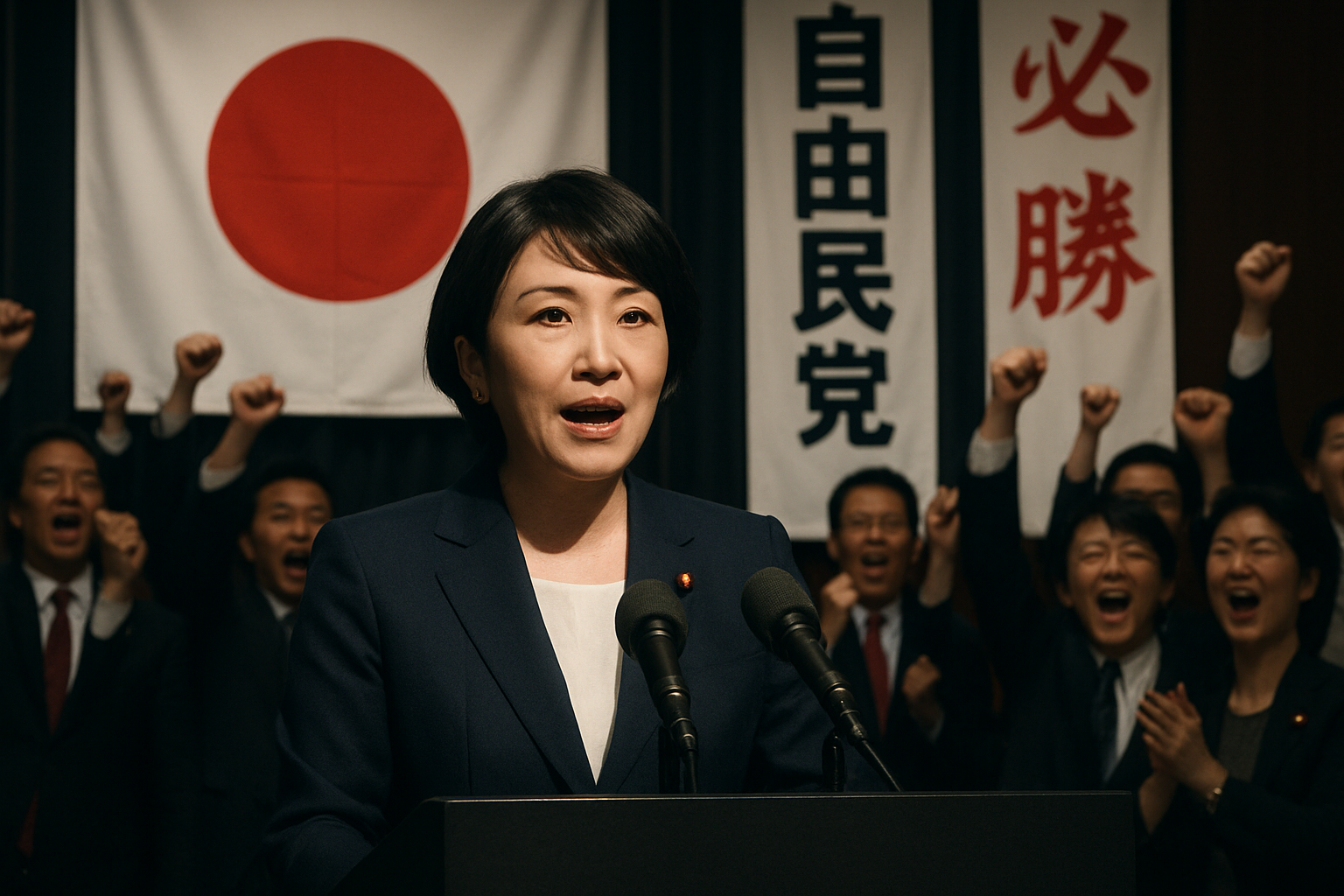
Prime Minister Sanae Takaichi's Liberal Democratic Party achieved a commanding supermajority in Japan's snap parliamentary elections on February 8, 2026, securing 316 of 465 lower house seats in what represents the most significant electoral triumph in Japanese politics in decades.
The victory, which far exceeded expectations, provides Japan's first female Prime Minister with an unprecedented mandate to implement her conservative agenda after less than four months in office. The LDP's performance surpassed its previous high-water mark and grants the party, together with coalition partners, the two-thirds majority needed for constitutional amendments.
Historic Electoral Achievement
The results announced early Monday morning showed the LDP had captured a higher proportion of representatives than any other party in postwar Japan. With 316 seats secured, Takaichi's party improved dramatically from the 233 seats it was defending, representing a gain of 83 seats and demonstrating the Prime Minister's remarkable political ascendancy.
The governing coalition's triumph was particularly striking given the challenging conditions under which the election was conducted. Japan faced its worst winter storm in decades during voting, with over 35 deaths recorded since late January and emergency services deploying across the country to maintain democratic processes.
"This victory represents not just an endorsement of our policies, but the resilience of Japanese democracy even in the face of unprecedented challenges."
— Sanae Takaichi, Prime Minister
Breaking Barriers: Japan's First Female PM Triumphant
Takaichi's electoral success marks a watershed moment in Japanese politics. As the country's first female Prime Minister, her decisive victory challenges long-standing assumptions about gender and political leadership in Japan's traditionally male-dominated political landscape.
The former heavy metal drummer and self-declared admirer of Margaret Thatcher called the snap election as a political gamble after promising to resign if her party failed to secure a majority. The risk has paid off spectacularly, establishing her as one of Asia-Pacific's most significant political leaders.
Her political journey from drummer to Prime Minister has captured international attention, with observers noting her strategic moderation on contentious issues while maintaining core reformist positions. The victory provides validation for her unconventional background and leadership style.
Opposition Collapse and Political Realignment
The election witnessed a crushing defeat for the opposition Centrist Reform Alliance, formed in January 2026 through a merger of the Constitutional Democratic Party and Komeito. Exit polls confirmed voter rejection of the alternative vision offered by the newly formed coalition, which had hoped to present a unified challenge to LDP dominance.
The scale of the opposition's collapse suggests a fundamental realignment in Japanese politics, with traditional party structures struggling to respond to Takaichi's populist appeal and policy positions. The result eliminates the need for complex coalition negotiations that have historically complicated Japanese governance.
Economic Mandate and Voter Concerns
The election was fundamentally shaped by economic anxiety, with 54% of voters citing inflation as their primary concern. Household food spending reached a 44-year high of ¥314,001 monthly, representing a 4.6% increase that created significant pressure on Japanese families.
Takaichi's campaign promises of tax cuts and economic revitalization resonated powerfully with voters experiencing cost-of-living pressures. While financial markets initially showed skepticism about her fiscal policies, the decisive mandate provides political cover for implementing economic stimulus measures.
The victory comes as Japan grapples with demographic challenges, including recording its lowest birth rate in history for 2024 and having 30% of its population over 65, making it the world's most aged society. These structural challenges will test Takaichi's policy innovations in the coming years.
International Implications and Diplomatic Relations
The election results carry significant implications for regional security and international relations. President Trump's unprecedented endorsement of Takaichi during the campaign, breaking diplomatic tradition, appears vindicated by the outcome. Plans for a March 19 summit between the two leaders signal strengthened US-Japan ties.
China's attempt to rally Southeast Asian support against Japan following Takaichi's November remarks on Taiwan gained little regional traction, with ASEAN countries preferring multilateral approaches to balance economic ties with China against security partnerships with Japan and the United States.
The supermajority provides Takaichi with the legislative tools needed to pursue enhanced defense capabilities and potential constitutional reforms. With Chinese military activity around Taiwan increasing 23% in 2025, Japan's role as a democratic anchor in the Asia-Pacific region becomes increasingly critical.
Overcoming Unprecedented Challenges
The election's conduct during Japan's worst winter storm in decades demonstrated remarkable democratic resilience. Despite extreme weather conditions that left northern communities buried under two-meter snow drifts and caused widespread infrastructure disruption, voting proceeded as scheduled.
The Self-Defense Forces were deployed for emergency operations while election officials maintained polling station access across the country. The successful completion of the first winter parliamentary election in 36 years under such conditions reinforces Japan's institutional strength.
Additionally, the election overcame an unprecedented AI-generated disinformation campaign using generative artificial intelligence to create fabricated political content within seconds. Digital platforms implemented enhanced fact-checking measures, while educational initiatives helped voters identify AI manipulation, demonstrating democratic adaptation to technological threats.
Constitutional Reform and Policy Trajectory
The two-thirds supermajority opens the possibility for constitutional amendments, including potential modifications to Japan's pacifist constitution. As a hardline conservative who has advocated for revising constitutional constraints on military capabilities, Takaichi now possesses the legislative authority to pursue such changes.
Her policy agenda includes enhanced military spending for China deterrence, implementation of promised tax reductions, and a balance between economic nationalism and international cooperation. The March 2026 U.S.-Japan summit will likely focus on defense cooperation, trade relationships, and coordinated responses to regional security challenges.
The supermajority also enables Takaichi to address Japan's demographic challenges through structural economic changes and potential immigration policy reforms, issues that have long required but lacked sufficient political consensus for implementation.
Democratic Resilience and Regional Leadership
The election's success amid multiple challenges—severe weather, technological disruption, international pressures—provides encouragement for regional democratic institutions facing similar stresses. Japan's ability to maintain electoral integrity while addressing voter concerns demonstrates the adaptability of democratic systems.
Takaichi's achievement as Japan's first female Prime Minister winning an election in her own right establishes an important precedent for democratic leadership in Asia-Pacific. Her success provides validation for diverse political representation and challenges traditional assumptions about leadership qualifications.
The victory positions Japan to play an enhanced role in regional security cooperation, democratic governance promotion, and economic integration efforts. With great power competition intensifying in the Indo-Pacific, Japan's democratic stability and strengthened leadership provide crucial strategic value for allied cooperation.
Looking Forward: Unprecedented Mandate
The historic supermajority grants Takaichi unprecedented legislative power to implement her conservative agenda while addressing Japan's long-term challenges. The elimination of opposition influence and potential for constitutional amendments represents the most significant concentration of political authority in modern Japanese democracy.
International observers will monitor how Takaichi utilizes this historic mandate to balance regional security concerns with democratic governance principles. Her success in conducting elections during extreme weather and technological challenges provides a template for democratic resilience that extends well beyond Japan's borders.
The February 8 election results mark not just a political victory, but a demonstration of democratic institutional strength under pressure. As Japan enters a period of single-party dominance under its first female Prime Minister, the implications extend across economics, security, and governance in one of Asia's most important democracies.