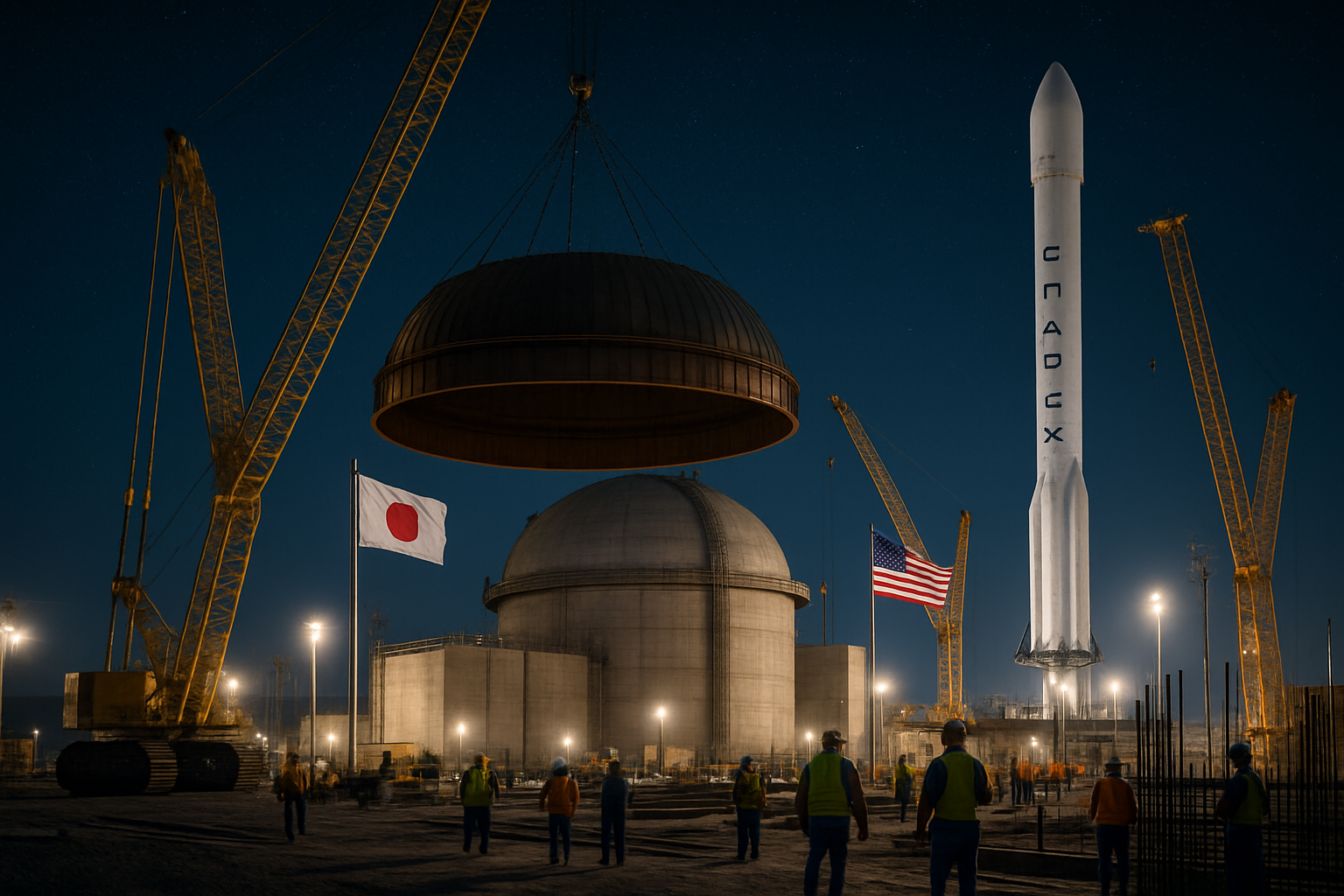
Japan has announced a multi-billion dollar agreement to construct advanced nuclear reactors in the United States, while NASA simultaneously reduces Boeing's role in its Artemis moon program in favor of SpaceX's Starship rocket, marking significant developments in both nuclear energy and space exploration sectors.
The nuclear reactor project, confirmed by German media sources, will see Japanese companies building next-generation atomic facilities in Tennessee and Alabama, representing one of the largest international energy infrastructure investments in recent years. The initiative also includes substantial investments in natural gas power generation facilities, positioning Japan as a major player in America's energy transition.
Nuclear Renaissance in the American South
The Japanese nuclear construction initiative comes at a critical time for global energy security, as nations worldwide seek reliable, low-carbon power sources. The reactors planned for Tennessee and Alabama will utilize advanced safety technologies developed through decades of Japanese nuclear expertise, despite the country's complex relationship with atomic energy following the Fukushima disaster.
Meanwhile, Swedish nuclear technology company Blykalla is simultaneously pursuing its own ambitious plans, preparing to apply for permits in 2026 to construct six small modular reactors in Norrsundet, Gävle, according to reports from Gefle Dagblad. This parallel development underscores the global nuclear industry's renewed confidence in atomic energy as a climate solution.
NASA's Strategic Pivot
In a dramatic reshuffling of America's lunar ambitions, NASA is reportedly revising its moon-landing strategy to reduce Boeing's traditional dominance while elevating SpaceX's Starship rocket system. Sources familiar with the matter indicate that Elon Musk's spacecraft will now handle the crucial task of propelling astronauts to lunar orbit, a role originally assigned to Boeing's Space Launch System.
This strategic shift reflects NASA's growing confidence in commercial space capabilities following SpaceX's consistent success with International Space Station crew rotations and cargo missions. The change comes as the Artemis program faces ongoing technical challenges, including persistent hydrogen leak issues that have delayed the Artemis II lunar flyby mission beyond its original March 2026 timeline.
"The space economy is entering its golden age, and we're seeing unprecedented collaboration between government programs and commercial innovation."
— Industry analyst, commenting on NASA's strategic pivot
International Cooperation and Competition
These developments occur during a period of intense international space competition and cooperation. China has successfully launched its fourth Shenlong reusable spacecraft, demonstrating growing capabilities in cost-effective orbital access. Meanwhile, Pakistan has selected astronaut candidates for China's Tiangong space station mission scheduled for October-November 2026, highlighting the democratization of space access.
The convergence of nuclear energy expansion and space exploration advancement reflects broader technological sovereignty trends. As SpaceX prepares for a potentially trillion-dollar IPO in June 2026, countries are increasingly investing in both terrestrial energy infrastructure and space capabilities to maintain strategic independence.
Sweden's Nuclear Ambitions
Sweden's Blykalla represents the European approach to next-generation nuclear technology. The company's planned six-reactor facility in Gävle would mark Sweden's significant expansion of nuclear capacity, aligning with the European Union's recognition of atomic energy as essential for carbon neutrality goals.
These small modular reactors promise enhanced safety features and operational flexibility compared to traditional large-scale nuclear plants. The timing of permit applications in 2026 suggests Swedish authorities are accelerating nuclear development amid ongoing energy security concerns following the European energy crisis.
Space Infrastructure Revolution
NASA's pivot toward SpaceX reflects the broader transformation of space exploration from government-led programs to public-private partnerships. The Starship rocket system offers unprecedented payload capacity and potential cost efficiency for lunar missions, potentially revolutionizing humanity's approach to deep space exploration.
This shift occurs as the space industry transitions from what experts term the "AI revolution" phase to the "space economy golden age." Commercial space companies are demonstrating capabilities that complement and sometimes exceed traditional aerospace contractors, forcing government agencies to adapt their procurement and mission planning strategies.
Global Energy Security Implications
Japan's nuclear construction in the United States represents a strategic partnership addressing both nations' energy security concerns. The advanced reactor technologies planned for Tennessee and Alabama could serve as models for future international nuclear cooperation, potentially influencing global standards for next-generation atomic facilities.
The inclusion of natural gas infrastructure alongside nuclear development suggests a comprehensive approach to energy transition, acknowledging the need for both baseload nuclear power and flexible gas generation to support renewable energy integration.
Looking Toward April
With NASA Administrator Jared Isaacman confirming the Artemis II mission now targets April 1, 2026, after resolving critical technical issues, the space industry approaches a pivotal moment. The four-astronaut crew, including Canadian Jeremy Hansen as the first Canadian beyond Earth orbit, will undertake humanity's first crewed lunar mission since Apollo 17 in December 1972.
The convergence of Japanese nuclear expansion in America, Swedish reactor development, and NASA's strategic space partnerships with commercial companies signals a broader realignment of global technological capabilities. These developments position 2026 as a watershed year for both nuclear energy renaissance and space exploration advancement.
As nations balance energy security with climate commitments and space ambitions with budget constraints, the success of these initiatives will likely influence international technology cooperation frameworks for decades to come. The combination of proven nuclear technologies, innovative space systems, and strengthened international partnerships offers a template for addressing 21st-century challenges requiring both terrestrial infrastructure and cosmic capabilities.