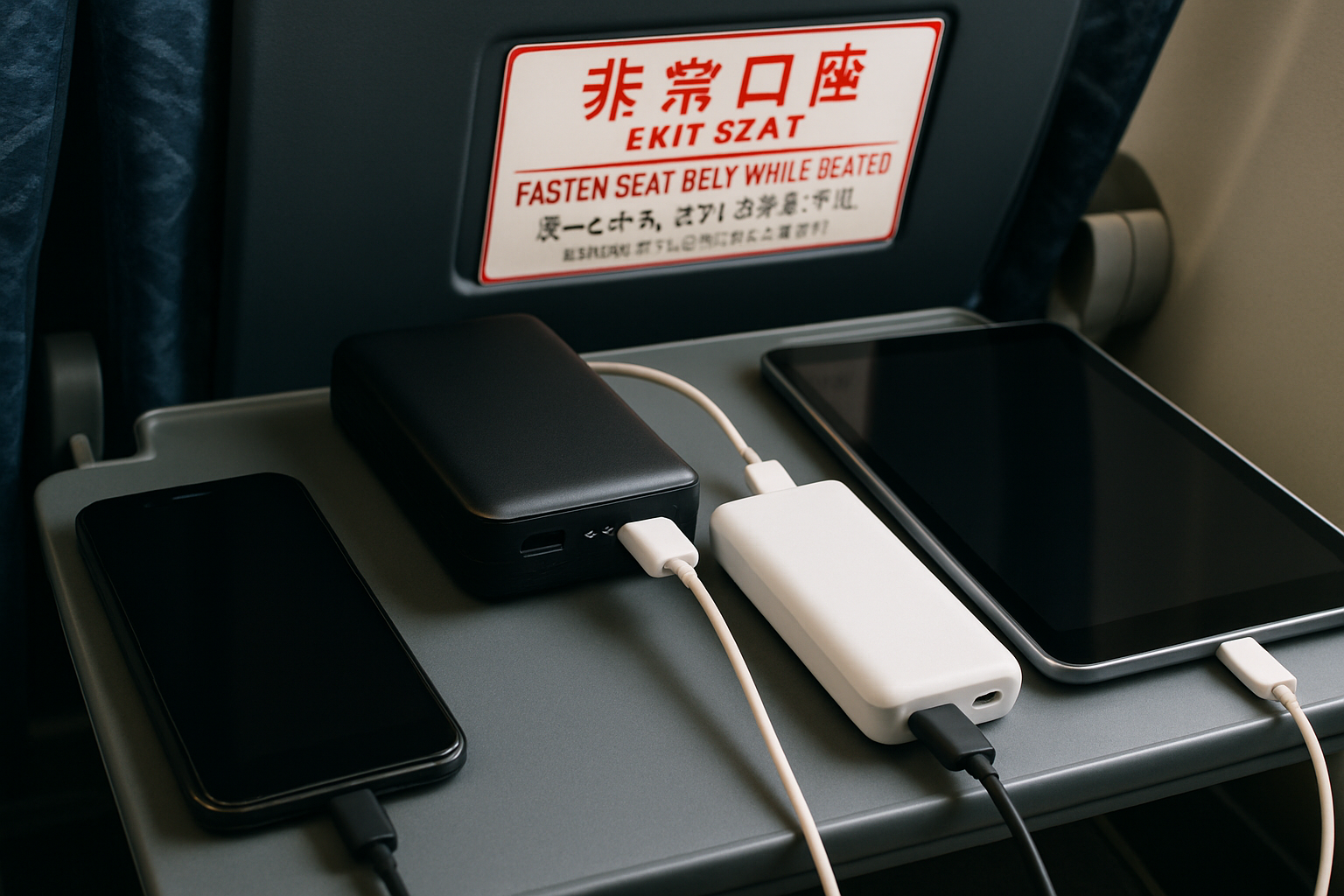
Japan's Ministry of Transport has announced a comprehensive ban on portable power banks aboard all flights departing from and arriving in Japan, scheduled to take effect in April 2026, marking the most restrictive aviation battery policy implemented by any major nation.
The unprecedented regulation represents a significant escalation in aviation safety measures, targeting the growing risks posed by lithium-ion battery devices in aircraft cabins. The policy affects both domestic and international flights, positioning Japan at the forefront of strict aviation safety protocols amid increasing global concerns over battery-related incidents.
Rising Safety Concerns Drive Policy Change
The decision follows a pattern of concerning aviation incidents involving portable battery devices across Europe and Asia. Recent memory includes the February 15, 2026 SAS flight SK4416 emergency landing at Trondheim Airport after a power bank overheated in the cabin, exposing crew members to toxic smoke. The incident required a full emergency response, with affected crew members requiring medical examination.
Aviation safety experts have increasingly documented the risks of thermal runaway events in lithium-ion batteries, which can produce toxic smoke and fire hazards in the confined environment of aircraft cabins. These incidents pose particular dangers at cruising altitudes, where emergency landing options may be limited and cabin air circulation systems can distribute dangerous fumes throughout the passenger compartment.
The thermal runaway phenomenon occurs when lithium-ion batteries overheat, potentially leading to fires that are difficult to extinguish and can spread rapidly. In aircraft environments, where passengers and crew have limited escape options, such incidents present extraordinary safety challenges that traditional fire suppression systems struggle to address effectively.
Japan's Aviation Safety Leadership
Japan's Ministry of Transport has positioned the country as a leader in aviation safety innovation, implementing proactive measures rather than reactive responses to emerging threats. The power bank prohibition represents the most comprehensive policy of its kind globally, exceeding current international aviation safety standards.
The policy applies to all aircraft operating in Japanese airspace, including major international carriers serving Tokyo Haneda, Tokyo Narita, Osaka Kansai, and other major Japanese airports. Airlines will be required to implement comprehensive passenger screening procedures to ensure compliance with the new regulations.
Industry observers note that Japan's approach reflects a precautionary principle that prioritizes passenger safety over convenience, potentially influencing aviation policies across Asia-Pacific and globally. The country's reputation for rigorous safety standards in transportation could accelerate adoption of similar measures by other aviation authorities.
Global Context of Aviation Battery Incidents
The Japanese policy emerges amid a broader pattern of aviation safety challenges related to electronic devices. European aviation networks have experienced multiple incidents involving overheating batteries, with several requiring emergency landings and medical attention for crew members exposed to toxic fumes.
Aviation authorities worldwide have documented increasing numbers of lithium-ion battery incidents aboard aircraft, ranging from smartphones and laptops to portable chargers and electronic cigarettes. The confined aircraft environment amplifies the risks associated with battery malfunctions, creating potentially catastrophic scenarios that require immediate response.
International aviation safety organizations have been studying the battery risk phenomenon, but Japan's comprehensive ban represents the most aggressive regulatory response to date. The policy goes beyond current International Civil Aviation Organization (ICAO) guidelines, which typically focus on restrictions for damaged or recalled devices rather than entire categories of consumer electronics.
Industry and Passenger Impact
The implementation of Japan's power bank ban will require significant adjustments across the aviation industry. Airlines serving Japanese routes must develop new passenger communication strategies, baggage screening procedures, and enforcement mechanisms to ensure compliance with the regulations.
Passengers frequently traveling to and from Japan will need to adapt their electronic device strategies, potentially relying on aircraft power systems or alternative charging solutions during long-haul flights. The policy particularly affects business travelers and tourists who depend on portable batteries for extended international journeys.
Industry analysts predict the policy could influence global aviation regulation, with other countries potentially implementing similar measures if Japan's experience demonstrates improved safety outcomes. The aviation industry has historically followed precedents set by major markets like Japan, the United States, and the European Union.
Enforcement and Implementation Challenges
The Ministry of Transport faces significant logistical challenges in implementing the comprehensive ban, requiring coordination with airport security agencies, customs authorities, and international airline partners. Detection of concealed power banks will require enhanced screening technology and trained personnel capable of identifying various battery device configurations.
Airport security systems must be upgraded to reliably detect power banks in carry-on luggage, checked baggage, and personal items. The policy's success depends on consistent enforcement across all Japanese airports and coordination with international partners to prevent passengers from circumventing the regulations through connecting flights.
Legal frameworks must address violations, penalties, and exceptions for medical devices or essential equipment that may contain similar battery technology. The Ministry will need to develop comprehensive guidelines distinguishing between prohibited power banks and essential electronic devices that passengers require for health or safety purposes.
Technology and Alternative Solutions
The power bank ban coincides with advancing aircraft technology that may provide alternative charging solutions for passengers. Modern aircraft increasingly feature individual power outlets, USB charging ports, and wireless charging capabilities that reduce passenger dependence on portable batteries.
Aviation manufacturers are developing integrated power management systems that provide reliable passenger device charging without introducing the safety risks associated with personal lithium-ion batteries. These systems incorporate aircraft electrical infrastructure rather than relying on potentially unstable personal devices.
The regulation may accelerate innovation in aircraft passenger services, encouraging airlines to invest in comprehensive charging infrastructure that eliminates the need for personal power banks while maintaining passenger connectivity and device functionality during flights.
International Aviation Policy Implications
Japan's unprecedented policy positions the country as a global leader in proactive aviation safety regulation, potentially influencing international standards and practices. Other major aviation markets will closely monitor the implementation and effectiveness of the power bank ban in determining their own regulatory approaches.
The policy represents a shift from international aviation's traditionally reactive safety culture toward predictive risk management that addresses emerging threats before they result in major incidents. This proactive approach could become a model for addressing other technological safety challenges in aviation.
Regional aviation partnerships and international aviation organizations must address the coordination challenges created by varying national policies on electronic devices. Harmonization of safety standards requires balancing national sovereignty with international cooperation in maintaining consistent global aviation safety protocols.
Japan's power bank ban, effective April 2026, represents a watershed moment in aviation safety regulation, demonstrating unprecedented commitment to passenger protection in the face of evolving technological risks. The policy's global impact will depend on its effectiveness in reducing battery-related incidents and its influence on international aviation safety standards in the years ahead.