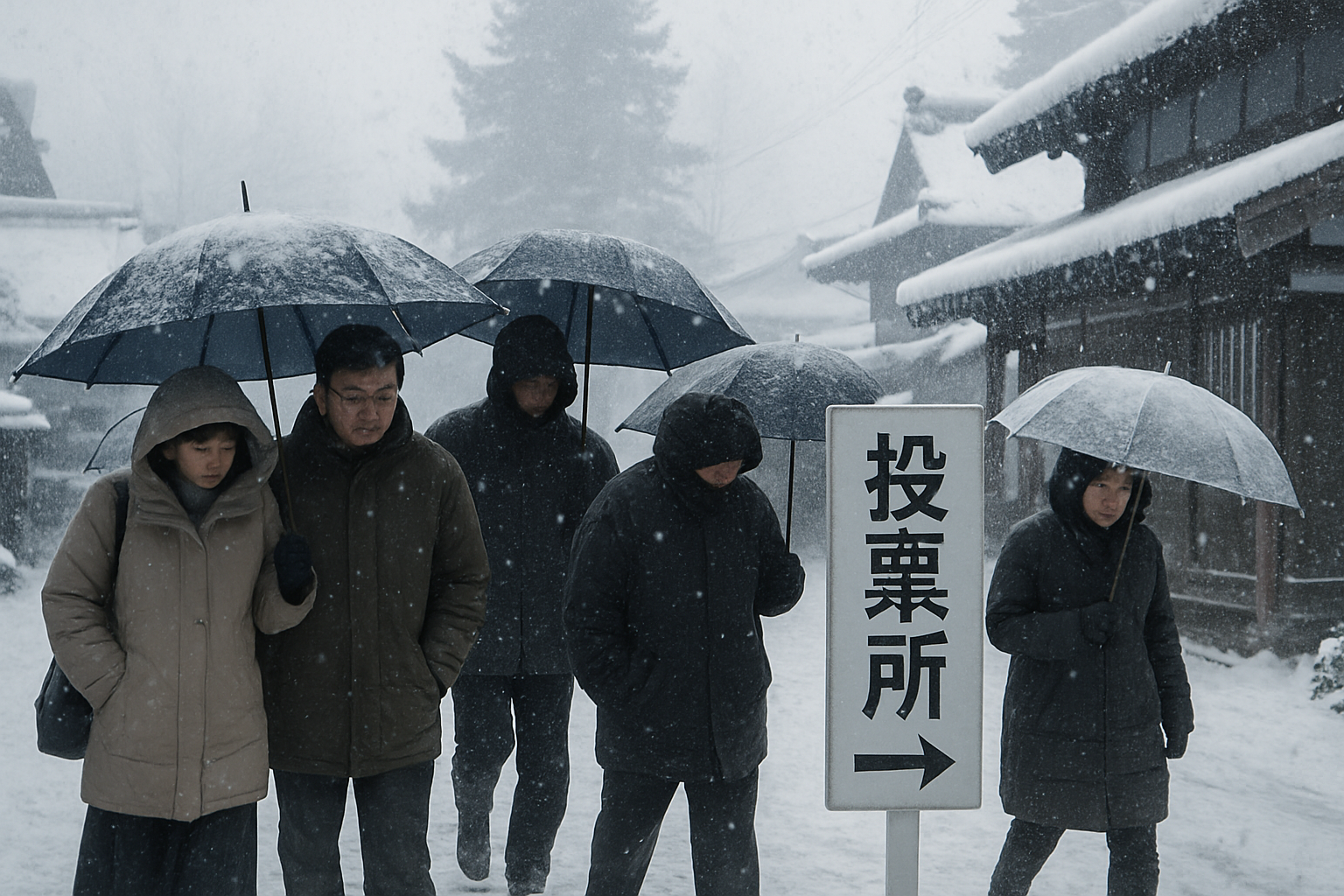
Japanese voters braved record snowfall on Sunday to deliver Prime Minister Sanae Takaichi a decisive victory in snap parliamentary elections, reinforcing her position as Japan's first female leader while demonstrating the resilience of democratic participation despite severe winter weather challenges.
Polling stations across Japan opened at dawn on February 8, 2026, as nearly 1,300 candidates competed for 465 seats in the lower house of parliament. Despite heavy snow that buried parts of central Japan under more than 2 meters of accumulation, voters trudged through harsh conditions to cast their ballots in what became a defining moment for Japanese democracy.
Election Results and Turnout Challenges
The conservative coalition led by Takaichi's Liberal Democratic Party (LDP) was projected to win approximately 300 of the 465 parliamentary seats, according to multiple opinion polls conducted throughout the campaign. This represents a significant gain from the 233 seats the party was defending, providing Takaichi with a commanding mandate for her conservative political agenda.
However, the extreme weather conditions took a toll on voter participation. By 11:00 AM local time (02:00 GMT), only 7.17% of the electorate had voted—3.26 percentage points lower than the same time during the previous election in 2024. The unprecedented snow accumulation, particularly along the Sea of Japan coast, created transportation disruptions and safety concerns that likely deterred some voters from reaching polling stations.
In the central prefecture of Niigata, where snow piled up more than 2 meters in some areas, 54-year-old teacher Kazushige Cho expressed his determination to support Takaichi despite the challenging conditions. "She's shown strong leadership and pushes various policies forward," he said outside a local polling station. "I think things could turn out quite well."
Historic Winter Election Context
This marked the first time in 36 years that Japan held parliamentary elections during winter, a strategic decision by Takaichi to capitalize on her popularity as the nation's first female prime minister. The 64-year-old leader, who became prime minister in October after being selected as LDP leader, called the snap election as a calculated move to secure a stronger parliamentary majority before potential challenges could emerge.
The election took place amid Japan's worst winter storm crisis in decades, which has claimed at least 35 lives since late January. The severe weather conditions created an additional layer of complexity for electoral logistics, with some polling stations experiencing power outages and transportation networks severely disrupted across northern prefectures.
Aomori city recorded snow depths of 1.8 meters—the highest since 1945—while other areas along the Sea of Japan coast experienced similar record-breaking accumulations. The Self-Defense Forces were deployed for emergency operations, and thousands of snow plows worked around the clock to keep essential routes open for voters.
Key Campaign Issues and Voter Concerns
Throughout the campaign, inflation emerged as the dominant concern for Japanese voters, with polling data showing 54% citing rising prices as their primary worry. Soaring food bills and household expenses that failed to keep pace with wage growth created significant electoral pressure for the ruling party.
Japan's household food spending reached a 44-year high, with average monthly expenditures of ¥314,001 representing a 4.6% nominal increase. This economic strain became a central theme of opposition campaigns, though Takaichi's promises of economic growth and enhanced security ultimately resonated with voters seeking stability amid global uncertainties.
The campaign also highlighted Japan's demographic challenges, with the country recording its lowest birth rate in history for 2024—the ninth consecutive year of decline. With approximately 30% of the population over 65, making Japan the world's most aged society, questions about long-term economic sustainability and social security dominated policy debates.
International Implications and Endorsements
The election gained international attention when U.S. President Donald Trump broke diplomatic tradition by providing an unprecedented endorsement of Takaichi during the active campaign period. Trump's support, along with announced plans for a March 19 summit, signaled strengthened U.S.-Japan ties and complicated China's regional strategic objectives.
This international backing came amid heightened tensions in the Asia-Pacific region, where Chinese military aircraft activity around Taiwan increased 23% in 2025, representing sustained pressure campaigns that directly impact Japanese security considerations. Takaichi's previous remarks on Taiwan had prompted China to convene meetings with Southeast Asian ambassadors in late 2025, though these efforts gained little regional traction.
The election results will influence Japan's role in the Quad partnership and broader Indo-Pacific security cooperation, particularly as regional powers navigate increasing great power competition between the United States and China.
Technology and Democratic Challenges
The 2026 election faced unprecedented challenges from AI-generated disinformation campaigns, with generative artificial intelligence creating fabricated political content "in seconds"—including fake party logos, candidate imagery, and false testimonials. Digital platforms implemented enhanced fact-checking measures and educational initiatives, particularly targeting young voters to identify AI manipulation tactics.
Despite these technological disruptions, the democratic process proved resilient, with traditional campaigning methods and direct voter engagement ultimately determining the outcome. The successful conduct of elections during both a natural disaster and information warfare demonstrated the strength of Japan's democratic institutions.
Economic and Strategic Outlook
Takaichi's victory provides her with the political capital necessary to implement comprehensive economic reforms and address Japan's structural challenges. Her administration faces the dual task of managing immediate economic pressures while positioning Japan for long-term competitiveness in critical minerals and advanced manufacturing sectors.
The timing coincides with Japan's breakthrough achievement in deep-sea rare earth mining at Minamitorishima, where concentrations up to 20 times higher than terrestrial mines could reduce dependence on Chinese supply chains. This technological advancement aligns with broader Japanese strategies for economic security and resource independence.
Infrastructure investments in thermal power facilities and strategic partnerships with the United States represent additional pillars of Japan's economic recovery strategy, though these commitments must be balanced against domestic spending pressures from record food costs and social security demands.
Regional Democratic Precedent
The successful completion of Japan's winter election provides a significant precedent for democratic resilience in the Asia-Pacific region, occurring alongside other major electoral processes in Thailand and Bangladesh. The peaceful transfer of democratic mandate amid natural disasters, technological challenges, and international pressures reinforces Japan's role as a stable democratic anchor in an increasingly volatile region.
As Asia-Pacific nations navigate complex geopolitical pressures and domestic challenges, Japan's democratic example demonstrates that constitutional governance can adapt to emerging threats while maintaining legitimacy and public support. The election outcome establishes Takaichi as a significant figure in regional leadership, particularly as the first female prime minister to achieve electoral success in her own right.
With polls officially closed at 8:00 PM local time (11:00 GMT) on Sunday, the results confirmed pre-election predictions of a substantial LDP victory, providing Takaichi with both the domestic mandate and international credibility necessary to lead Japan through an increasingly complex global environment. The winter election of 2026 will be remembered as a testament to Japanese democratic traditions and the determination of citizens to participate in governance despite extraordinary challenges.