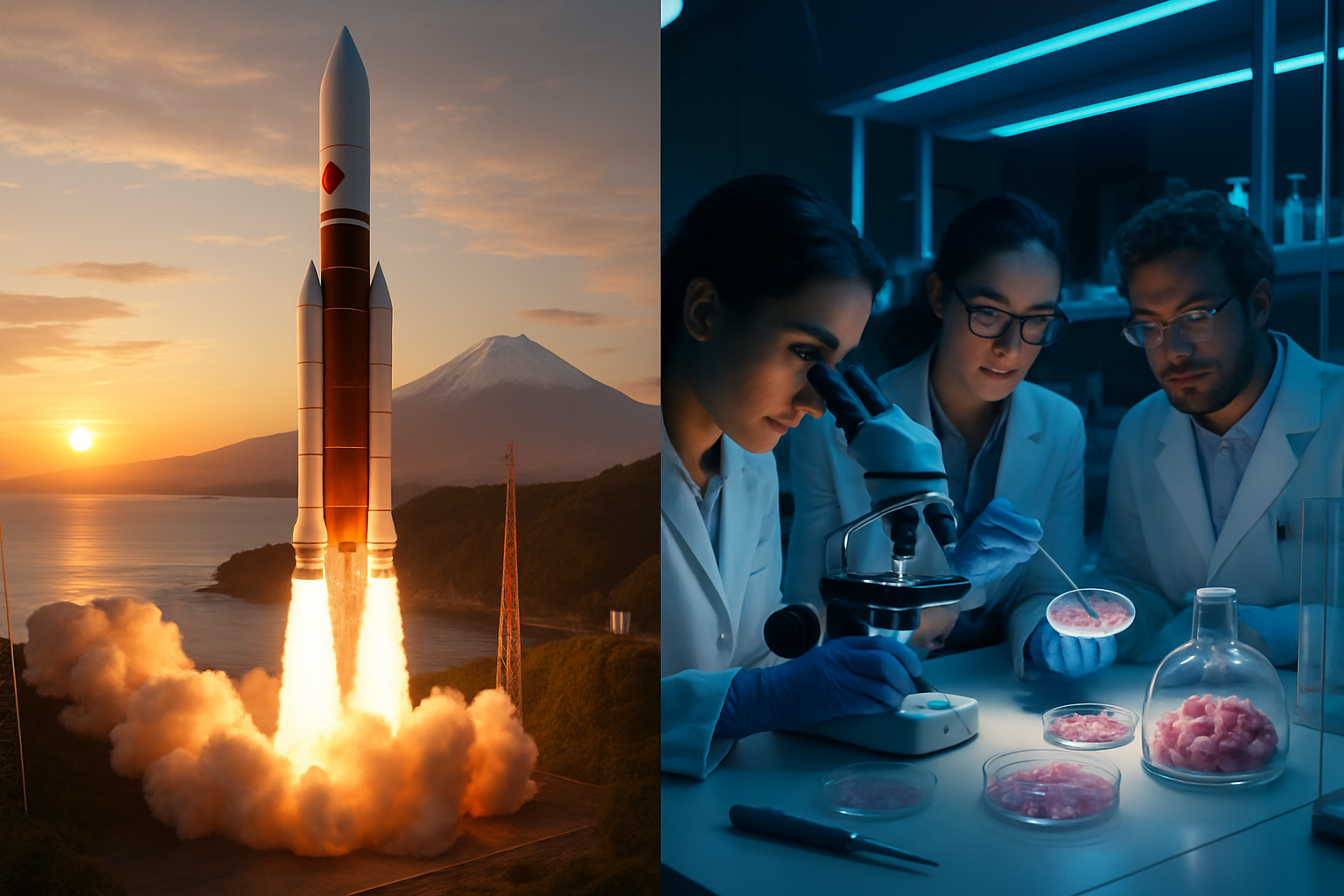
Japan is positioning itself at the forefront of global scientific innovation with simultaneous breakthroughs in space technology and biotechnology, as Space One prepares for its ambitious Kairos No. 3 rocket launch while researchers achieve a world-first in creating testicular organoids in laboratory conditions.
These developments underscore Japan's strategic commitment to advanced scientific research during what experts are calling the transition from the "AI revolution to the space economy golden age," a period marked by unprecedented technological convergence and international competition in high-value research sectors.
Space One's Kairos Mission: Japan's Commercial Space Ambitions
Space One, Japan's pioneering private space company, is scheduled to launch its Kairos No. 3 rocket this Sunday from the company's Spaceport Kii launch site in Kushimoto, Wakayama Prefecture. The launch window opens between 11:00 AM and 11:20 AM local time, representing a critical milestone for Japan's growing commercial space sector.
The Kairos rocket program embodies Japan's strategic shift toward private-sector space capabilities, complementing the nation's established government space programs. This launch comes amid a global surge in commercial space activity, with companies worldwide racing to establish cost-effective launch capabilities for the burgeoning small satellite market.
The timing is particularly significant given the broader context of international space developments. NASA continues to face delays with its Artemis II mission due to persistent hydrogen leak issues, while SpaceX prepares for a potential trillion-dollar IPO in June 2026. China has successfully launched its fourth Shenlong reusable spacecraft, and Pakistan has selected astronaut candidates for China's Tiangong space station mission scheduled for October-November 2026.
Biotechnology Breakthrough: World-First Testicular Organoids
In a parallel scientific achievement, Japanese researchers have successfully created testicular organoids in vitro, marking the first time scientists have replicated this complex reproductive tissue in laboratory conditions. This groundbreaking work builds upon the same research team's 2021 success in creating ovarian organoids from mouse embryonic stem cells.
The development of testicular organoids represents a significant advance in reproductive medicine and developmental biology research. These three-dimensional tissue structures, grown from stem cells, can mimic the architecture and function of actual testicular tissue, providing unprecedented opportunities for studying male reproductive development, fertility treatments, and potential therapeutic applications.
This achievement positions Japan as a global leader in organoid technology, a rapidly advancing field that promises revolutionary applications in drug testing, disease modeling, and regenerative medicine. The research comes as Japan becomes the first country to approve medical products using induced pluripotent stem (iPS) cells, including ReHeart for severe heart failure and Amchepry for Parkinson's disease, establishing the nation as a pioneer in what medical experts are calling the "Therapeutic Revolution of 2026."
Strategic Context: Japan's Scientific Leadership During Global Transformation
These simultaneous breakthroughs occur during a pivotal period in global scientific development. The space economy is experiencing unprecedented growth, with industry valuations reaching unprecedented levels. SpaceX's potential trillion-dollar valuation reflects the sector's transformation from experimental endeavors to essential infrastructure supporting modern civilization.
Japan's dual achievements in space technology and biotechnology demonstrate a sophisticated approach to technological sovereignty, investing in both established high-value sectors and emerging frontiers. This strategy mirrors broader international trends, where nations are pursuing technological independence while maintaining strategic cooperation in critical research areas.
The global memory crisis, with semiconductor prices increasing sixfold, has created new urgency around technological self-reliance. Countries are reassessing supply chain dependencies and investing heavily in domestic capabilities across multiple technology sectors. Japan's advances in both space launch capabilities and biotechnology research provide strategic advantages in this evolving landscape.
International Cooperation and Competition
While Japan advances its domestic capabilities, international cooperation continues to drive major scientific achievements. The International Space Station recently restored full operational capacity with the successful Crew-12 mission, featuring French astronaut Sophie Adenot conducting critical research on lung tissue cultivation and Space-Associated Neuro-Ocular Syndrome (SANS) studies essential for future lunar settlements and Mars exploration.
These international collaborations provide valuable precedents for Japan's expanding space program. As commercial space capabilities mature, countries are finding opportunities to participate in major missions through specialized contributions rather than massive independent infrastructure investments.
The biotechnology sector similarly benefits from international knowledge sharing, with Japanese organoid research building upon decades of global stem cell research while contributing unique innovations that advance the entire field. The approval of iPS cell therapies in Japan provides real-world validation that could accelerate similar approvals worldwide.
Economic and Strategic Implications
Japan's scientific advances carry significant economic implications beyond immediate research applications. The commercial space sector represents opportunities for high-value employment, technology exports, and strategic positioning in emerging markets including space-based data centers and satellite services.
Similarly, biotechnology innovations offer substantial economic returns through pharmaceutical applications, medical device development, and therapeutic services. The organoid technology could revolutionize drug testing processes, reducing development costs and accelerating the introduction of new treatments.
These developments also support Japan's broader technological ecosystem, creating synergies between different research sectors. Advanced materials developed for space applications can benefit biotechnology research, while biotechnology advances in tissue engineering could inform life support systems for extended space missions.
Future Implications and Research Trajectories
The convergence of space technology and biotechnology advances positions Japan strategically for future scientific breakthroughs. Space-based research platforms could provide unique environments for biotechnology experiments, while biotechnology advances could inform medical protocols for long-duration space missions to the Moon and Mars.
Japan's systematic approach to scientific investment, combining government research support with private sector innovation, provides a model for sustaining technological leadership during periods of rapid global change. The nation's emphasis on fundamental research while maintaining practical applications creates a balanced portfolio supporting both immediate economic benefits and long-term scientific advancement.
As humanity prepares for expanded space exploration and advanced biotechnology applications, Japan's dual achievements demonstrate the importance of maintaining excellence across multiple scientific disciplines. The nation's continued investment in both space technology and biotechnology research positions it to contribute significantly to humanity's technological future while securing strategic advantages in high-value economic sectors.
These developments suggest that February 2026 may be remembered as a watershed moment when Japan's scientific capabilities reached new levels of sophistication and international recognition, establishing the foundation for decades of continued leadership in critical technology sectors that will define the next phase of human advancement.