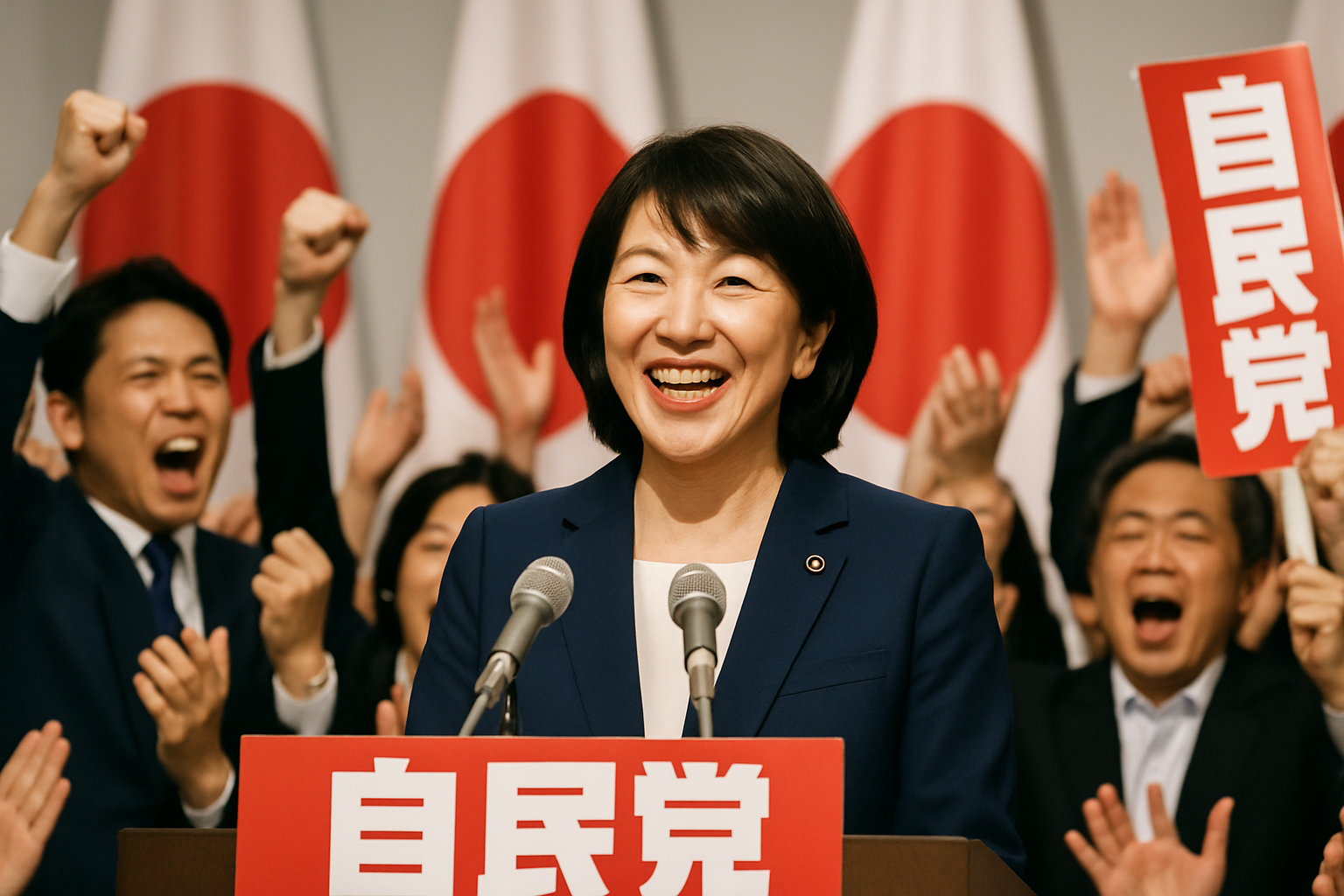
Japanese Prime Minister Sanae Takaichi's Liberal Democratic Party (LDP) achieved a commanding landslide victory in Sunday's snap parliamentary elections, securing over 300 of the 465 lower house seats and providing Japan's first female prime minister with an unprecedented mandate for her conservative agenda.
The decisive victory, confirmed through exit polls and ballot counting on February 8, 2026, represents one of the most significant electoral triumphs in recent Japanese political history. The LDP alone secured 316 seats according to NHK projections, far exceeding the 233 seats needed for a simple majority and marking the party's best performance since 2017 under Takaichi's mentor, the late Shinzo Abe.
Combined with their coalition partner, the Japan Innovation Party (Nippon Ishin), Takaichi's coalition now commands a two-thirds supermajority, enabling them to override the upper chamber and pursue constitutional reforms that have long been on the conservative agenda.
Historic Victory Against the Odds
The election took place under extraordinary circumstances, with Japan experiencing its worst winter storm crisis in decades. Heavy snowfall of over 2 meters in some regions, particularly affecting Niigata, Akita, and Aomori prefectures, led to 35+ deaths since late January and prompted the deployment of Self-Defense Forces for emergency operations.
Despite these challenging conditions - marking the first winter parliamentary election in 36 years - Japanese voters turned out in sufficient numbers to deliver a clear mandate. The severe weather initially depressed turnout, with only 7.17% participation recorded by 11:00 AM, significantly lower than the 2024 comparative figure of 10.43%.
Takaichi had staked her political future on this snap election, promising to resign if her party failed to secure a majority. The gamble has paid off spectacularly, transforming what many viewed as a risky political maneuver into a stunning vindication of her leadership.
Opposition Collapse and Coalition Success
The election dealt a crushing blow to the Centrist Reform Alliance, formed in January 2026 from the merger of the Constitutional Democratic Party and Komeito. Exit polls confirmed voter rejection of the opposition's alternative vision, with the alliance suffering significant seat losses despite attempts to present a unified challenge to LDP dominance.
International observers, including a Japanese Election Observer Mission led by Watanabe Masato, confirmed the election's fairness and legitimacy. The presence of international oversight underscored the global significance of maintaining democratic standards in Japan, particularly given the country's role as a stable democratic anchor in the Asia-Pacific region.
Economic Mandates and Policy Implications
Central to Takaichi's victory was her campaign's focus on economic revitalization amid widespread voter concern about inflation. Polling consistently showed 54% of voters cited rising prices as their primary concern, with household food spending reaching a 44-year high of ¥314,001 monthly (a 4.6% increase).
Takaichi's promises of tax cuts and economic growth resonated with voters struggling with cost-of-living pressures. However, these same tax reduction pledges have spooked financial markets, which view them as potentially inflationary and fiscally irresponsible. The new supermajority gives Takaichi the legislative power to implement these controversial policies despite market skepticism.
The victory also positions Japan to pursue enhanced military spending aimed at countering China's growing regional assertiveness. Chinese military aircraft activity around Taiwan increased 23% in 2025, with daily deployments representing a sustained pressure campaign that has heightened security concerns throughout the Indo-Pacific.
International Reactions and Strategic Implications
The election results have drawn significant international attention, particularly from the United States. U.S. Treasury Secretary Scott Bessent congratulated Takaichi on her "great victory," highlighting the importance of the U.S.-Japan alliance in regional security.
President Donald Trump's unprecedented endorsement of Takaichi during the campaign - breaking traditional diplomatic protocol by supporting an allied leader during active elections - appears to have been vindicated by the results. Trump had announced plans for a March 19 summit with Takaichi, signaling the strategic importance Washington places on strengthened bilateral ties.
In Taiwan, officials welcomed the results as potentially stabilizing regional dynamics, though they remain cautious about China's continued military pressure. Taiwan's representative to Japan, Li Yiyang, noted that the election outcome "demonstrates Japan's strong consensus supporting Takaichi" and predicted that Taiwan-Japan relations would "continue to heat up" under her strengthened leadership.
Technological Challenges and Democratic Resilience
The election faced unprecedented challenges from AI-generated disinformation campaigns using generative artificial intelligence to create fabricated political content within seconds. Fake party logos, candidate imagery, and false testimonials spread across social media platforms, representing the most sophisticated technological threat to democratic processes in Japanese history.
Digital platforms implemented enhanced fact-checking measures and educational initiatives targeting young voters to identify AI manipulation. The successful conduct of the election despite these technological challenges demonstrates democratic institutions' resilience against emerging threats to electoral integrity.
Climate and Democratic Adaptation
The election's successful completion during Japan's worst winter storm crisis provides a template for climate-democracy intersection challenges. With January 2026 being the hottest month globally recorded (marking 18 out of 19 months exceeding 1.5°C above pre-industrial levels), the juxtaposition of extreme regional cold with global warming patterns highlights climate volatility's potential to disrupt democratic processes.
Emergency services operated at capacity limits, with Sapporo deploying over 1,000 snow plows to clear 3,800 kilometers of roads. Despite widespread infrastructure disruption, including power outages affecting hundreds of thousands and transportation cancellations throughout the Tohoku and Hokuriku regions, democratic institutions maintained functionality.
Historical Significance and Future Trajectory
Takaichi's victory represents a historic milestone as Japan's first female prime minister to achieve electoral success in her own right. Her leadership during this challenging period - including multiple emergency cabinet meetings to address the winter crisis while campaigning - has established her as a significant regional leader.
The supermajority provides Takaichi with unprecedented legislative power to pursue constitutional reforms that previous LDP leaders could only dream of implementing. This includes potential changes to Japan's pacifist constitution, enhanced defense capabilities, and structural economic reforms addressing the country's demographic challenges.
The election's success amid natural disasters, technological disruption, and international pressures reinforces Japan's role as a stable democratic anchor in an increasingly volatile region. As great power competition intensifies between the United States and China, Japan's democratic stability and enhanced political mandate position it as a crucial ally in maintaining regional balance.
Looking Ahead: Policy Implementation and Regional Impact
With official results expected Monday, Takaichi's victory sets the stage for significant policy implementation in the coming months. The March 19 summit with President Trump will likely focus on enhanced defense cooperation, trade relationships, and coordinated responses to Chinese regional assertiveness.
The election's outcome also influences broader Asian democratic development patterns. Success in conducting free and fair elections despite extreme weather and technological challenges provides encouragement for other democratic institutions facing similar pressures throughout the Asia-Pacific region.
As Japan enters this new political era under strengthened conservative leadership, the international community will watch closely how Takaichi utilizes her historic mandate. The balance between economic nationalism, regional security cooperation, and democratic governance will shape not only Japan's future but also serve as a model for other democracies navigating 21st-century challenges.
The winter election of 2026 will be remembered as a defining moment in Japanese political history - demonstrating democratic resilience, validating female political leadership, and providing a conservative mandate that could reshape Japan's role in the global order for years to come.