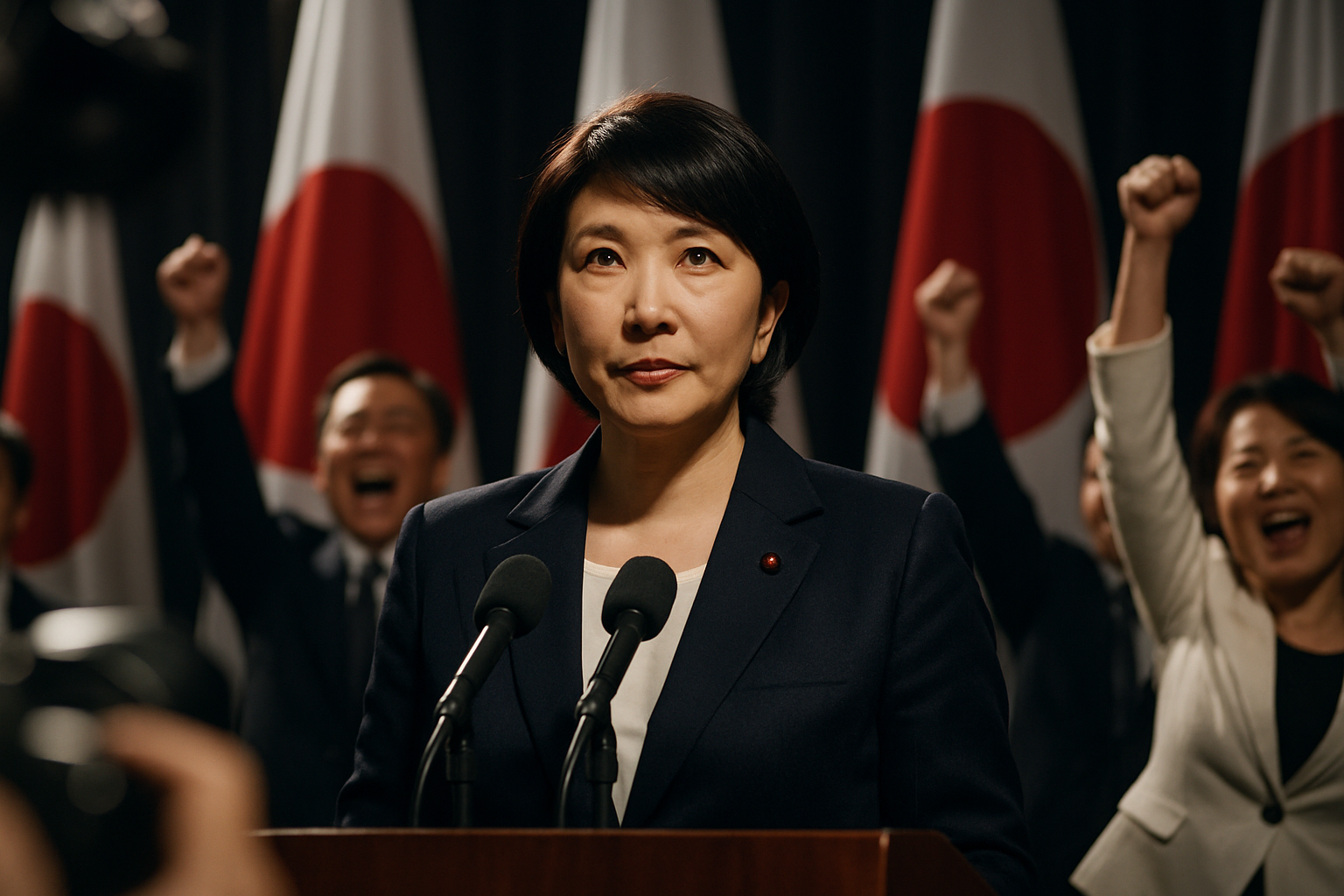
Prime Minister Sanae Takaichi's Liberal Democratic Party has achieved the most decisive electoral victory in modern Japanese democratic history, securing 316 of 465 lower house seats in Sunday's snap election and cementing her position as Japan's first female Prime Minister to win an election in her own right.
The landslide victory, conducted amid Japan's worst winter storm in decades, represents a historic political milestone and signals a potential conservative turn in Japanese politics. Takaichi, dubbed the "Iron Maiden" for her heavy metal passion and compared to Margaret Thatcher for her political style, now commands unprecedented parliamentary authority to pursue her ambitious agenda.
Unprecedented Electoral Triumph
The LDP's victory margin exceeded all expectations, with the party gaining 83 additional seats from their previous 233. Combined with coalition partner Japan Innovation Party's 36 seats, Takaichi's governing alliance now controls 352 seats—a commanding two-thirds supermajority that opens the door to constitutional reforms.
"With her party's thumping victory in Sunday's snap election, Takaichi has the parliamentary weight to steer her country, and Japan's neighbours will be monitoring the direction," noted international observers. The 64-year-old leader transformed what began as a risky political gamble into a historic mandate.
"This landslide win gives the 64-year old admirer of late British maverick prime minister Margaret Thatcher enough leeway to reform the constitution and break with eight decades of pacifism."
— Political Analyst
Election Conducted Under Extreme Conditions
The election's success despite severe weather challenges demonstrated Japan's democratic resilience. Heavy snowfall exceeding two meters buried parts of central Japan, while emergency services deployed 26,500 personnel—the largest peacetime rescue operation in Japanese history. Over 35 deaths were attributed to the winter storm crisis since late January.
Despite the challenging conditions marking the first winter parliamentary election in 36 years, Japanese voters demonstrated remarkable determination. Initial low turnout concerns were overcome as citizens prioritized their democratic participation, with the election ultimately proceeding smoothly across the nation's electoral infrastructure.
Economic Mandate and Voter Concerns
Takaichi's victory was built on addressing pressing economic concerns, with 54% of voters citing inflation as their primary worry. Household food spending reached a 44-year high of ¥314,001 monthly—a 4.6% increase that created significant financial strain for ordinary Japanese families.
The Prime Minister's promises of tax cuts and economic revitalization resonated with voters experiencing cost-of-living pressures, despite initial skepticism from financial markets. Her campaign effectively became a referendum on economic leadership, with voters endorsing her vision of making Japan "more prosperous and safer."
Opposition Collapse
The election witnessed a complete collapse of opposition forces, particularly the newly-formed Centrist Reform Alliance—a January 2026 merger of the Constitutional Democratic Party and Komeito. This crushing defeat eliminated the complex coalition negotiations that have historically complicated Japanese governance, providing Takaichi with unprecedented political stability.
International Implications and China Relations
The victory carries significant international weight, particularly regarding Japan's relationship with China and the broader Asia-Pacific region. China's attempt to rally Southeast Asian support against Japan following Takaichi's November Taiwan remarks gained little regional traction, with ASEAN countries preferring multilateral approaches to great power competition.
Adding to the international dimension, US President Trump provided an unprecedented campaign endorsement—breaking diplomatic tradition—and announced plans for a March 19 summit. This strengthening of US-Japan ties complicates China's regional objectives, particularly as Chinese military activity around Taiwan increased 23% in 2025.
Constitutional Reform Potential
Perhaps most significantly, the two-thirds supermajority opens the door to Japan's first constitutional amendments since 1947. This unprecedented legislative power could enable modifications to Article 9—Japan's pacifist constitution—and allow for enhanced defense capabilities to address regional security challenges.
Takaichi has long advocated for constitutional revisions and now possesses the parliamentary authority to pursue them. The implications extend beyond domestic politics to Japan's role in regional security cooperation and its ability to address the changing strategic landscape in the Indo-Pacific.
Demographic and Technological Challenges
The election occurred amid Japan's ongoing demographic crisis, with 2024 recording the lowest birth rate in history and 30% of the population over 65, making it the world's most aged society. Takaichi's victory provides political cover to address these fundamental challenges through comprehensive policy reforms.
The campaign also faced unprecedented technological disruption through AI-generated disinformation campaigns creating fake political content within seconds. However, enhanced fact-checking and youth voter education successfully countered these threats, demonstrating democratic resilience against technological manipulation.
Regional Security Implications
With Japan positioned as a democratic anchor in the Asia-Pacific region, Takaichi's victory strengthens the foundation for enhanced regional security cooperation. The result provides encouragement for democratic institutions across Southeast Asia while demonstrating that electoral integrity can be maintained despite extreme weather and technological challenges.
Looking Forward: Policy Implementation
The elimination of opposition influence enables long-term conservative agenda implementation across multiple areas. Key priorities include enhanced military spending for China deterrence, tax reductions to address economic pressures, and structural reforms to tackle demographic challenges.
The March 2026 US-Japan summit will likely focus on defense cooperation, trade relationships, and coordinated responses to China's regional assertiveness. Takaichi's mandate provides the domestic political foundation necessary for substantial policy commitments in these areas.
"Japan's first female Prime Minister brought the ruling Liberal Democratic Party its biggest-ever electoral victory, fueling her ambitions to pursue a political agenda which she says could 'split public opinion.'"
— International Media Analysis
Historical Significance
Beyond the immediate political implications, Takaichi's victory represents a significant milestone for female political leadership in Asia. As Japan's first female Prime Minister to achieve electoral success in her own right, she has shattered traditional assumptions about political leadership in one of the region's most influential democracies.
Her political journey—from heavy metal drummer to Margaret Thatcher admirer to Prime Minister—embodies a unique path to power that validates diverse representation in democratic governance. The success occurred during a period of substantial global democratic challenges, making the precedent particularly meaningful.
The election's success amid multiple simultaneous pressures—extreme weather, technological disruption, international tensions, and economic uncertainty—provides a template for democratic resilience that extends far beyond Japan's borders. As traditional democratic institutions face mounting challenges worldwide, Japan's electoral integrity under extreme conditions offers both inspiration and practical lessons for constitutional democracies globally.
With her historic mandate secured, Prime Minister Takaichi now faces the complex task of translating unprecedented political authority into effective governance that addresses citizens' needs while maintaining Japan's democratic institutions and international partnerships. The world watches as Japan's "Iron Maiden" begins to reshape one of Asia's most important democracies.