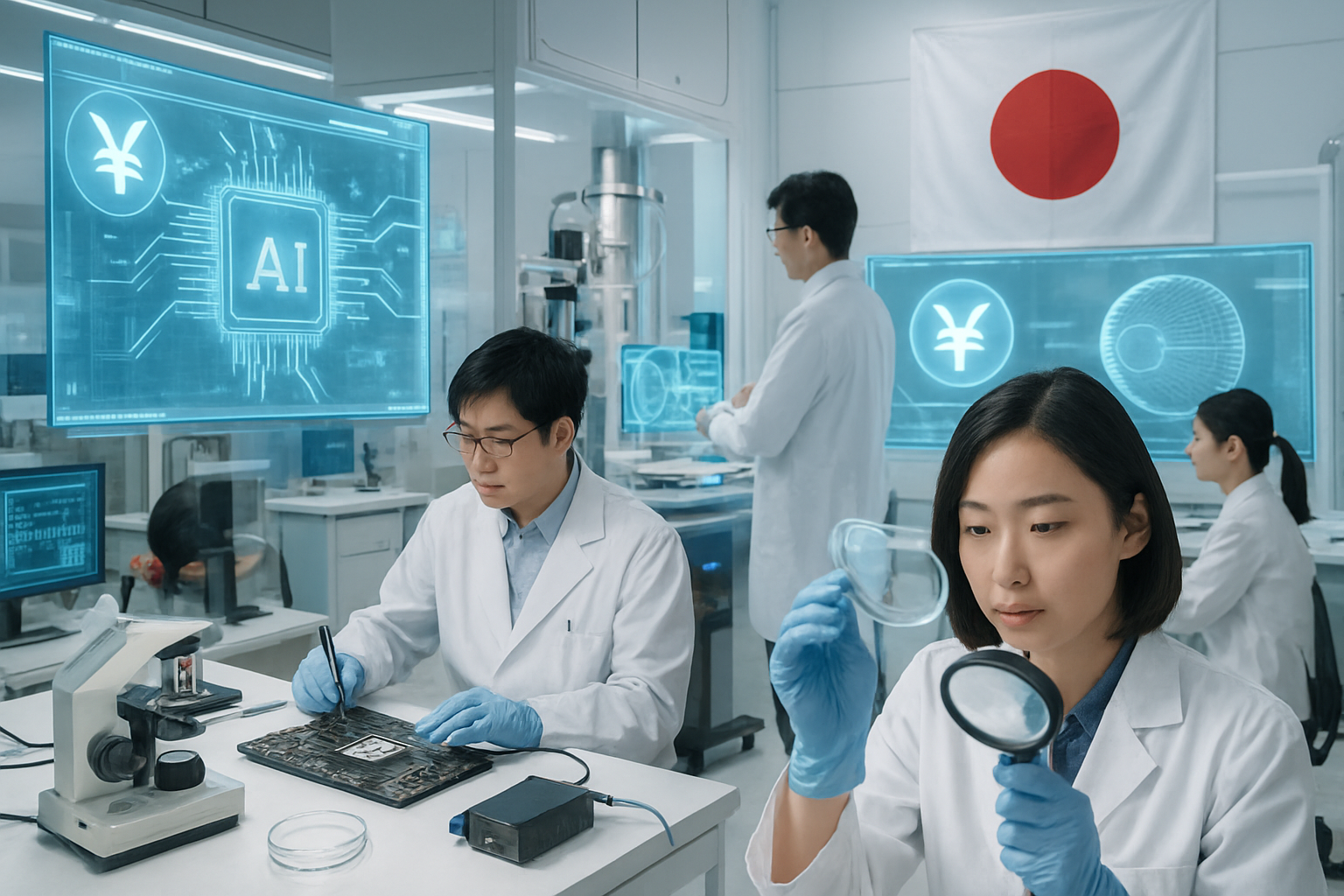
Japan has announced unprecedented technology investments totaling ¥632 billion ($4.2 billion) to propel the startup Rapidus into AI chip production, while simultaneously advancing smart contact lens technology for practical use by 2030, marking a decisive shift in the nation's strategy to compete in the global technology race.
The massive financial commitment represents Japan's most ambitious technology investment in decades, coming at a critical juncture when global artificial intelligence infrastructure demand is driving unprecedented competition for semiconductor manufacturing capabilities. The dual-pronged approach targeting both AI processing power and next-generation wearable technology positions Japan to challenge established tech powers while addressing its domestic "4-2-1 demographic problem" where single children support aging parents and grandparents.
Rapidus AI Chip Venture: A Strategic Gamble
The ¥632 billion investment in Rapidus represents what industry analysts describe as "ramping up financial support for a signature project widely regarded as a long shot." The startup, founded to challenge Taiwan's TSMC and South Korea's Samsung in advanced semiconductor manufacturing, faces the enormous challenge of entering a market dominated by established players with decades of experience and massive existing infrastructure.
This investment comes during a global semiconductor crisis that has driven memory chip prices sixfold higher, affecting major manufacturers including Samsung, SK Hynix, and Micron. The shortage, expected to persist until 2027 when new fabrication facilities come online, creates both challenges and opportunities for new entrants like Rapidus.
"This represents Japan's determination to reclaim technological sovereignty in the semiconductor sector, essential for national security and economic competitiveness in the AI age."
— Industry Analysis, Technology Policy Institute
The timing coincides with Alphabet's $185 billion AI infrastructure commitment for 2026—the largest single-year corporate technology investment in history—and Amazon's trillion-dollar development plans. These massive investments by tech giants underscore the strategic importance of AI processing capabilities and Japan's recognition that semiconductor independence is crucial for future technological sovereignty.
Smart Contact Lens Innovation: Vision for 2030
Parallel to the Rapidus investment, Japan is advancing smart contact lens technology that began overseas development around 2008. Currently, only contact lenses that measure intraocular pressure are available globally, representing a tiny fraction of the technology's potential applications.
Japanese researchers are targeting practical implementation by 2030, focusing on applications that could revolutionize healthcare monitoring, augmented reality interfaces, and assistive technologies. The development aligns with Japan's broader strategy to address aging population challenges through innovative technology solutions.
The smart contact lens initiative represents a convergence of Japan's strengths in precision manufacturing, materials science, and miniaturization technologies. Unlike purely digital solutions, these devices require sophisticated biocompatible materials and microscopic electronic components—areas where Japanese companies have traditional competitive advantages.
Global Technology Competition Context
Japan's massive technology investments occur within intensifying global competition for AI dominance. Microsoft announced a $10 billion investment in Japan's AI infrastructure and cyber defense capabilities, while Chinese companies like Unitree Robotics are scaling humanoid robot production from 5,500 to 20,000+ units annually.
The global context reveals a "March 2026 Critical Inflection Point" where AI transitions from experimental to essential business infrastructure. Countries implementing comprehensive strategies—combining infrastructure investment, educational reform, and worker retraining—demonstrate greater resilience in this transformation.

China maintains strategic advantages through controlling 60% of critical materials production and 90% of refining capacity for lithium, cobalt, and rare earth elements essential for advanced technology. The US-EU-Japan Critical Minerals Partnership, involving 55 countries and seven African suppliers, represents coordinated efforts to diversify these crucial supply chains.
Economic and Strategic Implications
The ¥632 billion Rapidus investment and smart contact lens development represent more than technological ambition—they constitute strategic responses to demographic and economic pressures. Japan's rapidly aging population creates urgent demand for AI and robotic solutions to maintain productivity and economic competitiveness.
Educational initiatives support these investments, with Japan approving 220 textbooks across 11 subjects teaching generative AI aspects, representing systematic national AI literacy curriculum development. This educational foundation aims to create a workforce capable of maximizing advanced technology benefits.
Economic analysis suggests digital infrastructure investments typically generate $3-4 returns per dollar over a decade. Japan's comprehensive approach—combining infrastructure development, education reform, and demographic challenge responses—positions the nation to capture these multiplier effects while maintaining technological independence.
Implementation Challenges and Opportunities
Despite substantial financial commitments, Japan faces significant implementation challenges. The global semiconductor industry requires not only massive capital investment but also specialized expertise, complex supply chains, and years of development before productive output. Rapidus must compete against established manufacturers with proven track records and existing customer relationships.
However, current market constraints create opportunities for innovation. The memory chip shortage is driving development of more efficient algorithms and sustainable deployment strategies, potentially democratizing advanced AI access through reduced hardware requirements. Japan's precision manufacturing heritage and engineering expertise provide competitive advantages in developing these efficient solutions.
"Japan's strategy recognizes that technological sovereignty requires domestic capabilities across the entire value chain, from basic research to commercial production."
— Tokyo Technology Research Institute
The smart contact lens development faces different but equally complex challenges. Regulatory approval for medical devices requires extensive testing and safety validation. However, Japan's aging population provides a natural testing ground for healthcare applications, while the nation's consumer electronics expertise offers pathways for augmented reality implementations.
International Cooperation and Competition
Japan's technology investments occur within complex international cooperation and competition dynamics. The Microsoft partnership demonstrates how Japan balances domestic capability development with strategic international relationships. Similarly, participation in the Critical Minerals Partnership shows recognition that technological independence requires cooperative approaches to supply chain challenges.
The success of human-AI collaboration models worldwide—including Canadian AI teaching assistants maintaining critical thinking, Malaysia's world-first AI-integrated Islamic school, and Singapore's WonderBot 2.0 heritage education—provides templates for Japan's approach emphasizing technology amplification rather than human replacement.
Regional competition intensifies as China advances systematic AI deployment across shipping, manufacturing, and governance sectors while European nations implement sophisticated regulatory frameworks. Japan's strategy combines substantial investment with regulatory clarity and international cooperation to create sustainable competitive advantages.
Future Trajectory and Global Impact
Japan's ¥632 billion technology investment represents a critical test of national strategy in the global AI revolution. Success would demonstrate that targeted investment, regulatory support, and international cooperation can enable technological leapfrogging in critical sectors. Failure could reinforce existing technological dependencies and limit Japan's ability to address demographic challenges through innovation.
The 2030 timeline for smart contact lens practical applications aligns with broader technological transformation cycles. If successful, Japan could establish early leadership in wearable technology integration, creating export opportunities and domestic applications that address aging population challenges.
Global implications extend beyond Japan's borders. Success could inspire similar comprehensive technology strategies in other developed nations facing demographic transitions. The integration of AI chip manufacturing with advanced wearable technology demonstrates how nations can leverage multiple technological competencies to create synergistic advantages.
Industry experts characterize this period as determining whether AI serves human flourishing or becomes an exploitation tool. Japan's approach—emphasizing practical applications for demographic challenges while maintaining international cooperation—offers a template for responsible technological advancement that preserves democratic values while achieving economic competitiveness.
The coming years will reveal whether Japan's massive technology investments successfully position the nation for global leadership in the AI age, or represent costly efforts that fail to overcome entrenched competitive disadvantages in rapidly evolving technological markets.