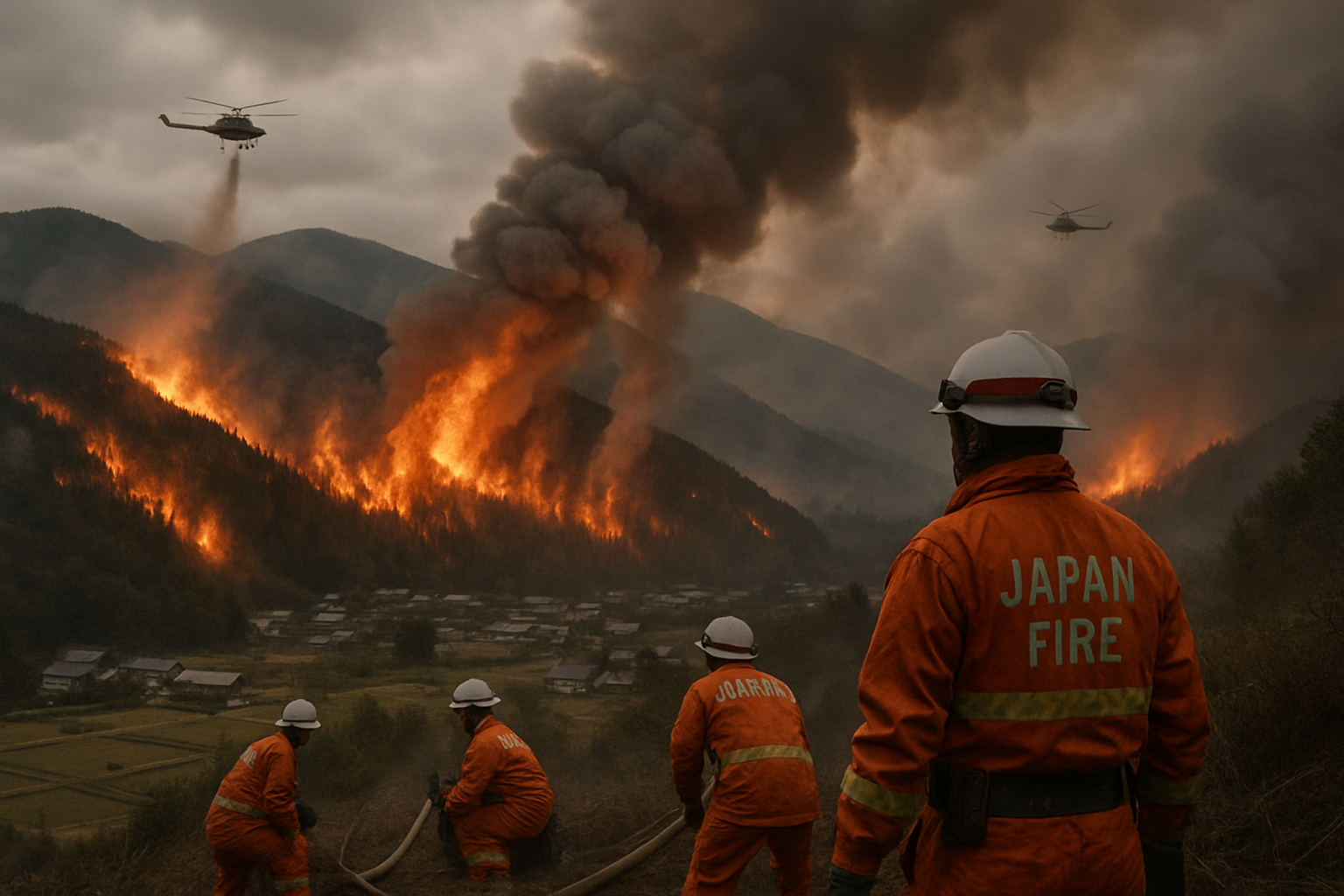
Devastating wildfires in Japan's northern Iwate Prefecture entered their fourth consecutive day Saturday, with over 1,200 firefighters deployed to battle rapidly spreading flames that have burned hundreds of hectares and forced the evacuation of more than 3,200 residents.
The massive blazes, which broke out Wednesday in mountainous regions near residential areas, have created towering smoke columns visible from 30 kilometers away, marking Japan's most severe wildfire emergency of 2026. Two separate fires erupted simultaneously, including one dangerously close to residential areas of Otsuchi, where flames have threatened homes and critical infrastructure.
Emergency Response Overwhelmed
Emergency services report the fires have consumed over 700 hectares of forested mountainous terrain, with the main blaze proving particularly difficult to contain due to strong winds and dry conditions. The scale of the emergency has required deployment of specialized aerial firefighting units alongside hundreds of ground crews working around the clock.
"The situation remains critical," said a spokesperson for the Iwate Prefecture Fire Department. "We have never seen fires of this intensity and scope in our region. The combination of dry conditions and changing weather patterns has created unprecedented challenges for our response teams."
More than 3,200 residents from surrounding communities have been evacuated to emergency shelters as a precautionary measure, with authorities expanding evacuation zones as the fires continued to spread Friday evening. Local officials report that while no fatalities have been confirmed, several firefighters have required medical treatment for smoke inhalation and heat-related conditions.
Climate Crisis Context
The Iwate wildfires occur during what climatologists have identified as the 24th consecutive month of global temperatures exceeding 1.5°C above pre-industrial levels – the longest sustained period of extreme warming in recorded human history. Japan has experienced increasingly severe fire conditions as traditional seasonal patterns become unreliable due to climate change.
"This represents a fundamental shift in how we must approach wildfire preparedness in Japan. The traditional fire season patterns our response systems were designed for no longer apply."
— Dr. Hiroshi Tanaka, Climate Research Institute, Tokyo University
Recent research on North American wildfire patterns shows that "fire-friendly hours" – periods when conditions favor rapid fire spread – have surged dramatically over the past 50 years, with nighttime and morning relief periods traditionally crucial for firefighter operations increasingly shrinking due to climate change.
Compound Disaster Challenges
The Iwate fires exemplify what emergency management experts term "compound disasters" – multiple emergency types occurring simultaneously across vast geographic areas, fundamentally challenging traditional resource allocation and mutual aid mechanisms designed for sequential rather than concurrent crises.
Australian Fire Emergency Services Authority (AFAC) research, which has been studying similar patterns globally, identifies this shift from isolated regional disasters to simultaneous incidents across different specialties as straining emergency response capabilities worldwide.
Traditional mutual aid mechanisms, where stable regions assist areas facing isolated emergencies, are proving inadequate when multiple continents face disasters simultaneously. Emergency services are operating at or beyond capacity limits globally, with transportation, power, and communication systems designed for historical climate patterns repeatedly failing as extreme weather exceeds operational parameters.
Infrastructure and Economic Impact
The economic impact extends beyond immediate firefighting costs to include agricultural losses, tourism disruptions, and long-term infrastructure rebuilding. Recovery timelines have fundamentally shifted from weeks to months or years, representing a permanent change in disaster response approaches.
Local authorities emphasize that "building back better" with climate-resilient infrastructure has evolved from an optional enhancement to an essential survival strategy for communities facing permanent climate volatility.
Mental health services report increased demand for support related to climate anxiety and repeated trauma, as families face the prospect of losing generational properties multiple times within a decade. Vulnerable populations, including elderly residents and those with respiratory conditions, are disproportionately affected by the compound stresses.
International Cooperation and Lessons
The crisis highlights the strain on international cooperation frameworks as environmental challenges transcend boundaries. Atmospheric and ocean systems operate regardless of political borders, making unilateral adaptation efforts insufficient.
Success in managing such crises requires unprecedented international cooperation, enhanced coordination across multiple sectors, and sustained financial commitments recognizing environmental protection as essential infrastructure rather than a regulatory burden.
Technology and Traditional Knowledge Integration
Effective responses demonstrate sophisticated synthesis of cutting-edge technology with traditional ecological knowledge and community-based management. Advanced monitoring through satellite imagery, environmental DNA sampling, and AI analysis provides rapid threat response capabilities, but requires community engagement and local expertise for maximum effectiveness.
Estonia's success with continental Europe's largest battery storage system serving 90,000 households with 88% renewable electricity, and Finland's implementation of "transformative adaptation" approaches for permanent climate volatility, provide templates for scaling adaptation globally.
Critical Action Window
Climate scientists describe April 2026 as a watershed moment requiring a critical choice between reactive crisis management and transformative infrastructure adaptation. Current conditions preview what could become routine in the 2030s without comprehensive climate adaptation investment.
The climate action window is narrowing as ecological systems approach critical thresholds that could trigger irreversible changes to global food security, climate stability, and human settlements. Additional weather systems developing in the Atlantic and Pacific regions suggest this crisis persistence may establish a "new normal" of extreme frequency and intensity, permanently challenging traditional frameworks.
Looking Ahead
The question is no longer whether transformative climate action is needed, but whether humanity can organize and implement solutions rapidly enough to maintain planetary habitability during Earth's most environmentally challenging period in recorded history.
Tools, knowledge, and cooperation frameworks exist for comprehensive environmental protection, but success depends on unprecedented speed of coordination and sustained international cooperation. As the Iwate fires continue to burn, they serve as both a warning and a call to action for the decisive climate action decade ahead.
Environmental protection must be recognized as essential infrastructure for human prosperity and planetary sustainability, requiring the same urgency and resources traditionally reserved for national security emergencies.