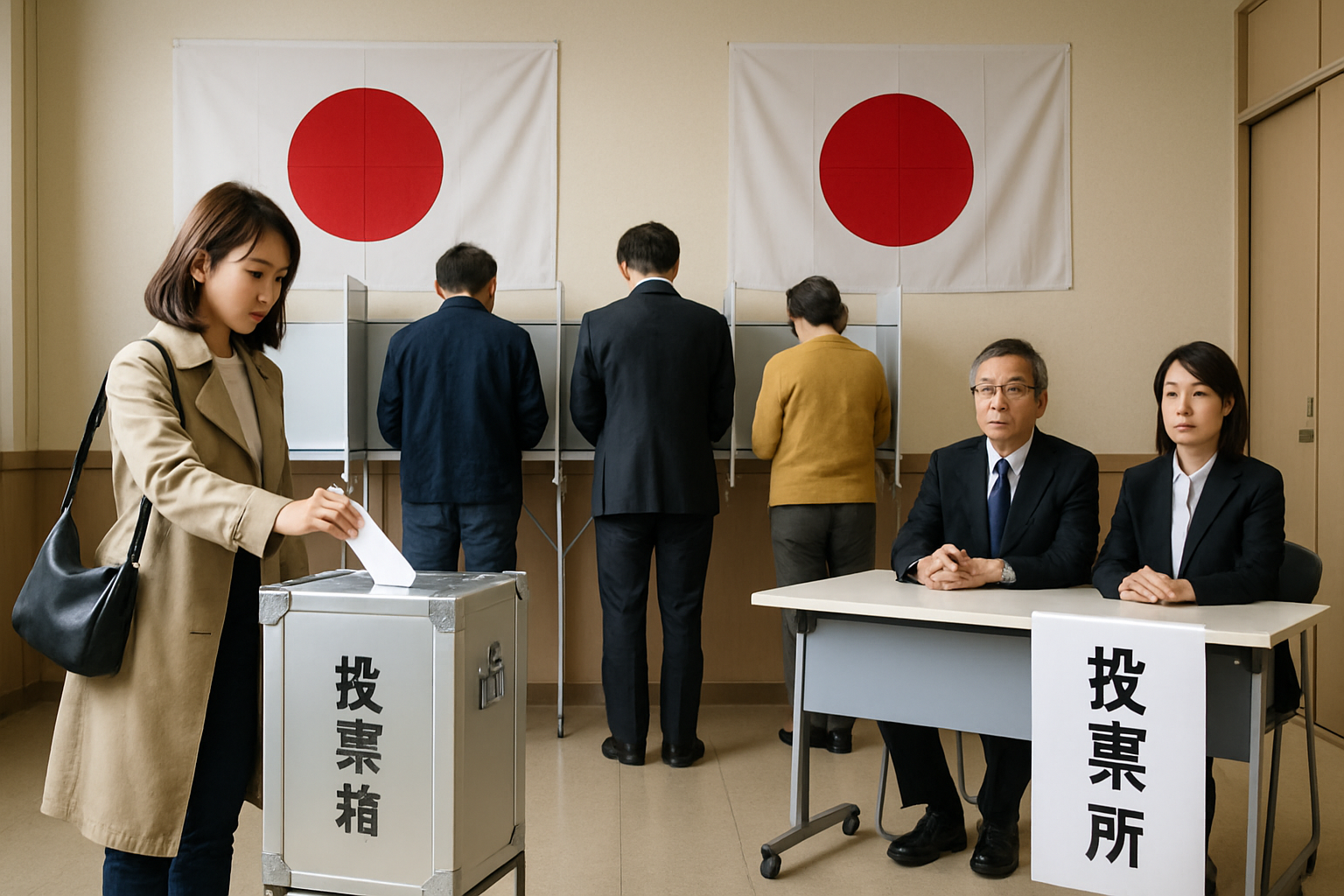
Prime Minister Sanae Takaichi has led Japan's Liberal Democratic Party (LDP) to a decisive victory in Sunday's snap parliamentary elections, securing the mandate she needs to implement her ambitious conservative political agenda as the nation's first female prime minister.
Polls opened across Japan at dawn on February 8, with voting continuing until 8:00 PM local time (11:00 GMT). The election, called by Takaichi in an attempt to strengthen her coalition's majority in the Lower House, represents a critical test of her leadership and Japan's democratic resilience in an era of global uncertainty.
Coalition Strategy Pays Off
The LDP's campaign strategy centered on forming a coalition with the Japan Innovation Party, aiming for what the party described as a "make-or-break" simple majority. According to multiple international news sources, pre-election polling consistently showed Takaichi's party positioned for a substantial victory, with French outlet Le Monde reporting that surveys gave the LDP a commanding lead in the February 8 legislative elections.
Speaking at a rally before thousands of supporters in Tokyo on Saturday, Takaichi promised to make Japan "more prosperous and safer," while committing to achieve economic growth amid persistent inflation concerns that have dominated the campaign discourse.
Inflation Emerges as Key Campaign Issue
The election campaign was significantly shaped by economic concerns, with Nikkei polling revealing that 54% of voters cited inflation as their biggest concern. Soaring food bills have emerged as a major electoral risk, as wages continue to fail to keep pace with rising prices, creating substantial household financial strain across the country.
"The prime minister's ability to address these economic challenges while pursuing her conservative agenda will define her mandate moving forward."
— Political analysts observing the campaign
This economic backdrop provided the context for what observers have described as a referendum on Takaichi's leadership style and policy priorities since taking office as Japan's first female prime minister.
International Dimensions and Trump's Unprecedented Endorsement
The election gained international attention following an unprecedented endorsement from U.S. President Donald Trump, who offered his "total endorsement" of Takaichi ahead of the vote. This breaks conventional diplomatic tradition of avoiding public endorsements during active foreign election campaigns, signaling strengthened U.S.-Japan ties under the new administration.
Trump also announced plans for a March 19 summit with Takaichi, demonstrating sustained high-level engagement between the two allies. This development has complicated China's regional objectives, particularly following Takaichi's controversial November remarks about Taiwan that prompted Beijing to attempt rallying Southeast Asian support against Japan.
Regional Security Context
The election takes place against a backdrop of heightened regional tensions, with Chinese military aircraft activity around Taiwan increasing by 23% in 2025 according to Taiwan's Defense Ministry. Daily Chinese deployments around Taiwan represent the most sustained pressure campaign to date, creating a challenging security environment that has influenced Japanese voters' considerations.
China's effort to rally Southeast Asian nations against Japan following Takaichi's Taiwan statements gained little regional traction, as ASEAN countries increasingly prefer multilateral approaches that balance economic ties with China against security partnerships with Japan and the United States.
Democratic Resilience Amid Technological Challenges
The 2026 Japanese election has been marked by an unprecedented challenge from AI-generated disinformation, with fake political content being created "in seconds" using generative artificial intelligence. This has included fabricated party logos, candidate imagery, and false testimonials, representing a significant test of democratic institutions in the digital age.
In response, digital platforms have implemented enhanced fact-checking measures, while educational initiatives have targeted young voters to improve their ability to identify AI manipulation. Social media-savvy teenagers have received specialized training to spot AI-generated content, highlighting the evolving nature of electoral integrity in the 21st century.
Coalition Building and Political Strategy
The LDP's approach has been characterized by strategic moderation on contentious issues while maintaining core conservative principles. On the death penalty, for instance, both the LDP and the main opposition Centrist Reform Alliance have avoided clear stances, reflecting the coalition-building requirements in Japan's complex political landscape.
This strategic ambiguity has created space for smaller parties to differentiate themselves while allowing major parties to focus on economic and security issues that resonate more broadly with voters.
Historical Significance of Takaichi's Leadership
As Japan's first female prime minister, Takaichi's electoral success represents a significant milestone in Japanese politics. Her rise to power came during a period of substantial global democratic stress, making her leadership test particularly significant for observers of democratic governance worldwide.
The snap election strategy itself demonstrated confidence in her political positioning, as she sought to convert what advisers described as a "honeymoon period" into a sustained electoral mandate for her conservative agenda.
Economic Policy Implications
With inflation concerns dominating voter priorities, Takaichi's victory positions her to implement economic policies aimed at addressing household financial strain while maintaining Japan's competitive position in the global economy. Her campaign promises to achieve economic growth will now face the reality of implementation amid continuing global economic uncertainty.
Looking Forward: Regional and Global Implications
The decisive LDP victory is expected to have significant implications for regional security arrangements, particularly regarding the Quad partnership with the United States, Australia, and India. Takaichi's strengthened mandate may enable more assertive Japanese participation in regional security cooperation.
The election results also demonstrate the continued vitality of Japanese democratic institutions despite facing challenges from technological disruption, economic uncertainty, and external pressure. This resilience provides an important model for other democracies navigating similar challenges in an era of great power competition.
"Japan's successful conduct of free and fair elections amid these challenges reinforces its role as a stable democratic anchor in the Asia-Pacific region."
— International observers
As vote counting continues and final results are confirmed, Takaichi's victory appears to provide the mandate she sought to implement her vision of a "more prosperous and safer" Japan. The international community will be watching closely to see how she utilizes this strengthened political position to address both domestic challenges and Japan's evolving role in regional security architecture.
The election represents not just a personal victory for Japan's first female prime minister, but a broader test of democratic resilience in an era of technological disruption and geopolitical competition. Initial results suggest Japanese voters have endorsed continuity and stability in uncertain times, providing Takaichi with the political capital needed to navigate the complex challenges ahead.