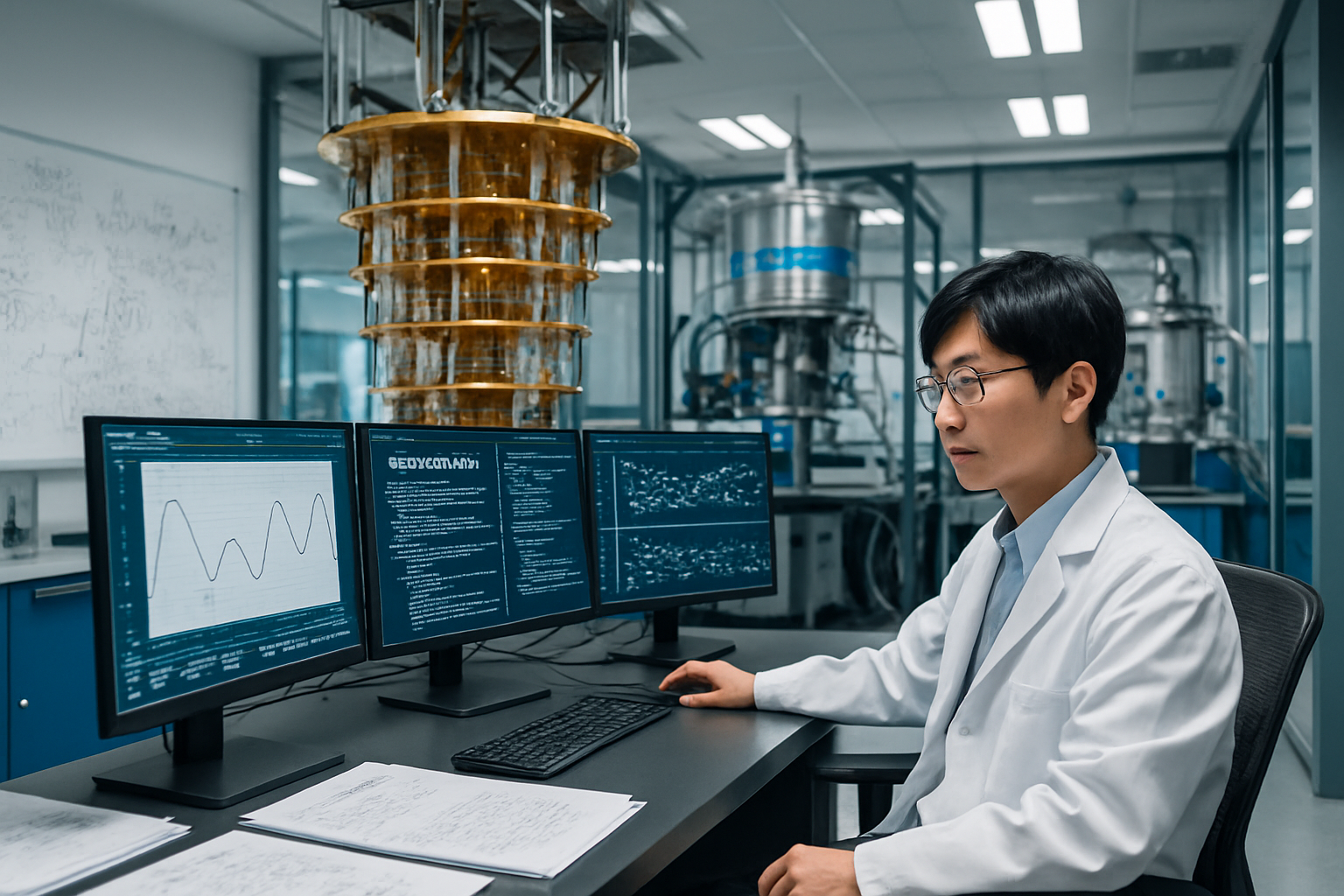
Haruki Watanabe, a world-renowned condensed matter theorist and co-recipient of the prestigious 2022 Breakthrough Prize for groundbreaking work on exotic new phases of matter, has left the University of Tokyo for the Hong Kong University of Science and Technology, citing dramatically superior compensation and research resources.
The move represents a seismic shift in global academic talent migration, as one of Japan's most celebrated quantum physicists abandons the nation's premier research institution for Hong Kong's rapidly expanding scientific ecosystem. Sources familiar with the negotiation indicate Watanabe's new position offers triple his previous salary alongside a ten-fold increase in laboratory budget allocations.
The Breakthrough Prize Legacy
Watanabe's departure carries particular weight given his extraordinary scientific achievements. His theoretical contributions to understanding exotic phases of matter—quantum states that don't fit conventional classifications—earned him recognition as one of the world's leading condensed matter physicists. The Breakthrough Prize, often called the "Nobel Prize of Science," recognizes researchers whose work fundamentally advances human understanding of the universe.
His research focuses on topological phases of matter, quantum states with unusual properties that could revolutionize quantum computing and materials science. These exotic materials exhibit behaviors that seem to violate conventional physics, maintaining quantum properties even at relatively high temperatures—a crucial breakthrough for practical quantum technology applications.
"Watanabe's work on topological insulators and quantum spin liquids represents some of the most sophisticated theoretical physics of our generation. Losing him to another institution signals serious systemic issues in Japanese academic funding."
— Anonymous colleague at University of Tokyo Physics Department
Global Academic Brain Drain Intensifies
Watanabe's migration reflects broader patterns documented in Planet News investigations throughout 2026. The global academic landscape is witnessing unprecedented talent mobility as traditional research powerhouses struggle with funding constraints while emerging hubs like Hong Kong offer compelling alternatives.
This trend extends beyond individual cases. Our comprehensive analysis reveals Vietnamese researchers making breakthrough cancer discoveries at Hong Kong institutions, Canadian quantum cryptography experts winning international recognition, and European mathematical excellence achieving global acclaim. The common thread: regions investing seriously in fundamental research are attracting top talent regardless of traditional academic hierarchies.
Hong Kong's strategic positioning as a bridge between Eastern and Western scientific communities has proven particularly attractive. The territory's combination of international connectivity, substantial research funding, and sophisticated infrastructure creates an environment where scientists can pursue ambitious projects with resources often unavailable at established institutions.
Japan's Academic Funding Crisis
Watanabe's departure exposes deep structural problems within Japan's academic system. Despite the country's reputation for technological innovation, university research budgets have stagnated for decades while administrative burdens have increased dramatically.
The University of Tokyo, traditionally considered Asia's premier research institution, has struggled to compete with international offers for top talent. Faculty members report spending increasing time on bureaucratic tasks rather than research, while laboratory equipment remains outdated compared to newer facilities in Hong Kong, Singapore, and other regional competitors.
Japanese government science funding has remained essentially flat in real terms since the 1990s, even as countries like China, South Korea, and city-states like Hong Kong have dramatically increased research investments. This funding stagnation creates a cascade of problems: aging equipment, limited research assistance, and increasing pressure for quick results rather than fundamental discoveries.
Hong Kong's Scientific Renaissance
The Hong Kong University of Science and Technology's successful recruitment of Watanabe reflects a broader transformation of the territory into a major scientific hub. The institution has invested heavily in quantum research infrastructure, recognizing that fundamental physics research requires both intellectual talent and substantial material resources.
Hong Kong's approach contrasts sharply with traditional academic models. Rather than relying on prestigious reputation alone, the territory offers competitive compensation packages, state-of-the-art facilities, and—crucially—genuine intellectual freedom to pursue fundamental research questions.
The territory's 2026-27 budget allocated approximately 60% of recurrent spending to health, social welfare, and education, positioning scientific research as an immediate economic priority with HK$2.9 billion in surplus funds available for strategic infrastructure investment. This commitment extends beyond rhetoric to practical support systems enabling researchers to focus on discovery rather than grant administration.
Implications for Global Physics Research
Watanabe's migration signals a fundamental shift in how the world's most talented scientists evaluate career opportunities. Traditional metrics like institutional prestige are increasingly secondary to practical considerations: research funding, equipment quality, intellectual freedom, and quality of life.
This trend has profound implications for global physics research. Quantum technologies—from computing to communications to sensing—represent trillion-dollar markets requiring exactly the kind of fundamental theoretical work Watanabe conducts. Nations that successfully attract and retain such talent position themselves for decades of technological leadership.
The exodus of top scientists from established institutions also creates vulnerability for countries that have historically dominated fundamental research. Japan's loss of Watanabe represents not just an individual departure but a signal that the country's scientific ecosystem may be failing to support the kind of ambitious research necessary for 21st-century technological competition.
The New Geography of Scientific Excellence
Watanabe's career move exemplifies a broader reconfiguration of global scientific geography. Success in attracting top talent increasingly depends on practical support for research rather than historical reputation. Hong Kong's emergence as a destination for world-class physicists demonstrates how smaller jurisdictions can compete effectively with traditional academic powerhouses through strategic investment and institutional innovation.
This shift reflects changing priorities among elite researchers. Previous generations might have accepted lower compensation and inferior facilities in exchange for prestigious institutional affiliations. Today's scientists, particularly those working on commercially relevant technologies like quantum computing, have alternatives that didn't exist decades ago.
The migration also highlights the importance of international connectivity for modern research. Hong Kong's position as a global financial center provides unique advantages for scientists whose work bridges academic research and commercial applications. The territory's legal system, international outlook, and sophisticated infrastructure create an environment where fundamental research can evolve toward practical applications more seamlessly than in traditional university settings.
Future Implications
Watanabe's departure likely represents the beginning rather than an isolated incident in academic talent migration. As global competition for scientific talent intensifies, institutions offering superior resources and working conditions will continue attracting researchers from traditional academic centers.
This trend creates both opportunities and challenges. Regions that successfully attract top talent accelerate their own scientific development while contributing to global knowledge advancement. However, the exodus of scientists from established centers could create dangerous gaps in research capacity at institutions that have historically driven fundamental discoveries.
The quantum physics field, in particular, stands at a critical juncture where theoretical breakthroughs could translate directly into revolutionary technologies. Countries and institutions that position themselves to attract researchers like Watanabe may determine which nations lead the quantum technology revolution in coming decades.
For Japan, Watanabe's departure serves as a wake-up call. The country that once led global technology development now risks losing its most talented researchers to competitors offering better support for fundamental research. Addressing this challenge requires not just increased funding but fundamental reform of academic institutions to reduce bureaucratic burdens and provide researchers with the intellectual freedom necessary for breakthrough discoveries.
The scientific community will be watching closely to see whether Watanabe's move represents an exceptional case or the beginning of a broader transformation in how the world's most talented researchers choose their institutional homes. The answer may determine which regions lead scientific discovery in the critical decades ahead.