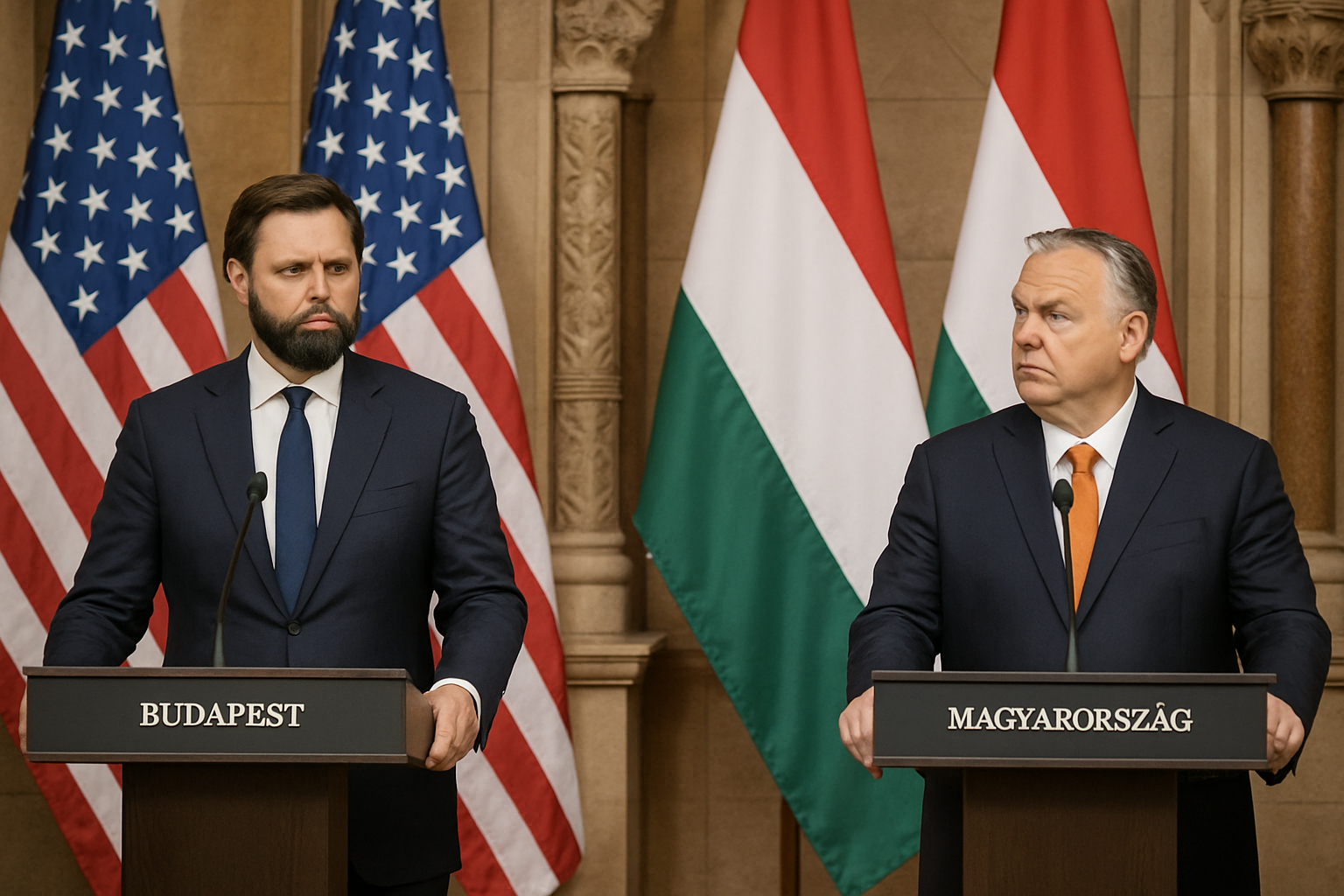
US Vice President J.D. Vance arrived in Budapest on Tuesday for an unprecedented diplomatic intervention, delivering strong support for Hungarian Prime Minister Viktor Orbán just five days before crucial parliamentary elections while launching scathing criticism of European Union interference.
The dramatic visit comes as Orbán faces his most serious electoral challenge since returning to power in 2010, with opposition coalitions led by Péter Magyar's Tisza Party holding leads in multiple polls for the first time in over a decade. Vance's presence represents the most direct American intervention in a European Union member state election in modern history.
Unprecedented Diplomatic Support
During a press conference in Budapest, Vance condemned what he called "shameless election interference" by "bureaucrats in Brussels," accusing the EU of attempting to "destroy Hungary's economy." The Vice President praised Orbán as a "model for Europe" and a "true statesman," emphasizing that President Trump "loves" the Hungarian leader.
"We will help support a true friend and true ally," Vance declared. "Viktor Orbán has been a model for what a European leader can be."
— J.D. Vance, US Vice President
The visit continues a pattern of explicit Trump administration support that began with the President's February endorsement calling Orbán "a truly strong and powerful leader" with "complete and unconditional support." Secretary of State Marco Rubio's February visit to Budapest further cemented this unprecedented American electoral backing.
Electoral Context and Opposition Challenge
Orbán's political system faces its gravest challenge since 2010, with Fidesz trailing opposition coalitions in polls for the first time in over a decade. Magyar's Tisza Party has organized massive demonstrations, including the "Greatest National March" that drew an estimated 500,000 participants—the largest opposition gathering since 2010.
The opposition has consolidated behind a pro-European platform promising wealth taxes, euro adoption, and stronger EU and NATO ties, contrasting sharply with Orbán's nationalist sovereignty approach. Magyar, a former government insider, represents a credible alternative that has resonated with voters across traditional party lines.
Dual Foreign Interference Operations
Vance's visit coincides with documented Russian interference operations supporting Fidesz. Investigative journalist Szabolcs Panyi's VSquare reporting revealed concrete evidence of Russian teams actively operating in Budapest—the first documented case of Kremlin operatives participating directly in European electoral campaigns.
This creates an unprecedented situation of dual foreign intervention, with American political support combining with Russian operational backing. Ukrainian Foreign Ministry spokesperson Heorhii Tykhyi characterized recent pipeline incidents as "false flag operations as part of Moscow's large-scale interference in Hungary's elections."
EU Relations Crisis Deepens
The visit occurs amid Hungary's continued blockade of a historic €90 billion EU aid package for Ukraine—the largest single-nation assistance program in European history. The crisis centers on the Druzhba oil pipeline, which has been offline since January 27, 2026.
Hungary and Slovakia claim Ukraine deliberately manipulated oil supplies as "political blackmail," while Ukraine maintains that Russian drone attacks damaged infrastructure requiring repairs. Lithuanian Foreign Minister Kestutis Budrys warned that "the EU cannot become Budapest's hostage."
The European Commission has frozen approximately €19 billion in funding for Hungary over rule of law concerns, while intelligence restrictions have been imposed following allegations that Foreign Minister Péter Szijjártó leaked EU Council details to Russian Foreign Minister Sergei Lavrov.
Energy Security and Strategic Stakes
The energy dimensions of the crisis extend beyond bilateral relations. Hungary threatened to halt gas deliveries to Ukraine until oil transit resumes, weaponizing energy infrastructure during critical winter conditions affecting millions of Ukrainian civilians. The Balkan Stream pipeline carries 15.75 billion cubic meters of gas annually through a Turkey-Bulgaria-Serbia-Hungary route critical for Central European energy security.
Recent discoveries of sophisticated explosive devices near pipeline infrastructure in Serbia, occurring exactly one week before the Hungarian elections, have raised additional security concerns. Opposition leaders dismissed the incident as "election campaign tactical panic-making," suggesting Orbán is exploiting security fears for political benefit.
Nuclear Governance Backdrop
The visit takes place against the backdrop of a nuclear governance crisis following the New START treaty's expiration on February 5, 2026—the first time in over 50 years without US-Russia nuclear constraints. Both nations control approximately 80% of global nuclear weapons, with UN Secretary-General António Guterres warning of a "grave turning point" with nuclear risks at their "highest in decades."
Democratic Governance Under Pressure
The April 12 elections represent what senior EU officials describe as a "template-setting moment for 21st-century crisis management," with the world watching whether democratic institutions can adapt while preserving European values. Enhanced cooperation mechanisms are being explored to bypass Hungarian vetoes, potentially fundamentally altering EU decision-making structures.
The stakes encompass European integration trajectory, collective action credibility, and democratic institutions' effectiveness under authoritarian pressure. An opposition victory would likely restore Hungarian-EU alignment and lift aid blockades, while Orbán's survival with foreign backing could embolden similar interference operations continent-wide.
International Implications
The Hungarian elections will influence EU decision-making capacity, NATO cohesion, and transatlantic relationships for decades to come. Success in maintaining electoral integrity while addressing political competition could provide a global template for democratic resilience. Failure might accelerate institutional fragmentation and undermine the sovereignty principles underpinning European success since 1945.
The outcome affects European security architecture, international law enforcement credibility, and territorial sovereignty principles as democratic governance faces unprecedented challenges in the era of great power competition.
As Vance concluded his visit, the convergence of American diplomatic support, Russian operational interference, EU institutional strain, and genuine electoral competition creates a perfect storm that will test European democratic resilience in ways unseen since World War II. The results on April 12 will reverberate far beyond Hungary's borders, shaping the future of European integration and democratic governance in the 21st century.