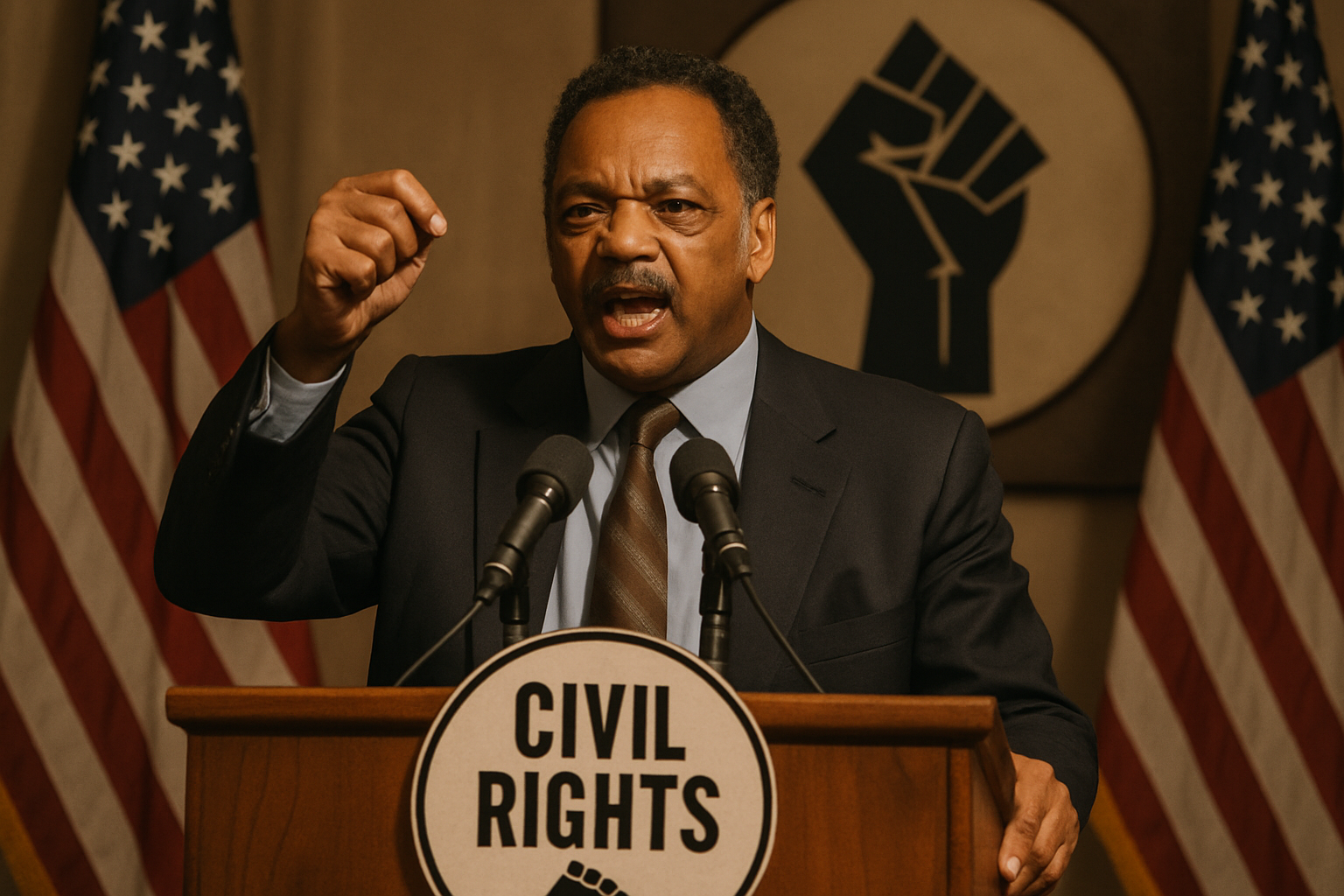
Rev. Jesse Louis Jackson, the towering civil rights leader and two-time presidential candidate who dedicated his life to fighting for justice, equality, and human dignity, died peacefully Tuesday morning, February 17, 2026, at age 84, surrounded by his family at his Chicago-area home.
Jackson's death marks the end of a historic chapter in American civil rights leadership, as he was among the last surviving major figures from the movement's golden age alongside Martin Luther King Jr. His family announced that he had been battling progressive supranuclear palsy (PSP), a rare neurological condition affecting movement and balance, and had been hospitalized in recent months.
"Our father was a servant leader - not only to our family, but to the oppressed, voiceless, and overlooked around the world," the Jackson family said in a statement. "His unwavering commitment to justice, equality, and human rights helped shape a global movement for freedom and dignity."
From Segregated South to National Leadership
Born October 8, 1941, in Greenville, South Carolina, during the Jim Crow era, Jackson rose from humble beginnings to become one of America's most influential civil rights leaders. He emerged as a national figure at just 26 years old following the assassination of Martin Luther King Jr. on April 4, 1968, at the Lorraine Motel in Memphis, where Jackson was present as one of King's closest protégés.
That defining moment propelled Jackson into a leadership role he would maintain for more than six decades. He founded Operation PUSH (People United to Save Humanity) in 1971 and later the Rainbow Coalition in 1984, organizations that became pillars of the civil rights movement's evolution beyond the 1960s.
Dr. Isaac Newton, who knew Jackson personally, was quoted in tributes as being "deeply touched by his incredible capacity to let words and meaning jolt the soul through the rhythm of hope, the call to faith, and his relentless pursuit of freedom, dignity, and justice for all, especially the downtrodden and outcast."
Master Orator and Political Trailblazer
Jackson became renowned for his powerful oratory skills and rhythmic speaking style, with phrases like "I am somebody" and "Keep hope alive" becoming rallying cries for generations of activists. His speeches combined moral urgency with poetic cadence, reflecting his Baptist ministry background and deep understanding of the African American experience.
In 1984 and 1988, Jackson made history as the first African American to mount serious campaigns for the Democratic presidential nomination. His 1988 campaign was particularly groundbreaking, winning 13 primaries and caucuses and finishing second to Michael Dukakis at the Democratic National Convention in Atlanta.
His famous "Keep Hope Alive" speech at that convention resonated far beyond the Democratic Party: "When I look out at this convention, I see the face of America - red, yellow, brown, black and white." The Rainbow Coalition he built united African Americans, Hispanics, Native Americans, Asian Americans, and white progressives in an unprecedented political alliance.
International Diplomacy and Prisoner Releases
Jackson's influence extended far beyond American borders. He successfully negotiated the release of American prisoners in Syria in 1984 and Yugoslavia in 1999, demonstrating his unique ability to bridge diplomatic divides through moral authority rather than official government channels.
His international recognition culminated in 2021 when France awarded him the Légion d'honneur for his lifetime of activism. Global tributes following his death came from Jamaica's People's National Party, Nicaragua's Vice President Rosario Murillo, Portugal's PÚBLICO, and Al Jazeera, emphasizing his advocacy for Arab American communities and the Palestinian cause.
The Times Kuwait reported that Jackson "spent more than six decades expanding the political and social rights of marginalized communities," while international observers noted his travels to apartheid South Africa, where he met with Nelson Mandela and advocated for human rights throughout his career.
Health Struggles and Final Years
In 2017, Jackson publicly revealed his diagnosis with Parkinson's disease, but he remained active in civil rights causes well into his 80s. Despite his declining health, he continued advocating for voting rights, economic justice, and police reform until his death.
His condition later progressed to progressive supranuclear palsy, which led to his recent hospitalizations. However, as the Haitian press organization OHDLP noted in their tribute, Jackson remained "a fervent defender of the rights of Afro-Americans and companion" to those fighting for justice until the end.
Chicago Vigil and "Keep Hope Alive"
As news of Jackson's passing spread Tuesday evening, those who knew him best gathered in Chicago for a prayer and vigil, vowing to "keep hope alive" - the very mantra that defined his decades-long fight for equality. The gathering demonstrated how Jackson's message of hope and perseverance continues to inspire activists and ordinary citizens alike.
Prime Minister of the Bahamas offered official condolences, reflecting the international scope of Jackson's influence and the global recognition of his contributions to human rights and social justice.
Political Legacy and Obama's Path
Jackson's presidential campaigns, while unsuccessful, fundamentally changed American politics by proving that a Black candidate could compete at the highest levels and build diverse coalitions. His groundbreaking efforts directly paved the way for Barack Obama's historic 2008 presidential victory.
The Rainbow Coalition model influenced progressive politics for decades, demonstrating how to unite diverse communities around shared values of economic justice and civil rights. Jackson kept issues of poverty, inequality, and racial injustice in the public consciousness long after the civil rights movement's peak years.
Enduring Philosophical Vision
Throughout his life, Jackson embodied a philosophy of hope in the face of adversity. One of his most quoted reflections captured this spirit: "Suffering breeds character. Character breeds faith. In the end, faith will not disappoint."
His vision of an inclusive, diverse America remains perhaps his most enduring contribution to the national conversation about identity, belonging, and democratic participation. Jackson served as a bridge between the 1960s struggles for basic civil rights and the 21st century fight for comprehensive equality.
Family and Memorial Plans
Jackson is survived by his wife of more than 50 years, Jacqueline Brown Jackson, and their five children, including former Congressman Jesse Jackson Jr., who served from 1995 to 2012. He also leaves behind numerous grandchildren who have continued his legacy of public service.
Memorial services are planned in both Chicago, where Jackson based his career, and South Carolina, his birthplace. The services are expected to draw thousands of mourners, including civil rights leaders, politicians, and ordinary Americans whose lives were touched by his message of hope and justice.
Jackson's death truly marks the end of an era in American civil rights leadership, occurring during a renewed national focus on racial justice that makes his passing particularly poignant for contemporary struggles for equality and human dignity.
As civil rights organizations and international leaders continue to pay tribute, Rev. Jesse Jackson's life stands as a testament to the power of unwavering commitment to justice and the belief that, in his own words, ordinary people can do extraordinary things when united by hope and purpose.