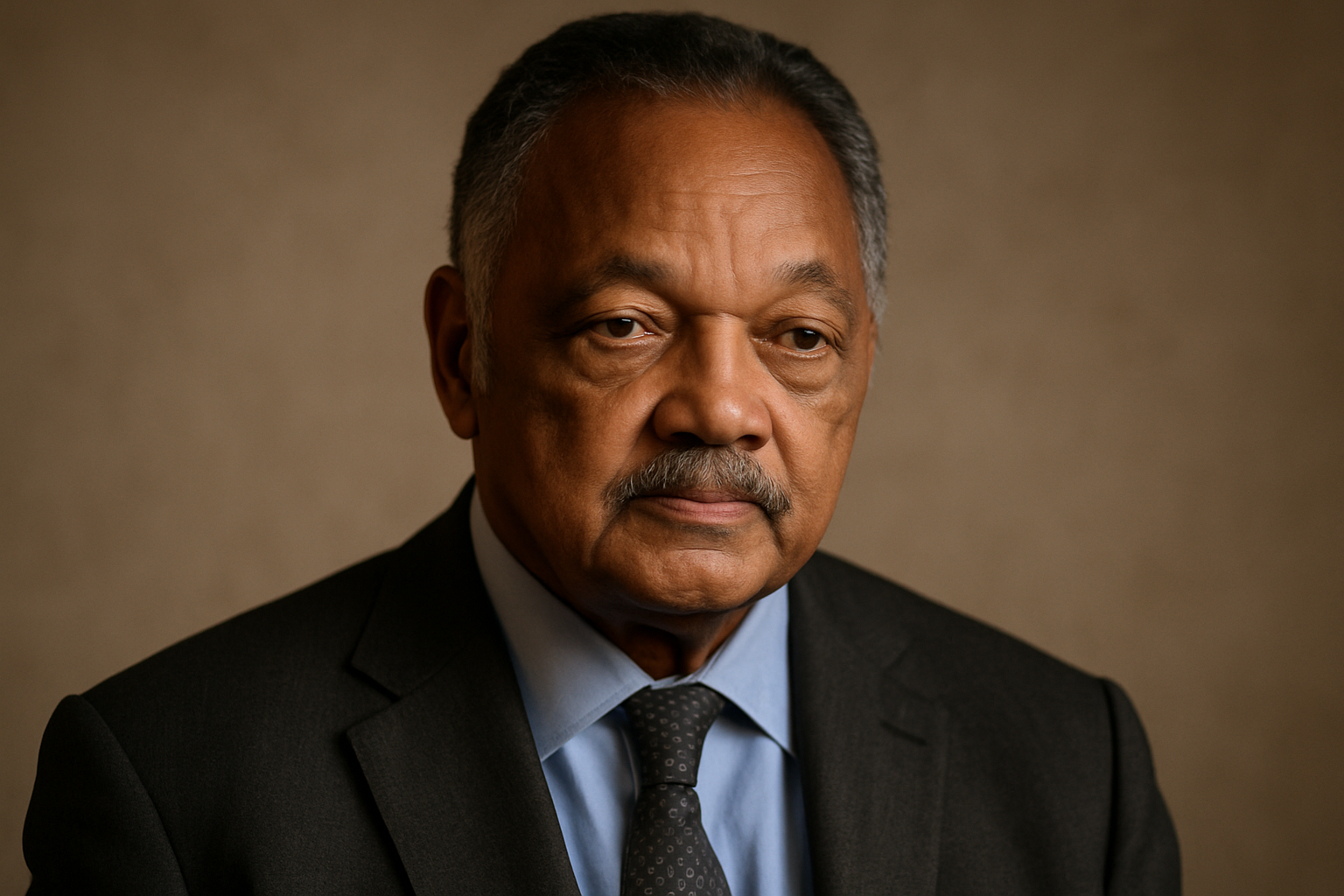
Reverend Jesse Louis Jackson, the towering civil rights leader whose moral vision and fiery oratory reshaped the Democratic Party and America itself, has died at age 84, surrounded by his family at a Chicago area hospital Tuesday morning.
Jackson, a protégé of the Reverend Martin Luther King Jr. and a commanding presence in the struggle for racial equality for more than five decades, had been hospitalized in recent months and was under observation for progressive supranuclear palsy (PSP), according to the Rainbow PUSH Coalition, the civil rights organization he founded.
"Our father was a servant leader — not only to our family, but to the oppressed, the voiceless, and the overlooked around the world," the Jackson family said in a statement released Tuesday. "We shared him with the world, and in return, the world became part of our extended family. His unwavering belief in justice, equality, and love uplifted millions, and we ask you to honor his memory by continuing the fight for the values he lived by."
A Historic Political Trailblazer
Jackson made history as the first African American to mount serious campaigns for the Democratic presidential nomination, running in 1984 and 1988 and capturing millions of votes while inspiring a generation of Black political leaders. His Rainbow Coalition brought together diverse groups of Americans — African Americans, Hispanics, Native Americans, Asian Americans, and white progressives — in an unprecedented political alliance.
In his 1988 campaign, Jackson won 11 primaries and caucuses, finishing second to eventual nominee Michael Dukakis. His speech at that year's Democratic National Convention in Atlanta, where he declared "Keep hope alive," became one of the most memorable moments in modern political history.
"When I look out at this convention, I see the face of America — red, yellow, brown, black and white. We're all precious in God's sight."
— Jesse Jackson, 1988 Democratic National Convention
From the Civil Rights Movement to National Leadership
Born October 8, 1941, in Greenville, South Carolina, Jackson was raised by his grandmother and stepfather in the segregated South. He first gained national prominence as a young seminary student when he joined Dr. King's movement in the 1960s, participating in the historic marches in Selma, Alabama, and serving as a key organizer for the Southern Christian Leadership Conference (SCLC).
Jackson was present at the Lorraine Motel in Memphis on April 4, 1968, when King was assassinated, and was thrust into national leadership of the civil rights movement at just 26 years old. He later founded Operation PUSH (People United to Save Humanity) in 1971 and the Rainbow Coalition in 1984, organizations that would become powerful forces for social and economic justice.
Master of Moral Suasion
Throughout his career, Jackson was renowned for his extraordinary oratorical gifts and his ability to articulate the moral dimensions of political issues. His rhythmic, poetic speaking style and memorable phrases — from "I am somebody" to "Hope over fear" — became rallying cries for the dispossessed and marginalized.
Jackson's influence extended far beyond electoral politics. He negotiated the release of American prisoners in Syria in 1984, traveled to Yugoslavia to secure the freedom of captured U.S. soldiers in 1999, and played crucial roles in countless labor disputes, corporate boycotts, and community conflicts throughout his career.
The Rainbow Coalition Legacy
Perhaps Jackson's greatest contribution to American politics was his Rainbow Coalition concept, which sought to unite people of all races and backgrounds around shared economic interests and democratic values. This multiracial, multiethnic coalition became a model for progressive politics that influenced Barack Obama's successful presidential campaigns decades later.
"Jesse Jackson made it possible for Barack Obama to become president," political historian Taylor Branch observed in 2008. "He opened doors that had been sealed shut and proved that a Black candidate could compete at the highest levels of American politics."
Later Years and Health Struggles
In 2017, Jackson revealed he had been diagnosed with Parkinson's disease, a progressive neurological disorder that gradually limited his public appearances. Despite his health challenges, he remained active in civil rights causes and continued to advocate for voting rights, economic justice, and police reform well into his 80s.
Jackson was present for many of the defining moments of the modern civil rights era, from the March on Washington in 1963 to the protests following George Floyd's death in 2020. His son Jesse Jackson Jr. served in Congress from 1995 to 2012, continuing the family's tradition of public service.
International Impact and Recognition
Jackson's influence extended globally, with international leaders and media outlets recognizing his role in advancing human rights worldwide. He traveled to South Africa during apartheid, met with world leaders from Nelson Mandela to Mikhail Gorbachev, and consistently advocated for America's moral leadership on the international stage.
His death prompted tributes from around the world, with European media outlets, Asian newspapers, and African publications all noting his contributions to the global struggle for human rights and democracy.
A Complex and Controversial Figure
While universally respected for his civil rights work, Jackson was not without controversy during his long career. He faced criticism over various statements and positions, financial management of his organizations, and his sometimes turbulent relationships with other civil rights leaders and Democratic Party officials.
Yet even his critics acknowledged his unique ability to focus national attention on issues of poverty, inequality, and racial injustice. His weekly Saturday radio program and frequent media appearances kept these issues in the public consciousness for decades.
The End of an Era
Jackson's death marks the end of an era in American civil rights leadership. He was among the last surviving major figures from the King era and represented a direct link to the heroic phase of the civil rights movement. His passing comes at a time when many of the issues he championed — voting rights, economic inequality, police reform — remain contentious and unresolved.
Jackson is survived by his wife of more than 50 years, Jacqueline Brown Jackson, five children, and numerous grandchildren. Funeral arrangements have not yet been announced, but the family indicated that memorial services will be held in both Chicago, where Jackson made his home for decades, and his native South Carolina.
"Suffering breeds character. Character breeds faith. In the end, faith will not disappoint."
— Jesse Jackson
As America mourns the loss of this towering figure, Jackson's life serves as a testament to the power of moral leadership, political courage, and unwavering commitment to justice. His famous exhortation to "Keep hope alive" remains as relevant today as it was when he first spoke those words to a nation still struggling to live up to its highest ideals.
The Reverend Jesse Louis Jackson leaves behind not just a legacy of political achievement, but a moral framework for understanding America's ongoing journey toward racial justice and human dignity. In death, as in life, he challenges Americans to measure their progress not by the comfort of the powerful, but by the condition of the powerless.