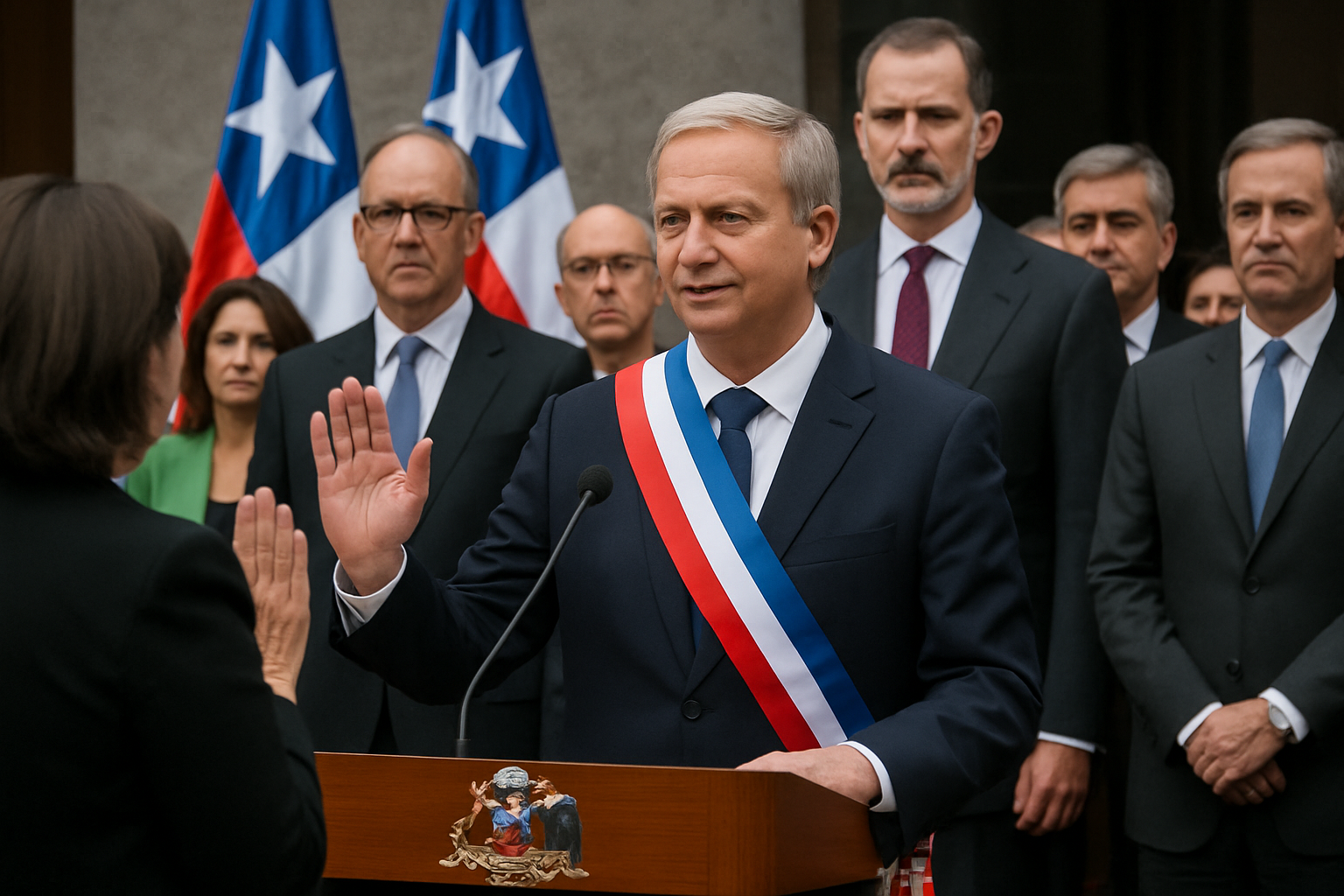
José Antonio Kast was sworn in as Chile's president on Wednesday, marking the Latin American nation's most pronounced shift to the right since the return of democracy in 1990 and making him the first far-right president since the Pinochet dictatorship ended.
The 57-year-old ultraconservative politician assumed power in a ceremony held in the coastal city of Valparaíso, taking over from left-wing President Gabriel Boric in what observers describe as a dramatic ideological reversal that reflects broader conservative trends sweeping parts of Latin America.
Historic Transition of Power
The transfer of power ceremony drew several high-profile international leaders, including Argentina's Javier Milei, Ecuador's Daniel Noboa, Paraguay's Santiago Peña, and Spain's King Felipe VI. Venezuelan opposition leader María Corina Machado also attended, highlighting Kast's appeal among conservative Latin American figures.
Kast's victory represents a remarkable political comeback after losing the 2021 election to Boric. His December 2025 landslide victory was built on promises to fight crime and curb illegal immigration, policies that hold striking similarities to those adopted by Donald Trump in the United States.
"I wish success to the incoming government, success for Chile, and may our homeland always come first, above any interest, above any disagreement."
— Gabriel Boric, Outgoing President
The outgoing president's farewell speech from La Moneda palace included what observers interpreted as a reference to ongoing tensions over Chinese infrastructure projects, particularly the controversial undersea cable dispute that dominated Boric's final weeks in office.
A Sharp Ideological Reversal
Kast's inauguration marks Chile's most significant political shift in over three decades. The Trump-inspired political veteran won his mandate on a platform of law and order, promising to clamp down on migration and lawlessness while boosting economic growth through deregulation, spending cuts, and market-friendly policies.
The new president takes office at a time when Chileans are increasingly worried about rising crime rates and economic stagnation. His tough stance on security issues and promise of authoritarian-style governance resonated with voters alarmed by deteriorating public safety conditions.
Security concerns notably shadowed the inauguration ceremony, reflecting the very issues that propelled Kast to power. His administration has already indicated plans for enhanced security measures and stricter immigration controls as immediate priorities.
International Implications and Regional Context
Kast's victory represents part of a broader conservative realignment across Latin America, contrasting sharply with the traditional left-leaning blocs that dominated the region in the 2000s. His presidency is expected to strengthen partnerships with other right-wing leaders in the region, particularly with El Salvador's Nayib Bukele, who is scheduled to visit Chile in May 2026 for security cooperation discussions.
The timing of Kast's inauguration carries profound symbolic weight, occurring exactly 36 years after the Pinochet dictatorship ended in 1990. Unlike previous Chilean presidents since the democratic transition, Kast has publicly defended aspects of the military regime, making him a controversial figure both domestically and internationally.
Former Venezuelan opposition leader Juan Guaidó, who attended the ceremony, praised Chile's democratic transition as "an example for Venezuela," highlighting the broader regional implications of Kast's conservative governance model.
Challenges Facing the New Administration
The new president inherits significant challenges, including managing Chile's relationship with its large Venezuelan migrant population. Approximately 42% of Chile's 2 million migrants are Venezuelan, and this community faces considerable uncertainty under the far-right administration's proposed immigration restrictions.
Kast's economic agenda focuses on deregulation and market-friendly policies designed to stimulate growth, but critics worry about the social implications of his proposed spending cuts. His administration will also need to navigate complex international relationships, particularly with China, following the recent disputes over infrastructure projects.
The president's tough stance on law enforcement and immigration has drawn comparisons to authoritarian governance models, raising concerns among human rights organizations and democratic institutions about the potential erosion of civil liberties.
A Historic Moment for Chilean Democracy
Despite the controversies surrounding his political positions, Kast's inauguration represents a peaceful democratic transition that demonstrates the strength of Chilean institutions. The ceremony proceeded without major incidents, and opposition parties, while critical, have committed to working within the democratic framework.
The international presence at the inauguration, including representatives from across the political spectrum, underscores Chile's continued importance in regional geopolitics. The attendance of both conservative allies like Milei and opposition figures like Machado reflects the complex political realignments occurring across Latin America.
As Kast begins his presidential term, Chile stands at a crossroads between its democratic traditions and the authoritarian-style governance he has promised. His presidency will serve as a crucial test case for how established democracies adapt to rising demands for strongman leadership while maintaining institutional integrity.
The success or failure of Kast's presidency will likely influence political developments across Latin America, potentially providing either a model for conservative governance or a cautionary tale about the risks of democratic backsliding in the region.