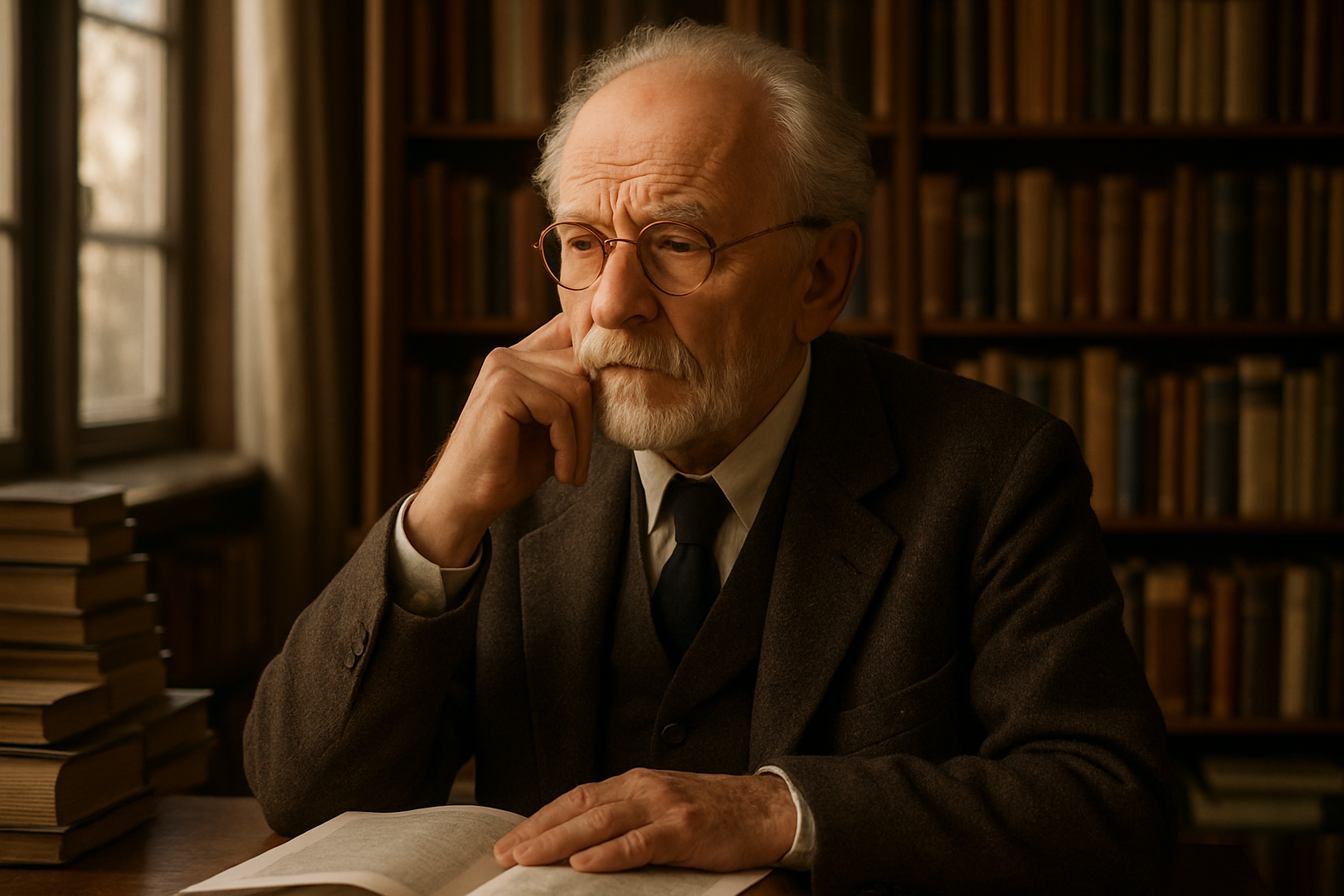
Jürgen Habermas, the towering German philosopher and sociologist whose theories on communicative action and democratic discourse shaped post-war European intellectual life, died Saturday at his home in Starnberg, Bavaria. He was 96 years old.
The death of one of the most influential public intellectuals of the modern era was confirmed by his publisher, Suhrkamp Verlag, which cited family sources. Habermas, who remained intellectually active well into his nineties, leaves behind an extraordinary legacy that bridged academic philosophy with urgent questions of democratic legitimacy, social justice, and human communication.
The Last Great Public Intellectual
Born on June 18, 1929, in Düsseldorf to a bourgeois family, Habermas underwent multiple surgeries in early childhood to correct a cleft palate, an experience that some scholars suggest influenced his lifelong fascination with communication and the conditions necessary for authentic dialogue. Despite this early challenge, he would become renowned for his eloquent and passionate interventions in public discourse.
Over seven decades of public engagement, Habermas evolved from a fierce critic of Germany's incomplete denazification in the 1950s to a prophetic voice warning against resurgent nationalism and militarism in his final years. His intellectual journey paralleled—and often guided—Germany's transformation from a nation grappling with the legacy of fascism to a cornerstone of European democracy.
Architect of Communicative Democracy
Habermas is perhaps best known for his theory of communicative action, which proposed that genuine democratic legitimacy emerges through rational public discourse among free and equal citizens. This framework, developed across multiple seminal works including "The Theory of Communicative Action" (1981), offered both a critique of instrumental reason and a hopeful vision for democratic renewal.
"The public sphere is a domain of our social life in which something approaching public opinion can be formed."
— Jürgen Habermas, The Structural Transformation of the Public Sphere
His concept of the "public sphere"—a space where private people come together to debate public concerns—became foundational to understanding modern democratic societies. This work proved prescient as digital technologies transformed how citizens engage in political discourse, with scholars continuing to apply Habermasian frameworks to analyze everything from social media to deliberative democracy experiments.
A Philosopher for Critical Times
What distinguished Habermas from many academic philosophers was his willingness to enter the political fray directly. He was among the first major German intellectuals to harmonize the analytical Anglo-Saxon philosophical tradition, focused on logic and language, with the Continental tradition, centered on ideas and social critique.
Throughout his career, Habermas never hesitated to intervene in crucial debates. His searing critiques of fascist thought in the 1950s helped establish the intellectual foundations for Germany's democratic reconstruction. In the 1960s, he engaged in heated exchanges with student radicals who challenged the Federal Republic's legitimacy. Later, he became a passionate advocate for European integration and a fierce critic of what he saw as the democratic deficits of neoliberal capitalism.
The Frankfurt School Legacy
As a leading figure of the second generation of the Frankfurt School, Habermas inherited the critical theory tradition of Theodor Adorno, Max Horkheimer, and Herbert Marcuse. However, he diverged significantly from his predecessors' pessimism about Enlightenment rationality. While the first generation saw instrumental reason as inherently dominating, Habermas argued for the emancipatory potential of communicative rationality.
This optimistic turn made his work particularly influential in political theory and democratic practice. His ideas about deliberative democracy influenced constitutional design in emerging democracies and provided intellectual foundations for experiments in participatory governance worldwide.
European Integration and Global Influence
As European integration deepened, Habermas became one of its most thoughtful champions. He argued that European unity represented humanity's best hope for democratic governance beyond the nation-state. His vision of a "post-national" democratic order, based on constitutional patriotism rather than ethnic nationalism, offered an alternative to both narrow nationalism and technocratic governance.
This European focus reflected his broader concern with what he called the "postnational constellation"—the challenge of maintaining democratic legitimacy in an increasingly globalized world. His later works grappled with how democratic institutions could adapt to transnational challenges like climate change, financial crises, and technological disruption.
A Living Bridge Across Generations
The remarkable longevity of Habermas's career—spanning from the 1950s to the 2020s—made him a living bridge between different eras of German and European history. He witnessed and analyzed the transformation of post-war Europe, the student movements of 1968, German reunification, European integration, and the digital revolution.
In recent years, even as age limited his public appearances, Habermas continued to offer penetrating analyses of contemporary challenges. He warned against the rise of authoritarian populism, critiqued the democratic deficits of EU institutions, and grappled with the implications of artificial intelligence for human autonomy and communication.
The Enduring Relevance of Habermasian Thought
As news of his death spread across Europe and beyond, scholars and political leaders emphasized the continued relevance of his ideas. In an era of polarized public discourse, misinformation, and democratic backsliding, Habermas's vision of rational, inclusive deliberation among equals offers both diagnostic tools and normative guidance.
His work on the conditions necessary for legitimate democratic decision-making remains particularly urgent as societies grapple with the impact of social media on political discourse. The "public sphere" he theorized faces new challenges from algorithmic filtering, echo chambers, and the commodification of attention.
Personal Reflections and Final Years
Despite his global influence, Habermas remained deeply connected to his German roots. He spent his final decades in Starnberg, near Munich, where he continued to write and think until his final years. Colleagues described him as retaining his intellectual curiosity and moral passion even as physical frailty increasingly limited his activities.
In one of his final interviews, Habermas reflected on the "darker prospects" facing democratic societies but maintained his fundamental faith in the possibility of human progress through rational discourse and mutual understanding. This combination of critical realism and cautious optimism captured the essence of his philosophical outlook.
A Legacy for Democracy
Jürgen Habermas leaves behind not just a vast body of scholarly work but a model of engaged intellectual citizenship. He demonstrated how rigorous philosophical analysis could inform urgent political questions without sacrificing intellectual integrity. His example of public engagement—passionate but reasoned, critical but constructive—offers a template for scholars seeking to contribute to democratic life.
As Europe and the world confront new challenges to democratic governance, Habermas's core insight remains as relevant as ever: legitimate political authority depends on the ability of citizens to engage in free, rational, and inclusive discourse about their common concerns. His death marks the end of an era, but his ideas about communication, democracy, and human possibility continue to illuminate the path forward.
Jürgen Habermas is survived by his wife and children. Funeral arrangements have not yet been announced, but tributes from across the academic and political worlds attest to the profound impact of his seven-decade commitment to democratic thought and practice.