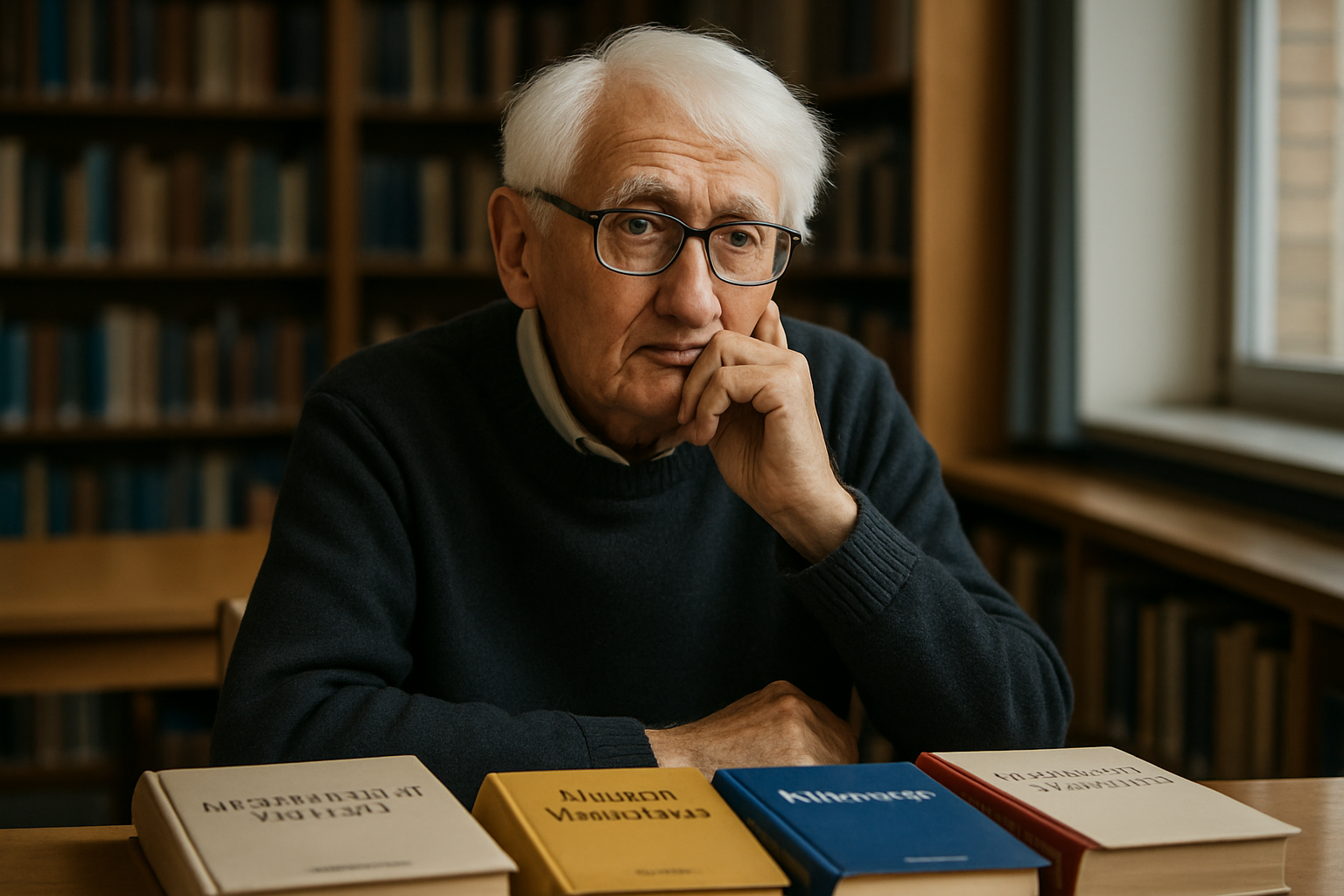
Jürgen Habermas, one of the most influential philosophers of the modern era and a towering intellectual voice for democratic ideals, died at age 96 in Starnberg, Bavaria, on Saturday, March 14, 2026, leaving behind an unparalleled legacy of scholarship that fundamentally shaped our understanding of democratic society and rational discourse.
The death was confirmed by his publishing house Suhrkamp Verlag, with the news quickly spreading through international media outlets. Habermas, a leading representative of the second generation of the Frankfurt School, spent his final years continuing to write about democracy's contemporary challenges in the quiet Bavarian town where he had lived for decades.
An Intellectual Giant's Journey
Born on June 18, 1929, in Düsseldorf, Habermas underwent childhood surgeries for a cleft palate that may have profoundly influenced his lifelong focus on communication and discourse. This personal experience with communication difficulties arguably shaped his revolutionary theories about how human understanding emerges through dialogue rather than individual reflection.
His intellectual career spanned over seven decades, from his first publication in the Frankfurter Allgemeine Zeitung in 1952 critiquing the poet Gottfried Benn, to his recent warnings about democratic backsliding and the implications of artificial intelligence for rational public discourse. Throughout this remarkable journey, Habermas maintained extraordinary intellectual vitality well into his nineties, continuing to adapt his theories to address 21st-century challenges.
Revolutionary Theoretical Contributions
Habermas's intellectual contributions fundamentally altered multiple academic disciplines and democratic practice itself. His concept of the "public sphere," introduced in 1962, revolutionized understanding of the relationship between media, politics, and democracy. This framework showed how democratic legitimacy requires spaces where citizens can engage in rational deliberation about public affairs, free from economic or political coercion.
"The democratic constitutional state can preserve and fulfill its promise of freedom and justice only as long as it draws its legitimacy from the communicative practices of a democratic citizenry."
— Jürgen Habermas, Theory of Communicative Action
His monumental "Theory of Communicative Action" (1981) represented perhaps his greatest philosophical achievement. This work argued that human rationality emerges through mutual understanding and communication, challenging both traditional philosophy's focus on individual consciousness and postmodern skepticism about rational discourse entirely.
The theory proposed that legitimate democratic decision-making requires inclusive rational dialogue that goes beyond mere majority rule. For Habermas, democracy's strength lay not in perfect outcomes but in the quality of deliberative discourse that precedes collective decisions.
Engaged Intellectual Citizenship
What distinguished Habermas from many academic philosophers was his willingness to engage directly with pressing political questions while maintaining rigorous scholarly standards. He advocated consistently for European integration, deliberative democracy, and what he termed "constitutional patriotism" as an alternative to ethnic nationalism.
Following German reunification, he warned against triumphalism and expressed concerns about populism, EU democratic deficits, and recently, the implications of artificial intelligence for democratic discourse. His framework for understanding when political power enjoys genuine legitimacy through inclusive rational deliberation provided crucial analytical tools for citizens and scholars alike.
Habermas also distinguished himself by bridging analytical Anglo-Saxon and Continental philosophical traditions, creating unprecedented cross-methodological dialogue in philosophy and social theory. His famous debates with figures like Michel Foucault and Jacques Derrida exemplified the kind of rational discourse his theories championed.
Global Impact and Contemporary Relevance
Universities worldwide teach Habermas's concepts across philosophy, political science, sociology, and communications. His ideas have influenced constitutional courts, deliberative democracy experiments, and citizen participation initiatives globally. The vision of democracy requiring inclusive rational dialogue rather than mere majority rule continues to inspire democratic renewal efforts.
His theories gained renewed significance amid contemporary challenges including social media's transformation of discourse, the rise of authoritarian populism globally, and questions about democratic legitimacy in increasingly diverse societies. His framework for understanding legitimate governance through rational public discourse offers both analytical clarity and practical guidance for citizens navigating unprecedented stress on democratic institutions.
International Reactions
The SPÖ-Bundesbildungsorganisation in Austria responded to news of his death with "great dismay," calling him "a philosopher of the century for democracy, freedom and justice." The organization emphasized how Habermas provided the Federal Republic of Germany with "a vision of itself as a society that resolves its conflicts through arguments."
International coverage highlighted different aspects of his legacy. French media described him as one of the last great thinkers of the 20th century and among the world's most influential intellectuals. Swiss commentary noted how his idea of democratic public discourse appears increasingly fragile in today's political environment.
American scholars emphasized how his thinking might help in confronting contemporary democratic challenges, with one German publication asking whether "his thinking helps in the fight against Donald Trump?" This reflects the global relevance of his democratic theory framework during periods of authoritarian challenge.
A Life Paralleling Democratic Transformation
Habermas's intellectual journey remarkably paralleled Germany's transformation from a devastated authoritarian state to a leading European democracy. His early critiques of fascism in the 1950s, his role in the 1968 student movements, his contributions to discussions around German reunification, and his advocacy for European integration demonstrated how rigorous scholarship could engage with the most pressing questions of democratic development.
His final years were spent observing and commenting on what he saw as a critical period for democratic institutions worldwide. The challenges he identified—from the quality of public discourse in digital environments to the rise of authoritarian movements—remain central to contemporary democratic struggles.
Enduring Framework for Democratic Life
While Habermas's death removes a towering intellectual presence, his theoretical framework provides essential tools for understanding and strengthening democratic life that will outlast any individual thinker. His vision that democracy's strength lies in the quality of collective discourse rather than in perfect outcomes offers guidance for democratic renewal efforts worldwide.
The framework he developed for legitimate governance through rational public discourse provides both analytical tools for understanding contemporary challenges and practical guidance for citizens and institutions committed to democratic values. His legacy reminds us that democracy requires active cultivation of the conditions that enable genuine public deliberation.
As democratic institutions face unprecedented stress globally, Habermas's work offers a foundation for addressing fundamental questions about how diverse societies can make collective decisions that enjoy genuine legitimacy. His commitment to rational discourse as the foundation of democratic life provides a framework for future generations committed to preserving and strengthening democratic governance.
Jürgen Habermas died as he lived—as an engaged intellectual citizen whose rigorous scholarship served the cause of human freedom and democratic possibility. His death marks the end of an extraordinary individual voice, but his ideas about democratic discourse and rational communication will continue to guide those working to strengthen democratic societies for decades to come.