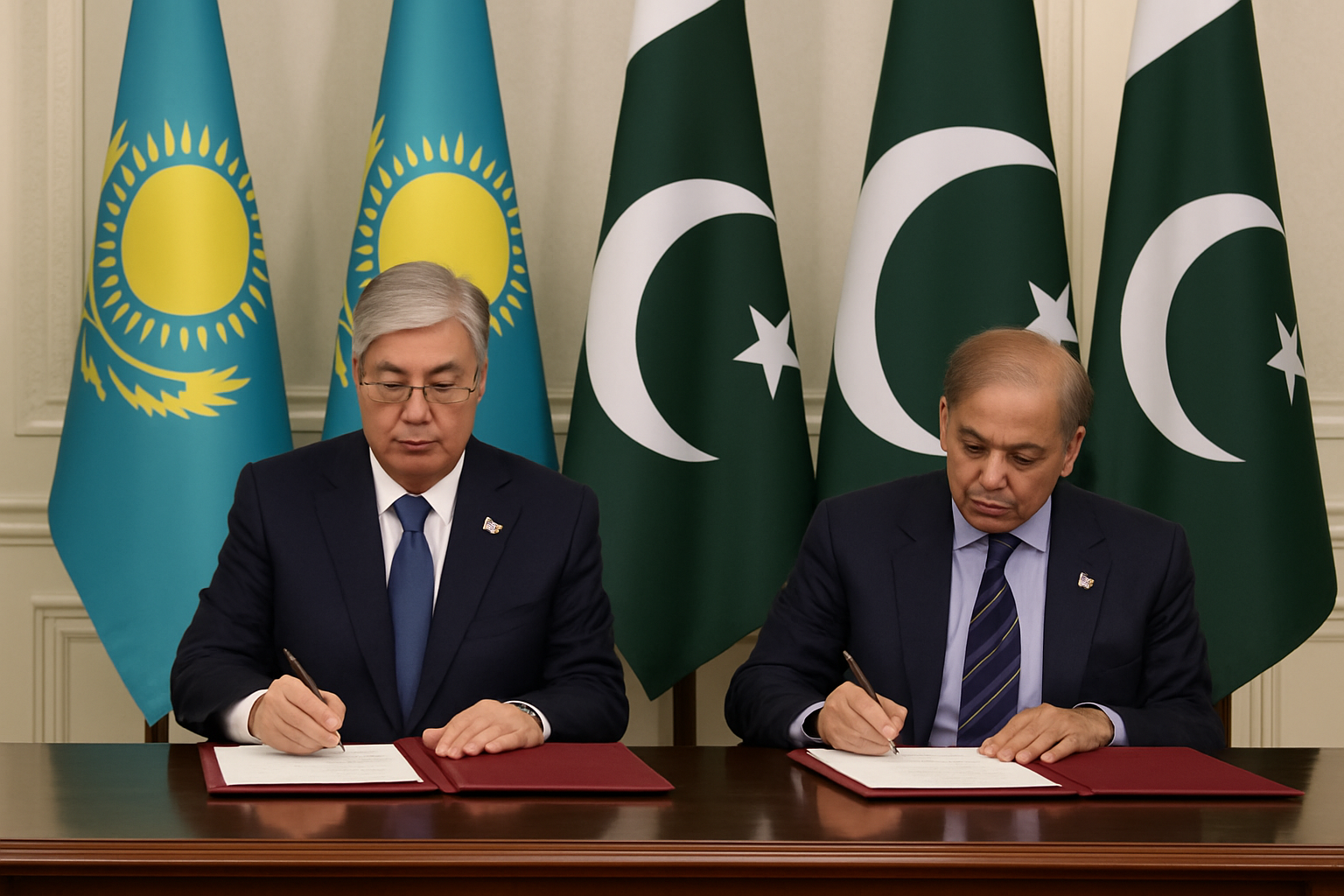
Kazakhstan and Pakistan have elevated their bilateral relationship to strategic partnership level, with President Kassym-Jomart Tokayev and Prime Minister Shehbaz Sharif signing a Joint Declaration on the Establishment of a Strategic Partnership during Tokayev's historic state visit to Pakistan on February 4, 2026.
The landmark agreement marks a significant milestone in Central-South Asian cooperation, with both nations committing to boost bilateral trade to $1 billion in the medium term while expanding collaboration across multiple strategic sectors including petroleum, mining, and maritime infrastructure.
High-Level Diplomatic Breakthrough
President Tokayev's two-day state visit to Pakistan represents his first state visit as Kazakhstan's head of state, underscoring the strategic importance both nations place on deepening their partnership. The talks, conducted in both narrow and expanded formats at the official residence, demonstrated what Prime Minister Sharif characterized as a "shared commitment to deepening the strategic partnership between the two countries."
The comprehensive agreement package includes 37 separate agreements and memorandums of understanding spanning critical sectors of bilateral cooperation. This represents one of the most extensive diplomatic frameworks established between the two nations since their independence.
"This step elevates our bilateral relationship to unprecedented levels of cooperation," President Tokayev stated during the signing ceremony.
— President Kassym-Jomart Tokayev, Kazakhstan
Economic Integration and Trade Expansion
The strategic partnership framework establishes ambitious targets for bilateral economic cooperation, with both countries committing to achieve $1 billion in bilateral trade volumes. This represents a substantial increase from current trade levels and reflects the untapped potential for economic integration between Central and South Asia.
Key economic sectors identified for enhanced cooperation include:
- Petroleum exploration and development, leveraging Kazakhstan's 30+ billion barrel reserves against Pakistan's 1.5 million barrels per day import requirements
- Mining partnerships focusing on uranium, copper, zinc, and rare earth elements
- Maritime infrastructure development, including potential access to Pakistan's Gwadar Port
- Agricultural trade expansion and food security cooperation
- Technology transfer and industrial modernization
Energy Sector Cooperation
The partnership places particular emphasis on energy sector collaboration, addressing Pakistan's significant energy import needs through Kazakhstan's substantial hydrocarbon resources. With Pakistan importing approximately 1.5 million barrels of oil daily and Kazakhstan possessing over 30 billion barrels in proven reserves, the partnership offers mutual benefits for energy security and export diversification.
The agreement includes provisions for national currency trade mechanisms, reducing both countries' dependence on dollar-denominated transactions and potentially enhancing trade efficiency. This reflects broader regional trends toward currency diversification in international trade.
Strategic Regional Context
The Kazakhstan-Pakistan strategic partnership unfolds against a backdrop of significant regional diplomatic activity. Both nations are members of the Shanghai Cooperation Organization (SCO), providing an established institutional framework for broader multilateral cooperation.
The timing coincides with several major regional developments, including ongoing efforts to stabilize Afghanistan, China's Belt and Road Initiative expansion, and evolving Central Asian connectivity projects. For Kazakhstan, the partnership provides alternative trade routes beyond traditional northern corridors, while Pakistan gains access to critical energy resources and minerals essential for technological development.
Implementation Framework
The strategic partnership establishes comprehensive institutional mechanisms for implementation, including:
- Regular high-level consultations between government officials
- Technical working groups for sector-specific cooperation
- Joint investment committees to facilitate private sector engagement
- Monitoring mechanisms to track progress on bilateral commitments
Both nations have committed to establishing dedicated coordination bodies to ensure effective implementation of the 37 signed agreements and to identify additional areas for cooperation.
Security and Infrastructure Considerations
While the partnership offers significant economic opportunities, successful implementation will require addressing security challenges, particularly in Pakistan's Balochistan province, which has recently experienced heightened tensions. The region's stability is crucial for protecting infrastructure investments and ensuring safe trade corridors.
The agreement includes provisions for infrastructure protection and security cooperation, reflecting both nations' recognition that economic development requires stable operating environments. Pakistan's recent counter-terrorism operations in Balochistan, while demonstrating government capacity, also highlight the security considerations inherent in major infrastructure projects.
Maritime and Connectivity Dimensions
A significant component of the strategic partnership involves maritime cooperation, potentially including Kazakhstan's access to Pakistan's strategic Gwadar Port. This development would provide Kazakhstan with important southern connectivity options, complementing its existing northern and western trade routes.
The maritime dimension is particularly significant given Pakistan's role in the China-Pakistan Economic Corridor (CPEC) and its position along crucial shipping lanes. For Kazakhstan, southern maritime access could revolutionize its export capabilities and reduce dependence on traditional transit routes.
Future Implications
The Kazakhstan-Pakistan strategic partnership could serve as a template for broader Central-South Asian integration, potentially influencing regional connectivity patterns and economic relationships. The success of this partnership may encourage similar agreements between other Central Asian and South Asian nations.
Industry analysts expect the partnership to generate thousands of jobs in both countries while building local capabilities across traditional and emerging technology sectors. The emphasis on technology transfer and capacity building suggests long-term benefits beyond immediate trade volume increases.
Both nations face the challenge of translating diplomatic commitments into concrete economic outcomes. Success will depend on sustained political will, effective institutional coordination, and the private sector's ability to capitalize on new opportunities created by the strategic framework.
The strategic partnership represents a significant evolution in Central-South Asian relations, demonstrating how neighboring regions can develop mutually beneficial cooperation frameworks that enhance economic security while promoting regional stability and integration.