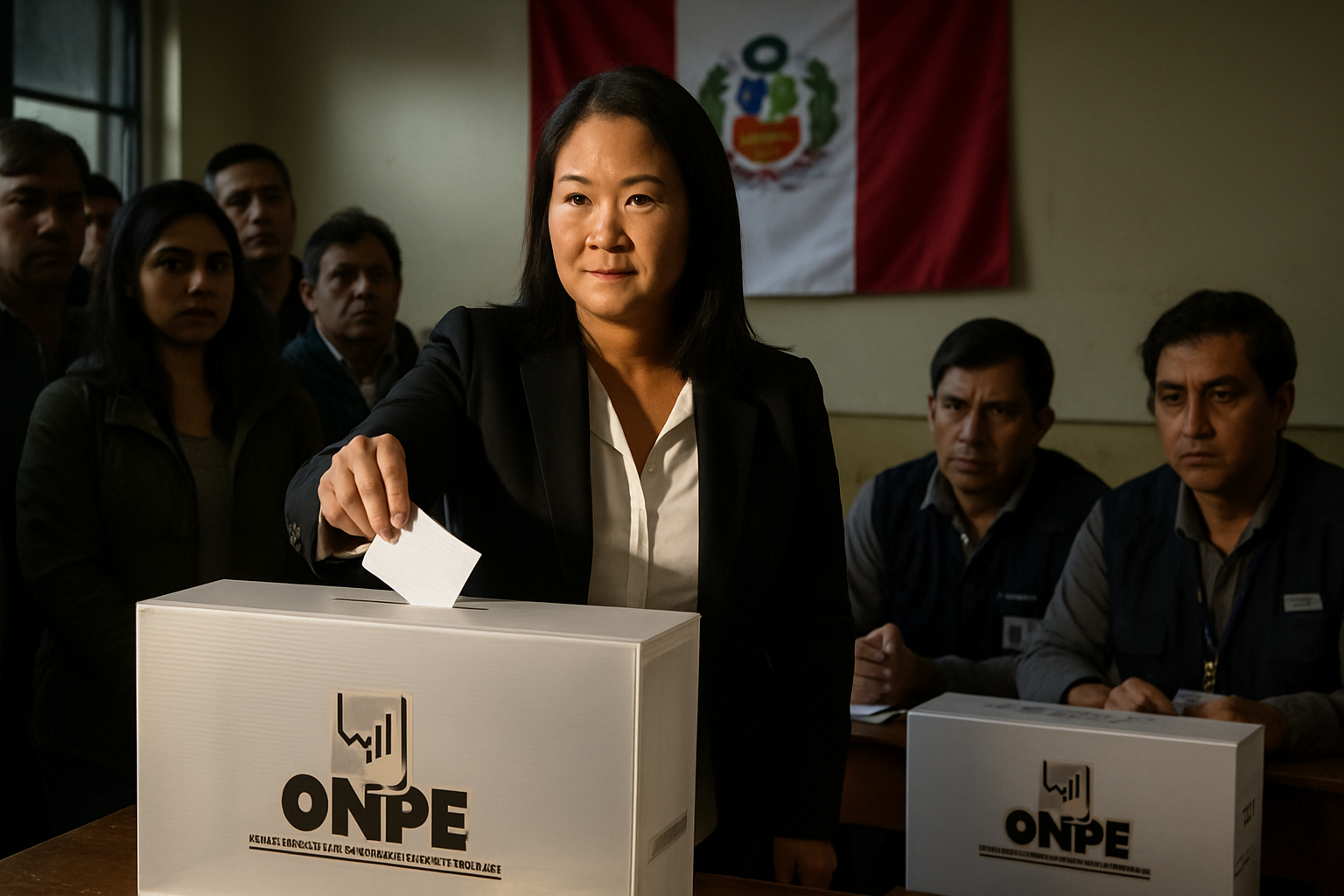
Right-wing candidate Keiko Fujimori has taken an early lead in Peru's presidential election according to exit polls, but massive organizational failures have forced electoral authorities to extend voting into Monday, marking one of the most chaotic election days in the country's democratic history.
According to polling firm Datum, Fujimori secured 16.5% of votes in her fourth presidential attempt, followed by ultra-conservative Rafael López Aliaga with 12.8%. Center-right candidate Jorge Nieto obtained 11.6%, while right-wing Ricardo Belmont garnered 10.5% in the crowded field of 35 candidates.
The election, which should have concluded at 6:00 PM on Sunday, was marred by unprecedented logistical failures that prevented over 52,000 voters from casting their ballots. Peru's National Elections Jury (JNE) made the extraordinary decision to extend voting hours until Monday 6:00 PM in affected areas after the National Office of Electoral Processes (ONPE) failed to install 187 voting tables across 13 polling locations.
Electoral Crisis Forces Historic Extension
The electoral chaos was most severe in Lima's southern districts, including San Juan de Miraflores, Lurín, and Pachacámac, where critical voting materials never arrived. Long lines of frustrated voters waited for hours only to discover their polling stations could not open due to missing ballot boxes, voting records, and other essential materials.
"They have not provided guarantees of a clear process... There is no other name for this than fraud," declared Karina Herrera, one of hundreds protesting outside ONPE headquarters as the crisis unfolded.
The Organization of American States (OAS) Electoral Observation Mission praised the JNE's decision to extend voting hours, calling it "timely" to guarantee voting rights. However, the crisis has raised serious questions about ONPE's competence and preparation for what many consider Peru's most critical election in decades.
"One hour before the flash electoral results were announced, which positioned her in first place, presidential candidate Keiko Fujimori criticized ONPE chief Piero Corvetto for the non-installation of 211 voting tables."
— El Comercio coverage of Fujimori's election day activities
Political Context: Ninth President in a Decade
The election takes place against a backdrop of unprecedented political instability. Peru is seeking its ninth president in ten years following the February removal of José María Balcázar's predecessor José Jerí over the "Chifagate" scandal involving secret meetings with Chinese contractors. This pattern of presidential instability includes the removal of Martín Vizcarra in 2020, Pedro Castillo's coup attempt in 2022, and Dina Boluarte's exit in 2025.
The constitutional "vacancy" procedure has been repeatedly weaponized by Congress, reducing average presidential tenure by 70% since 2016. Business confederation CONFIEP has warned the country "cannot afford a new stage of uncertainty" as political instability threatens economic confidence and international investment.
For Fujimori, daughter of imprisoned former president Alberto Fujimori, this represents her fourth attempt at the presidency. She previously reached runoff elections in 2011, 2016, and 2021 but failed to secure victory. Her campaign has focused heavily on security concerns amid rising violence, daily extortions, and increased homicides that have reshaped daily life, particularly in Lima.
Fragmented Political Landscape
The massive field of 35 presidential candidates virtually guarantees a runoff election, extending the period of uncertainty well beyond Sunday's voting. No candidate is expected to achieve the 50% threshold required for first-round victory, meaning the top two finishers will compete in a second round.
The fragmented political landscape reflects deep divisions in Peruvian society about the country's direction. Voters are choosing not only a president but also senators, deputies, and Andean Parliament representatives under a new electoral threshold system designed to reduce political fragmentation.
Security has dominated the campaign discourse, with candidates competing over proposals to address organized crime, drug trafficking, and the general climate of fear that has gripped much of the country. The deteriorating security situation has become a central electoral issue, influencing voter preferences and campaign strategies.
International Implications and Democratic Resilience
International observers are monitoring Peru's election as a critical test of democratic resilience in Latin America. The country's chronic political instability has broader regional implications, as Peru plays an important role in Andean cooperation and serves as a potential template for democratic governance challenges.
The election also carries implications for Peru's relationship with major powers. The "Chifagate" scandal raised questions about Chinese influence through Belt and Road Initiative infrastructure projects, including the controversial Chancay Port. These sovereignty concerns have become electoral issues affecting candidates' foreign policy positions toward China and the United States.
Despite the organizational chaos, millions of Peruvians demonstrated their commitment to democratic participation by waiting in long lines and persisting through the difficulties. This civic engagement provides hope for democratic consolidation even amid institutional challenges.
Looking Ahead: Challenges for Democratic Governance
The next president will inherit a country facing multiple crises: chronic political instability, rising crime rates, economic uncertainty, and severely damaged institutional trust. Success will require not only competent leadership but fundamental structural reforms to address the systematic problems that have made Peru seemingly ungovernable.
The electoral chaos experienced Sunday underscores the urgent need for institutional strengthening and electoral reform. The fact that over 52,000 citizens were denied their fundamental right to vote represents a serious democratic failure that must be addressed to restore public confidence in electoral institutions.
As vote counting continues and results are tallied, Peru faces a critical test of whether it can break its cycle of political crisis and establish the governance stability necessary for effective democracy and economic development. The stakes extend far beyond Peru's borders, as the outcome will influence regional stability and serve as a model for democratic consolidation efforts across Latin America.
With no clear frontrunner emerging and a runoff election virtually certain, Peru's political uncertainty is set to continue for weeks or months to come. The ultimate question remains whether the country can transition from crisis management to democratic consolidation, or whether it will remain trapped in a permanent pattern of institutional breakdown that has characterized the past decade.