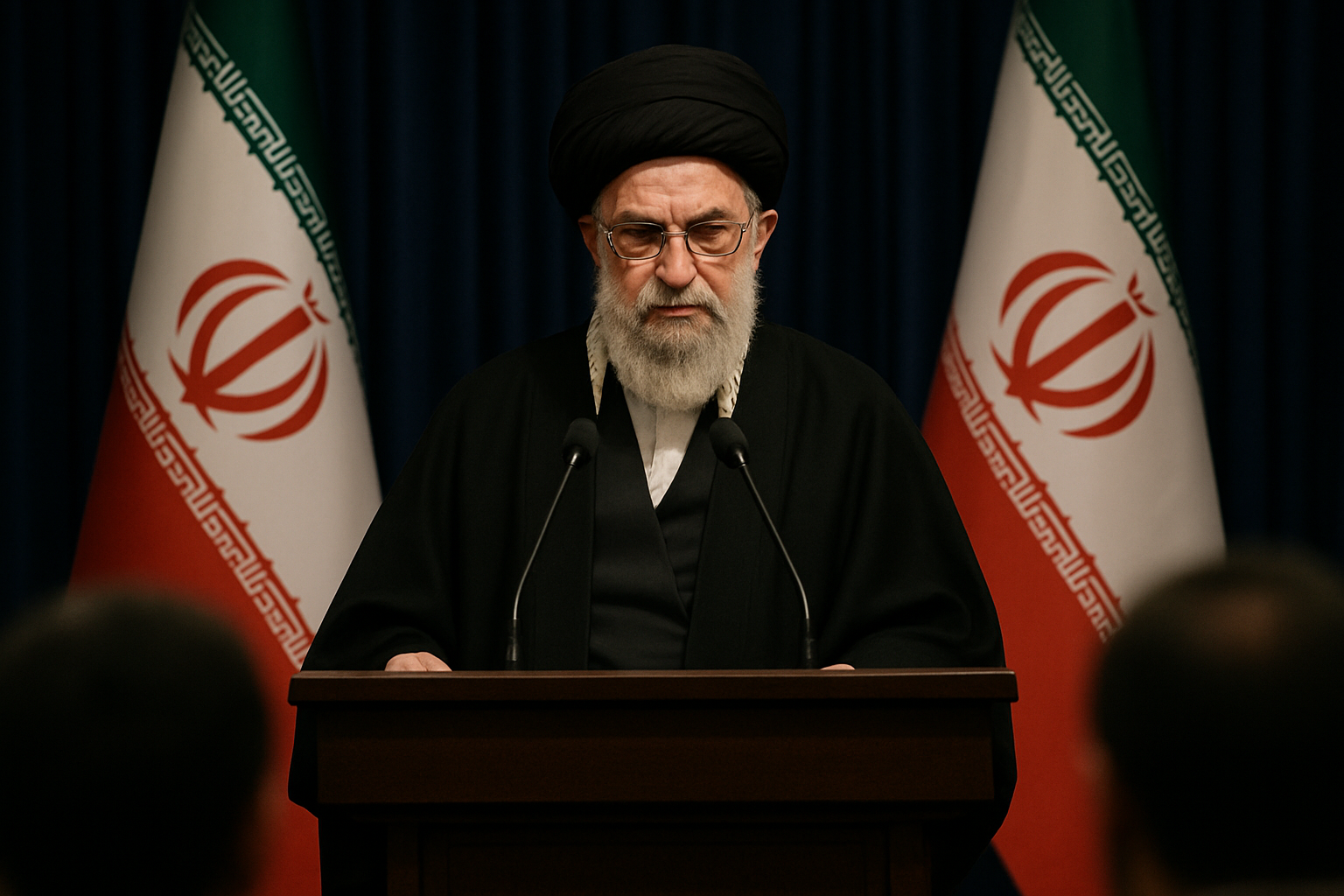
Iran's Supreme Leader Mojtaba Khamenei delivered a defiant Persian New Year message claiming the Islamic Republic's enemies have been "defeated" in their conflict with the United States and Israel, while categorically denying Iranian responsibility for recent attacks on Turkey and Oman.
The message, broadcast on Iranian state television Friday for Nowruz celebrations, marked Khamenei's first major public address since assuming the supreme leadership role following his father Ali Khamenei's death in March. Notably, the younger Khamenei has yet to appear publicly since the ongoing conflict began, with the written message read by television presenters.
Claims of Victory Amid Ongoing Conflict
In the televised statement, Khamenei asserted that Iran's "frontline is much stronger than enemies imagine," emphasizing that Tehran had faced three military and security wars over the past year in reference to escalating confrontations with the United States and Israel and their regional ramifications.
The Supreme Leader's message comes as Iran continues to face the most dangerous international crisis since the Cold War, with ongoing military operations that have disrupted global energy markets, aviation networks, and diplomatic relations across the Middle East. Oil prices have surged past $100 per barrel as Iran maintains effective control over the Strait of Hormuz, which carries 40% of global oil transit.
"The outbreak of war came after the enemy despaired of achieving an internal popular movement in his favor"
— Supreme Leader Mojtaba Khamenei, Nowruz Message
Denial of Regional Attacks
Significantly, Khamenei denied Iranian involvement in recent strikes against Turkey and Oman, describing these as Israeli false flag operations designed to damage Iran's relationships with friendly nations. "Ankara and Muscat have good relations with us," the message stated, suggesting the attacks were part of an Israeli plan to isolate Iran diplomatically.
This denial comes amid reports of systematic Iranian retaliation operations targeting regional allies of the United States and Israel. The ongoing "Operation True Promise 4" has resulted in casualties across multiple Gulf states, with the Islamic Revolutionary Guard Corps declaring that "no red lines remain" in their targeting protocols.
Historical Context of Hereditary Succession
Mojtaba Khamenei's leadership represents the first hereditary succession in the Islamic Republic's 47-year history, marking a fundamental shift from clerical to military governance under Revolutionary Guards influence. Intelligence assessments suggest this transition consolidates hardline military control over Iranian state apparatus during the most critical period in the nation's modern history.
The younger Khamenei assumed power following the death of his father Ali Khamenei in March 2026, ending a 37-year rule that transformed Iran into a regional anti-American power. The succession occurred during active warfare conditions, breaking Islamic Republic constitutional norms that traditionally favored clerical leadership.
Regional and Global Implications
The Supreme Leader's defiant tone contrasts sharply with the unprecedented international pressure facing Iran. The conflict has triggered the largest coordinated evacuation since the Arab Spring of 2011, with Australia alone reporting 115,000 nationals trapped in the region and Germany evacuating 30,000 stranded tourists.
European territory was attacked for the first time since World War II when Iranian drones struck RAF Akrotiri in Cyprus, prompting an unprecedented naval coalition response including HMS Dragon and frigates from Spain, Italy, France, Netherlands, and Greece. The European Union activated its ESTIA evacuation protocol for the first time in bloc history.
Economic and Energy Crisis
The ongoing conflict has created a global energy crisis of unprecedented scale. The International Energy Agency released a record 400 million barrels from strategic reserves—the largest intervention in the agency's 50-year history. Natural gas prices have surged 24% in Europe and 78% in the United States, while Qatar has halted LNG production, affecting approximately 20% of global exports.
Global aviation networks remain paralyzed with over 18,000 flights cancelled worldwide, making this the most severe aviation disruption since COVID-19. Eight Middle Eastern countries maintain simultaneous airspace closures, with Dubai International Airport—the world's busiest—remaining shuttered due to missile damage.
Diplomatic Breakdown and Nuclear Concerns
The current crisis emerged from the complete breakdown of nuclear diplomacy despite what negotiators described as achieving "broad agreement on guiding principles"—the most progress since the JCPOA collapse in 2018. Fundamental disagreements over Iran's ballistic missile program and regional proxy networks proved insurmountable, with Iran maintaining these were "red lines" while the United States demanded comprehensive reforms.
Iran continues uranium enrichment at 60% purity with over 400 kilograms of weapons-grade material—sufficient for multiple nuclear weapons if weaponized. This occurs amid a broader nuclear governance crisis, with the New START treaty having expired in February 2026, leaving the world without US-Russia nuclear constraints for the first time in over 50 years.
Congressional and International Response
The conflict faces unprecedented bipartisan opposition in the US Congress, with lawmakers demanding comprehensive strategy answers and expressing concerns about potential ground troop deployment. Senator Richard Blumenthal stated he was "more concerned than ever" about boots on the ground, while conflict unpopularity has reached historically low levels with only 25% American support.
UN Secretary-General António Guterres has called the crisis the "greatest test of multilateral cooperation in the modern era," emphasizing the template-setting nature of how this conflict resolves for future territorial and nuclear disputes globally.
Looking Forward
Khamenei's Nowruz message signals Iranian determination to continue resistance despite mounting international pressure. The Supreme Leader's claims of victory appear designed to project strength domestically while his denial of regional attacks suggests awareness of the diplomatic costs of expanding the conflict beyond Iran's immediate adversaries.
The crisis represents a watershed moment in international relations, with implications extending decades beyond current events. Success in containing the conflict could provide a framework for future nuclear crisis resolution, while failure may accelerate military solutions, reshape Middle Eastern geopolitics for generations, and undermine diplomatic credibility worldwide.
As the conflict enters a critical phase, the world faces what experts describe as the most consequential international crisis since the Cold War, affecting global energy security, nuclear governance credibility, and the fundamental principles of post-World War II international order.