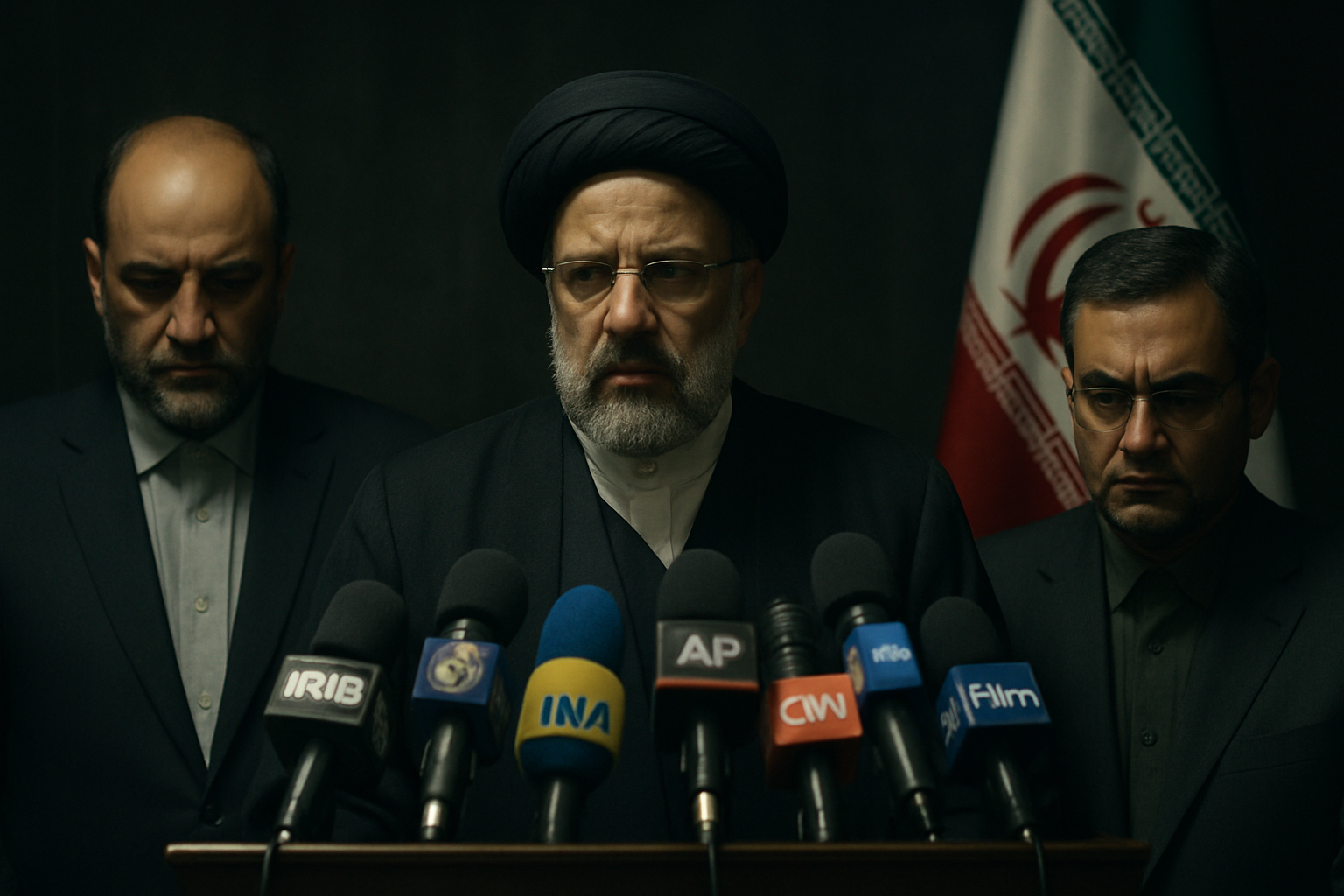
Iranian state media confirmed on March 1, 2026, that multiple family members of Supreme Leader Ayatollah Ali Khamenei were killed during the coordinated US-Israeli military operation known as "Epic Fury," marking an unprecedented escalation in targeting the Iranian leadership's inner circle.
According to Fars news agency and multiple Iranian sources, Khamenei's daughter, son-in-law, and granddaughter were killed in what Iranian officials described as Saturday morning strikes. Additional reports from Mehr news agency and sources close to the Supreme Leader's office confirmed that a daughter-in-law was also among the casualties.
Confirmation from Multiple Sources
The news was first reported by Iranian media outlets and subsequently confirmed by international news agencies. Sky News, citing Fars agency, reported that the family members died during "broad daylight" strikes that targeted multiple locations across Iran.
Italian news agency ANSA quoted Fars sources as saying the deaths were "confirmed by sources close to the Supreme Leader's family." Norwegian broadcaster NRK reported that Iranian media described the casualties as occurring during "USA and Israel's attacks against Iran on Saturday."
Egyptian media outlet Sada El Balad reported that in addition to the daughter, son-in-law, and granddaughter, a daughter-in-law of the Supreme Leader was also killed in the attacks.
Operation Epic Fury Context
The family casualties occurred during the largest US-Israeli coordinated military operation against Iran since 2003, dubbed "Operation Epic Fury." The operation involved unprecedented dual-carrier deployment of USS Gerald R. Ford and USS Abraham Lincoln, representing approximately one-third of the active US Navy fleet positioned within 800 kilometers of Iran's coast.
The strikes followed the complete breakdown of nuclear negotiations in Geneva, despite earlier achieving what Iranian Foreign Minister Abbas Araghchi had described as "broad agreement on guiding principles" - the most significant diplomatic progress since the 2018 JCPOA collapse.
"After contact with well-informed sources in the Supreme Leader's household, the news of the martyrdom of the daughter, son-in-law and granddaughter of the revolutionary leader has unfortunately been confirmed."
— Fars News Agency
Disputed Reports of Khamenei's Death
Alongside the confirmed family casualties, conflicting reports emerged regarding the status of Supreme Leader Khamenei himself. Israeli sources claimed the 85-year-old leader was killed in the strikes, with multiple Israeli officials suggesting his compound was destroyed.
However, Iranian Foreign Minister Abbas Araghchi firmly denied these claims, stating Khamenei is "still alive as far as I know" while acknowledging that "one or two commanders" were killed in the operations. Iranian media dismissed the death reports as "psychological warfare."
The absence of official confirmation from either US or Israeli governments regarding Khamenei's alleged death, combined with Iranian denials, leaves his status unverified despite the scale of targeting Iranian leadership.
Massive Iranian Retaliation
In response to the strikes, the Islamic Revolutionary Guard Corps (IRGC) launched what it described as a "first wave" of retaliatory missiles and drones targeting Israeli and US installations across the Gulf region. Iranian officials declared that "no red lines remain" and that all US and Israeli assets are now "legitimate targets."
The retaliation resulted in casualties across multiple countries: one civilian was killed in Abu Dhabi, UAE, from missile debris; Kuwait's airport was struck by drones causing employee injuries; explosions occurred in Dubai; and US military installations in Qatar and Bahrain came under attack.
Nuclear Diplomacy Collapse
The military escalation followed the breakdown of intensive nuclear negotiations that had achieved unprecedented progress. The Geneva talks, mediated by Switzerland and Oman, had reached what Araghchi described as "broad agreement on guiding principles" - the most significant breakthrough since the 2018 JCPOA collapse.
However, fundamental disagreements persisted over the scope of any agreement. Iran maintained that ballistic missiles and regional proxy support were "red lines" that should be excluded from nuclear-only talks, while US Secretary of State Marco Rubio insisted on a comprehensive agreement covering missiles, armed groups, and human rights.
Unprecedented Regional Coalition
The crisis has severely strained an unprecedented regional coalition of Saudi Arabia, UAE, Qatar, and Egypt that had been backing the diplomatic process. The attacks on Gulf territories have complicated this extraordinary Middle Eastern consensus that had been supporting negotiations to prevent military confrontation.
Egypt condemned the Iranian strikes on "sisterly Arab countries," warning of "comprehensive chaos" in the region. The disruption of this coalition represents a significant setback for regional stability efforts.
Global Aviation Crisis
The escalation has triggered a massive global aviation crisis, with Iran, Iraq, Israel, UAE, and Qatar all closing their airspace to civilian traffic. Major carriers including Emirates, Air France-KLM, Wizz Air, and Bulgarian Air have suspended Middle East operations, affecting hundreds of thousands of passengers worldwide.
The Middle East serves as a critical Europe-Asia connecting hub, and the airspace closures have created the most extensive regional flight disruption since the COVID-19 pandemic.
International Reactions
The United Nations Security Council has scheduled an emergency session following requests from France, China, Russia, Colombia, and Bahrain. Russia has condemned what it described as "reckless actions by Washington and West Jerusalem" as violations of international law.
Multiple European governments have issued urgent travel warnings, with Sweden and Serbia ordering immediate evacuations of their citizens from Iran, citing "extremely uncertain" security conditions.
Nuclear Governance Crisis
The crisis occurs amid a broader breakdown in global nuclear governance, with the New START treaty having expired on February 5, 2026 - the first time in over 50 years without US-Russia nuclear arms constraints. UN Secretary-General António Guterres has warned that nuclear risks are at their "highest levels in decades."
Iran continues enriching uranium at 60% purity, significantly above the 3.67% limit set in the JCPOA, and approaching the 90% threshold considered weapons-grade. Intelligence sources suggest Iran now possesses sufficient enriched uranium for multiple weapons if the decision were made to weaponize.
Historical Significance
The targeting of Khamenei's immediate family members represents an unprecedented escalation in the conflict between the US-Israeli alliance and Iran. If confirmed, it would mark one of the most direct attacks on a sitting head of state's family in modern international relations.
Khamenei has served as Supreme Leader since 1989, following the death of Ayatollah Ruhollah Khomeini, and has overseen Iran's transformation into a major regional power with significant influence across the Middle East through proxy networks and military capabilities.
Implications for Regional Security
The family casualties and broader Operation Epic Fury represent a critical juncture in Middle East geopolitics. The collapse of the most promising US-Iran diplomatic opening in years, combined with the escalation to direct family targeting, suggests the conflict has entered a new and more dangerous phase.
The success or failure of international efforts to contain this escalation will likely influence approaches to conflict resolution beyond the current crisis, potentially setting precedents for military versus diplomatic solutions to international disputes for decades to come.
As the situation continues to develop, the international community faces urgent pressure to prevent further escalation while addressing the underlying issues that led to this dramatic breakdown in diplomacy and surge in military confrontation.