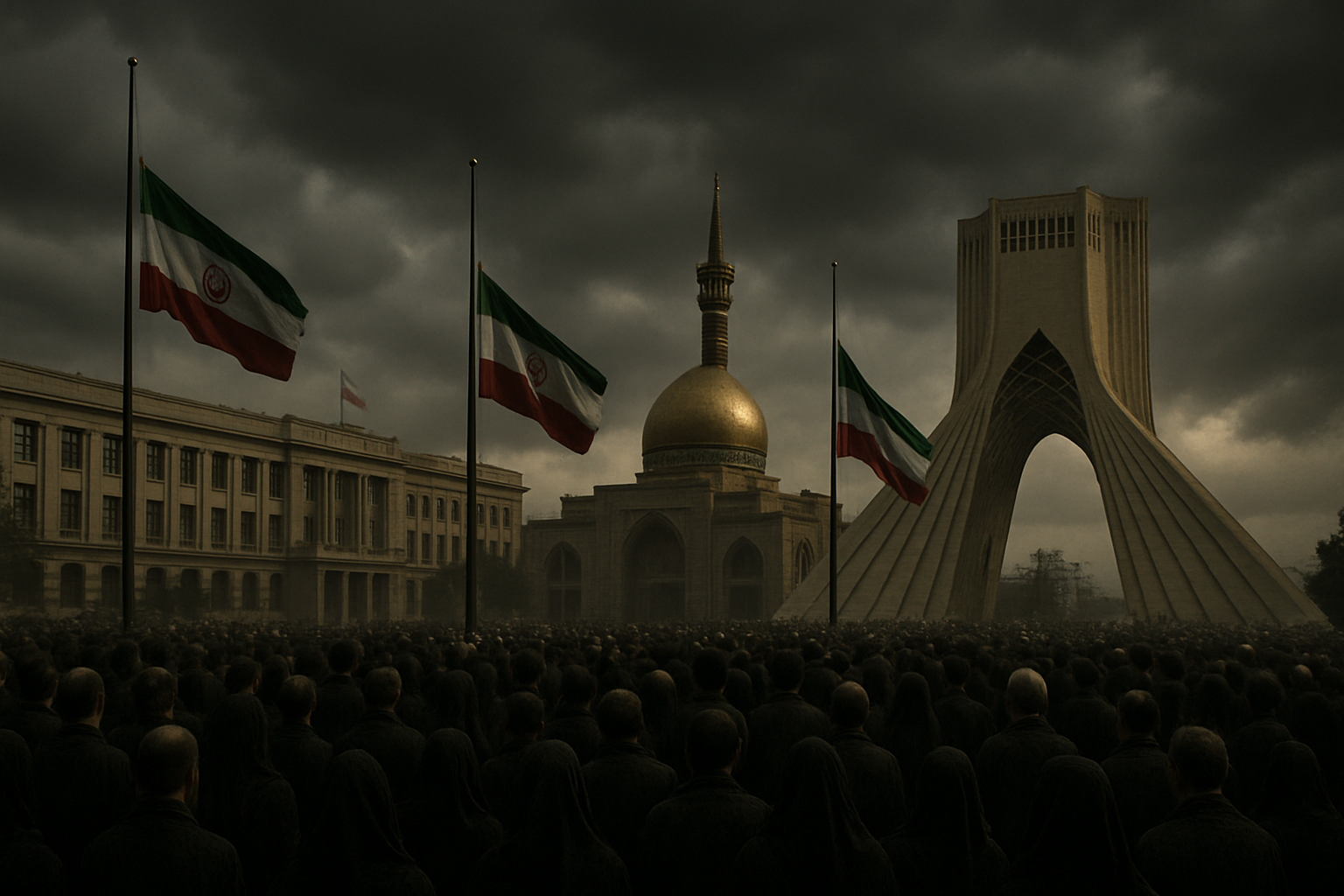
Iranian state media officially confirmed the death of Supreme Leader Ayatollah Ali Khamenei on Sunday following coordinated US-Israeli military strikes, marking the end of his 37-year rule and triggering the most dangerous Middle East crisis in decades.
The 86-year-old cleric died "at his place of work" in Tehran's leadership compound while "performing official duties," according to state television broadcasts. Iran has declared 40 days of official mourning and formed a three-member transitional council as the Islamic Republic faces its gravest existential challenge since the 1979 revolution.
Operation Epic Fury: Unprecedented Military Action
The coordinated strikes, codenamed "Operation Epic Fury," represented the largest US-Israeli military operation since the 2003 Iraq invasion. President Donald Trump confirmed Khamenei's death hours before Iranian state media, calling him "one of the most evil people in History" and describing the moment as "the single greatest chance for the Iranian people to take back their country."
The operation involved unprecedented dual-carrier deployment of USS Gerald R. Ford and Abraham Lincoln, representing approximately one-third of the active US Navy fleet positioned 800 kilometers from Iran's coast. Israeli Prime Minister Benjamin Netanyahu claimed "growing indications" that Khamenei was "no longer with us" after strikes destroyed the Supreme Leader's compound.
"At least four senior Iranian commanders were killed alongside Ali Khamenei in the reported joint strikes, marking a significant blow to Iran's top military leadership."
— Islamic Revolutionary Guard Corps Statement
Among the confirmed casualties were Defense Minister Aziz Nasirzadeh, IRGC Chief Mohammad Pakpour, and senior aide Ali Shamkhani. The operation also targeted Khamenei's family directly, killing his daughter, son-in-law, granddaughter, and daughter-in-law according to Fars News Agency reports.
Iran's Immediate Retaliation
Iran's Islamic Revolutionary Guard Corps launched what it called "Operation True Promise 4," declaring "no red lines remain" as it systematically targeted US and Israeli assets across the Middle East. The retaliatory strikes caused casualties across multiple Gulf nations:
- United Arab Emirates: One civilian killed in Abu Dhabi from missile debris, Dubai International Airport completely shut down with extensive damage
- Kuwait: Airport Terminal 1 struck by drones causing employee injuries
- Qatar: 65 ballistic missiles and 12 drones intercepted by Patriot systems, 8 people injured
- Bahrain: Fifth Fleet headquarters targeted with residential areas hit
- Israel: Tel Aviv residential building struck, killing one woman and injuring 27, including an infant
The Iranian retaliation extended beyond direct targets, with strikes hitting luxury hotels in Dubai's Palm Jumeirah district and causing fires at the iconic Burj Al Arab. At least nine people were killed in violent clashes at the US Consulate in Pakistan as protesters stormed the facility.
Global Aviation Crisis Unfolds
The escalation triggered the most comprehensive aviation disruption since the COVID-19 pandemic. Iran, Iraq, Israel, UAE, and Qatar closed their airspace completely, forcing the cancellation of over 18,000 flights worldwide. Major carriers including Emirates, Air France-KLM, Wizz Air, and Bulgaria Air suspended Middle East operations, affecting hundreds of thousands of passengers globally.
Dubai International Airport, the world's busiest hub for international passengers, remained completely shut down as debris from missile interceptions damaged runways and terminals. The closure severely disrupted the critical Europe-Asia travel corridor, with complex rerouting required for long-haul flights.
Nuclear Diplomacy's Collapse
The military escalation came despite recent diplomatic progress in Geneva talks that had achieved "broad agreement on guiding principles" - the most significant breakthrough since the JCPOA collapse in 2018. However, fundamental disagreements over scope proved insurmountable.
Iran had maintained ballistic missiles and regional proxies as "red lines" excluded from nuclear-only talks, while the US demanded comprehensive agreements including missiles, armed groups, and human rights issues. Despite the diplomatic opening, Iran continued uranium enrichment at 60% purity - approaching the 90% weapons-grade threshold - with sufficient material for multiple nuclear weapons if weaponized.
"We will burn the hearts of America and Israel as our hearts have burned. The enemy is delusional if it thinks the assassination of leaders will destabilize Iran."
— Ali Larijani, Secretary of Iran's Supreme National Security Council
Constitutional Succession Crisis
Iran has established an Interim Leadership Council consisting of President Masoud Pezeshkian, the judiciary head, and a Guardian Council jurist, following constitutional protocols. The Assembly of Experts, comprising 88 clerics, is responsible for selecting a permanent successor, though the process faces unprecedented challenges amid external military pressure.
The succession occurs against a backdrop of severe domestic unrest, with over 42,000 arrests since 2022 protests. CIA assessments suggest a Revolutionary Guards member likely as successor, indicating potential hardline military influence in the next leadership selection.
International Reactions and Energy Markets
The crisis sent shockwaves through global markets, with oil prices rising sharply on concerns about the Strait of Hormuz - through which 40% of global oil transit passes. Iran warned that shipping through the strait would "not be allowed" in retaliation for the strikes.
Russian President Vladimir Putin expressed condolences to Iran's president, condemning Khamenei's killing as "committed in cynical violation of all norms of human morality and international law." The UN Security Council convened an emergency session as governments across Muslim-majority nations in South and Southeast Asia called for restraint.
UK Defence Secretary John Healey stated that "few will mourn" Khamenei, describing the Iranian regime as "evil" and noting its sponsorship of at least 20 terror plots against the UK. Multiple European nations issued immediate travel warnings and began evacuating embassy personnel from the region.
Spontaneous Celebrations and Protests
Despite the regime's decades-long grip on power, reports emerged of spontaneous celebrations across Tehran as news of Khamenei's death spread. Residents were seen dancing at bus stops, participating in car parades, and chanting "the tyrant is no more" from balconies. Revolutionary Guards reportedly told citizens to leave the city as celebrations grew.
Similar scenes played out among Iranian diaspora communities worldwide, with hundreds celebrating in Rome's Piazza San Giovanni and "full celebrations" outside the Iranian embassy in Oslo. However, pro-government demonstrations also occurred in southern Iranian cities, with thousands calling for vengeance against the United States and Israel.
Nuclear Governance in Crisis
The crisis unfolds against a broader nuclear governance breakdown, with the New START treaty between the US and Russia having expired on February 5 - the first time in over 50 years without such constraints. Combined with China's nuclear expansion, UN Secretary-General António Guterres warned that nuclear risks are now "at their highest in decades."
The collapse of Iran diplomacy raises fundamental questions about the viability of diplomatic solutions to modern nuclear crises, potentially setting a dangerous precedent for 21st-century proliferation challenges.
Regional Coalition Under Strain
The unprecedented coalition of Saudi Arabia, UAE, Qatar, and Egypt that had backed diplomatic efforts now faces severe strain as Iranian retaliation directly targeted member territories. Egyptian President Abdel Fattah el-Sisi condemned attacks on "sisterly Arab countries," warning of potential "comprehensive chaos" across the region.
The crisis disrupted what analysts described as the most extraordinary Middle Eastern consensus in decades, as nations that had united behind conflict prevention now faced direct attacks on their own soil.
Historical Significance and Global Implications
Khamenei's death marks the end of an era that began with Iran's 1979 Islamic Revolution. As Supreme Leader since 1989, he transformed Iran into a regional anti-US power with extensive proxy networks spanning from Lebanon to Yemen. His death creates immediate questions about the future of the Islamic Republic as currently constituted.
The rapid transition from diplomacy to military escalation demonstrates the fragility of modern crisis management in a multipolar era. Success in containing the escalation could provide a template for future international crisis resolution, while failure may accelerate military solutions over diplomatic approaches, potentially reshaping regional geopolitics for decades.
The stakes extend far beyond the Middle East, affecting global energy security, nuclear governance credibility, and international law enforcement mechanisms. As the world watches, the coming days will determine whether this crisis marks a contained confrontation or the beginning of a broader regional war with worldwide implications for conflict resolution in the 21st century.
March 1, 2026, now stands as one of the most dangerous moments since the Cold War's end, with the potential to reshape not only Middle Eastern geopolitics but also the international system's approach to nuclear proliferation, territorial sovereignty, and diplomatic engagement versus military solutions.