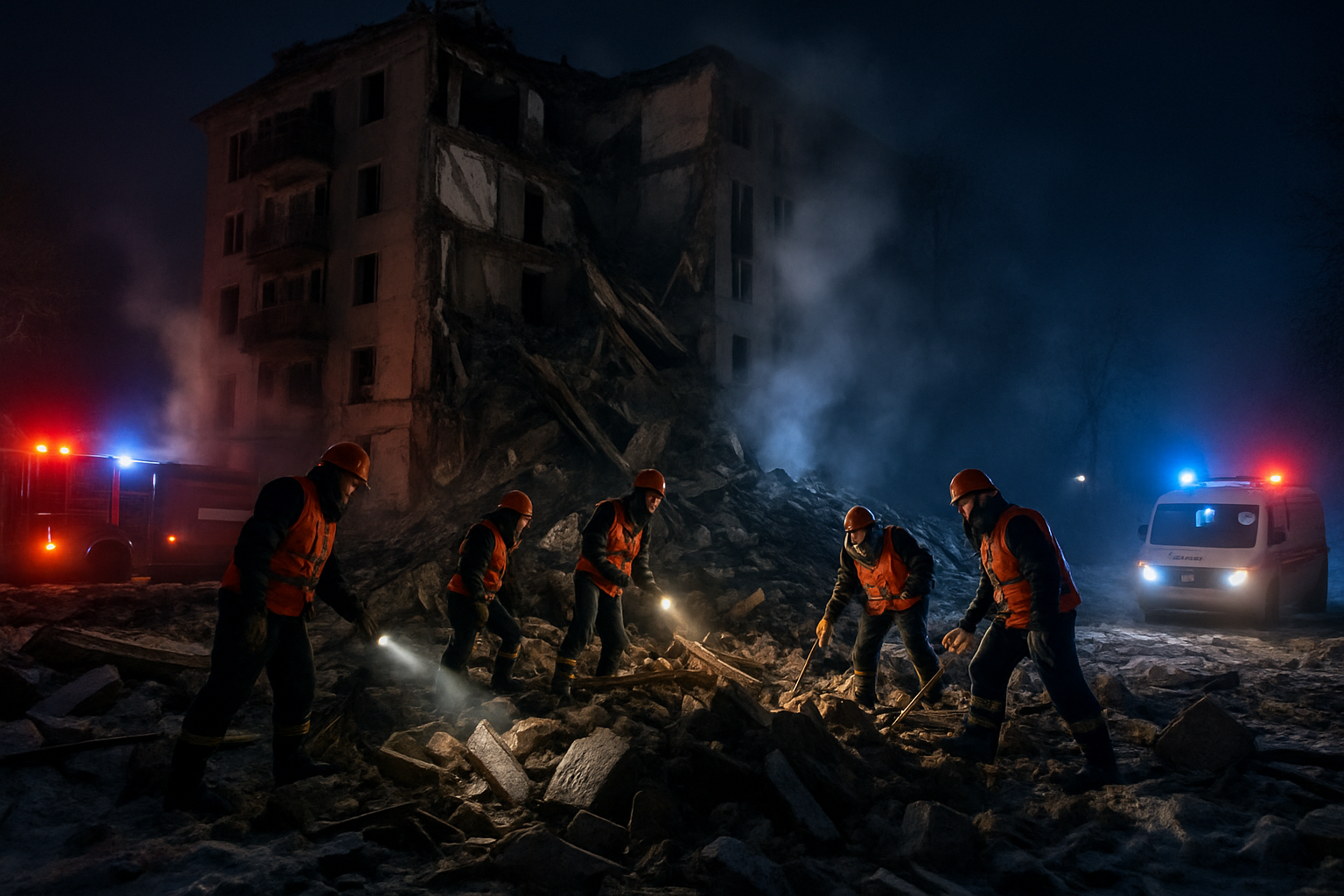
Russian forces struck a five-story residential building in Kharkiv with a ballistic missile, killing at least 11 people as part of a massive overnight assault involving 480 drones and 29 missiles—one of the most extensive single attacks of 2026.
The ballistic missile hit the residential building in Kharkiv's Kyiv district early Saturday morning, causing partial collapse and trapping multiple victims under debris. Emergency services worked through the night to rescue survivors, with the death toll rising throughout the day as rescue operations continued.
Ukrainian President Volodymyr Zelensky confirmed that Russia launched 480 attack drones and 29 missiles targeting energy infrastructure and railway systems across the country overnight. Ukrainian air defense units managed to intercept 453 drones and 19 missiles, according to the air force, but 26 attack drones and 9 missiles struck 22 sites nationwide.
Devastating Impact on Kharkiv
The missile strike on the residential building represented the deadliest single incident of the night's attacks. Rescue workers used specialized equipment to clear rubble and search for survivors trapped beneath the collapsed sections of the five-story structure.
Sources varied on the exact casualty count, with different reports indicating between 7 and 11 fatalities in Kharkiv alone. The discrepancy appears to reflect the ongoing nature of rescue operations and the difficulty in confirming casualties amid continued debris removal.
Beyond Kharkiv, the attacks claimed additional lives across Ukraine. Reports indicate casualties in the Dnipropetrovsk region and Sumy, bringing the total death toll from the overnight assault to at least 9-10 people, with numerous others injured.
Pattern of Systematic Civilian Targeting
The latest assault follows a documented pattern of Russian forces targeting civilian residential areas and critical infrastructure, particularly during periods of diplomatic engagement. The attacks came as international efforts continue to seek a peaceful resolution to the conflict.
Energy facilities in the Odesa region sustained damage during the night's bombardment, continuing Russia's strategy of targeting civilian infrastructure during winter months—a tactic Ukrainian officials have characterized as "energy terrorism."
The systematic targeting of residential buildings housing families violates international humanitarian law, specifically the Geneva Conventions' protections for civilian populations during armed conflict.
International Response and Ongoing Support
The attacks occurred amid unprecedented international support for Ukraine, including the European Union's historic €90 billion loan package—the largest single-nation assistance program in EU history. Sweden and Denmark have committed €246 million for air defense systems, while Germany has provided 35 Patriot missiles.
Poland deployed fighter aircraft along its border with Ukraine as a precautionary measure due to the proximity of the attacks, demonstrating the regional security implications of the ongoing conflict.
Over 17.8 million Ukrainians are currently accessing winter support programs, highlighting the humanitarian scope of the crisis as civilians face both direct attacks and infrastructure damage during harsh winter conditions.
Military Context and Territorial Disputes
The assault comes as Russian territorial gains have accelerated significantly, with Moscow capturing 481 square kilometers in January 2026 compared to 260 square kilometers in December 2025—an 85% increase representing the fastest territorial expansion in recent months.
Ukrainian forces have disclosed that 55,000 soldiers have been officially confirmed killed since the conflict began, with a "large number" still classified as missing in action. International research estimates suggest actual military casualties could be 2-3 times higher when including missing personnel and undocumented deaths.
Despite the military pressures, Ukraine has maintained its territorial integrity position in ongoing diplomatic efforts, rejecting any territorial concessions to Russia as part of a potential peace agreement.
Nuclear Crisis Context
The attacks occur against the backdrop of an unprecedented nuclear governance crisis, with the New START treaty between the United States and Russia having expired on February 5, 2026—marking the first time in over 50 years without formal nuclear constraints between the superpowers.
Both nations control approximately 80% of the world's nuclear weapons, with Russia possessing 4,380 warheads and the United States 3,708. UN Secretary-General António Guterres has described the situation as a "grave turning point" with nuclear risks at their "highest in decades."
The restoration of U.S.-Russia military communications through recent diplomatic breakthroughs represents the only remaining formal channel between the nuclear superpowers, adding extraordinary urgency to diplomatic efforts.
Diplomatic Efforts Amid Escalation
The attacks come despite recent diplomatic breakthroughs, including a historic 314-prisoner exchange achieved through trilateral talks between Ukraine, Russia, and the United States in Abu Dhabi—the first such exchange in five months.
Geneva peace talks held in February achieved "significant progress" on ceasefire monitoring mechanisms, though fundamental territorial disputes remain unresolved. European observers from Germany, France, Italy, the UK, and Poland participated for the first time in the trilateral format.
The Trump administration has established a June 2026 deadline for a comprehensive peace agreement, with potential talks in Washington representing a deliberate diplomatic escalation from the successful Abu Dhabi and Geneva frameworks.
However, the fundamental sticking point remains unchanged: eastern Ukrainian territories currently under Russian control. Russia demands territorial recognition and insists any Putin-Zelensky talks must occur in Moscow, while Ukraine maintains its territorial integrity position and seeks long-term security guarantees.
Humanitarian Impact and Winter Warfare
The systematic targeting of energy infrastructure during extreme winter conditions has left over 1,170 buildings in Kyiv without heating during temperatures as low as minus-30°C. Emergency warming centers have been activated nationwide to provide shelter for affected civilians.
Ukrainian officials have documented a pattern of attacks on repair personnel, with 15 energy workers killed in previous strikes while attempting to restore damaged infrastructure. This targeting of emergency services personnel represents a calculated strategy to prevent infrastructure recovery and maximize civilian suffering.
The attacks have forced Ukrainian nuclear power plants to reduce electricity production for the first time since the conflict began, creating cascading effects throughout the interconnected power grid and raising concerns about nuclear facility safety.
Strategic Implications
Military analysts describe the overnight assault as representing one of the most sophisticated coordinated attacks of 2026, involving multiple types of weapons systems designed to overwhelm Ukrainian air defense capabilities.
The timing and scale of the attacks suggest continued Russian military commitment despite ongoing diplomatic engagement, raising questions about Moscow's genuine commitment to peaceful resolution versus using humanitarian pressure as a negotiating tactic.
The attacks demonstrate Russia's continued ability to project military power across Ukrainian territory while maintaining pressure on civilian populations through infrastructure targeting—a strategy that has characterized much of the conflict's fourth year.
For the international community, the attacks represent a critical test of diplomatic innovation versus traditional military escalation in resolving what has become Europe's deadliest conflict since World War II. The success or failure of ongoing peace initiatives carries implications far beyond Ukraine, potentially affecting global conflict resolution frameworks and international law enforcement for decades to come.