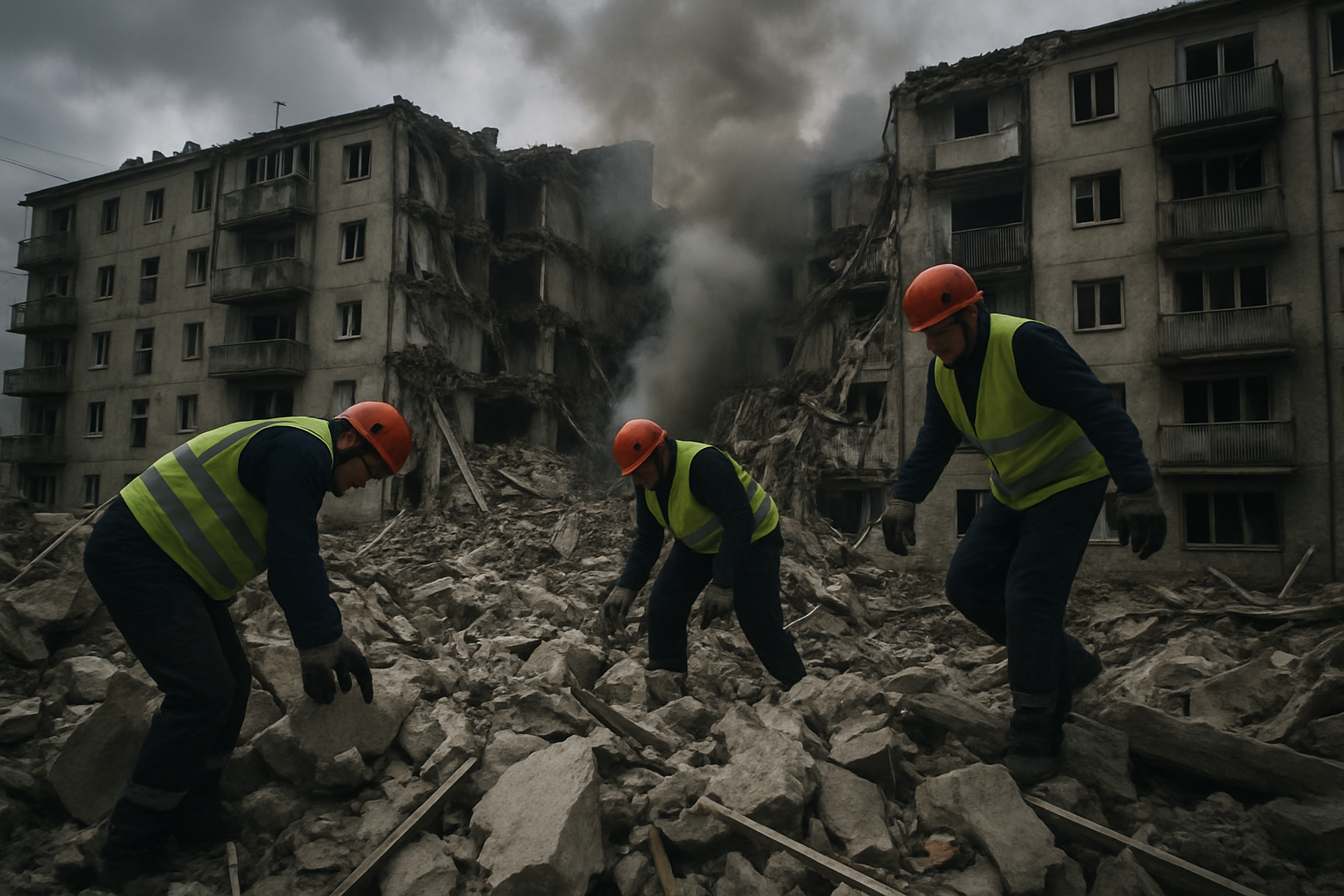
Russian forces launched a devastating missile strike on a five-story residential building in Kharkiv early Saturday morning, killing at least seven civilians including two children and injuring ten others, as Ukraine faces a massive coordinated assault involving 29 missiles and 480 drones across multiple regions.
The attack, which occurred overnight between Friday and Saturday, completely destroyed a large section of the apartment building in Kharkiv's Kyiv district. Regional governor Oleh Synehoubov confirmed the death toll, which includes two children among the seven fatalities, while at least ten people were wounded, including three minors.
According to preliminary information from Ukraine's prosecutor's office, Russian forces used an Izdeliye-30 ballistic missile to strike the residential building. The sophisticated weapon system represents an escalation in the types of armaments being deployed against civilian targets in Ukraine's second-largest city.
Massive Coordinated Russian Assault
The Kharkiv strike was part of a much larger Russian military operation launched overnight. President Volodymyr Zelensky reported that Russia deployed 29 missiles and 480 drones against Ukrainian targets in what represents one of the most extensive single-night attacks in recent months.
"On the night of March 7, Russia launched 29 missiles and 480 drones against Ukraine," Zelensky stated, highlighting the unprecedented scale of the assault that targeted multiple regions simultaneously.
Emergency rescue teams continue working at the Kharkiv site, searching through the debris for potential survivors. The attack has left a devastating scene of destruction, with rescue workers reporting that a significant portion of the five-story building collapsed following the direct missile impact.
Pattern of Civilian Targeting
The Kharkiv attack continues a documented pattern of Russian forces systematically targeting civilian infrastructure and residential areas. International observers have noted that such attacks on civilian buildings constitute violations of the Geneva Conventions and international humanitarian law.
Ukrainian officials report that Russia has launched over 10,000 drones and bombs since January 2026 alone, with many specifically targeting civilian infrastructure including energy facilities, residential buildings, and essential services during the harsh winter months.
"This represents a continuation of Russia's systematic targeting of civilian populations and infrastructure, which violates fundamental principles of international humanitarian law."
— International humanitarian law expert
Broader Military Context
The latest attacks occur amid ongoing diplomatic efforts, creating a paradox where humanitarian breakthroughs are achieved alongside continued military escalation. Recent prisoner exchanges and the restoration of US-Russia military communications after a four-year suspension have provided some hope for diplomatic progress, yet civilian targeting has intensified.
Military analysts report that Russian territorial gains have accelerated significantly, with forces capturing 481 square kilometers in January 2026 compared to 260 square kilometers in December 2025, representing an 85% increase in territorial expansion rate.
Ukrainian Military Response
Ukrainian forces have maintained their defensive capabilities and conducted retaliatory operations. The Unmanned Systems Forces reported successful strikes on four Russian surface-to-air missile defense systems overnight, including a Buk and S-300V system, in Ukraine's Russian-occupied Zaporizhzhia and Kherson regions.
Ukrainian military officials described the successful operations as part of their ongoing "Air Defense Zoo" campaign, demonstrating continued operational capabilities despite facing massive Russian attacks.
International Support and Response
The attacks have drawn international condemnation and renewed pledges of support for Ukraine. The European Union has approved a historic €90 billion loan package for Ukraine, representing the largest single-nation assistance package in EU history, though Slovakia, Czech Republic, and Hungary have refused participation.
Additional military support continues to flow to Ukraine, including advanced air defense systems from Sweden and Denmark worth €246 million and 35 Patriot missiles from Germany, as the international community maintains its commitment to Ukrainian defense capabilities.
Nuclear Governance Crisis Context
The attacks occur against the backdrop of an unprecedented nuclear governance crisis. The New START treaty between the United States and Russia expired on February 5, 2026, marking the first time in over 50 years that the two nuclear superpowers operate without bilateral nuclear constraints.
Both nations control approximately 80% of the world's nuclear weapons, with Russia possessing 4,380 warheads and the United States 3,708, creating what UN Secretary-General António Guterres has described as a "grave turning point" with nuclear risks at their "highest in decades."
Humanitarian Impact
The human cost of the conflict continues to mount, with President Zelensky having disclosed that 55,000 Ukrainian soldiers have been officially killed, with a "large number" missing in action. International estimates suggest actual casualties may be 2-3 times higher than official figures.
The systematic targeting of civilian infrastructure has left over 1,170 buildings in Kyiv without heating during sub-zero temperatures, part of what Ukrainian officials describe as "energy terrorism" designed to break civilian morale during the harsh winter months.
Over 17.8 million Ukrainians are currently accessing winter support programs as the country struggles to maintain essential services under sustained attack on energy infrastructure and civilian facilities.
Diplomatic Efforts Continue
Despite the continued military escalation, diplomatic efforts persist. Recent Geneva peace talks in February achieved "significant progress" on ceasefire monitoring mechanisms, though fundamental territorial disputes remain unresolved. The talks, which included European "Big 5" observers for the first time, built on earlier Abu Dhabi breakthrough negotiations.
The Trump administration has established a June 2026 deadline for comprehensive peace negotiations, potentially at the presidential level in Washington, representing the most significant diplomatic opportunity since the conflict began.
Looking Forward
As rescue operations continue in Kharkiv and Ukraine faces this latest wave of attacks, the international community faces critical decisions about escalating support and diplomatic engagement. The contrast between ongoing civilian casualties and diplomatic progress highlights the complex challenges of resolving Europe's deadliest conflict since World War II.
The coming weeks will prove decisive in determining whether diplomatic innovation can overcome military escalation, or if continued attacks on civilian targets will undermine international efforts to achieve a negotiated resolution to the conflict that has now entered its fifth year.