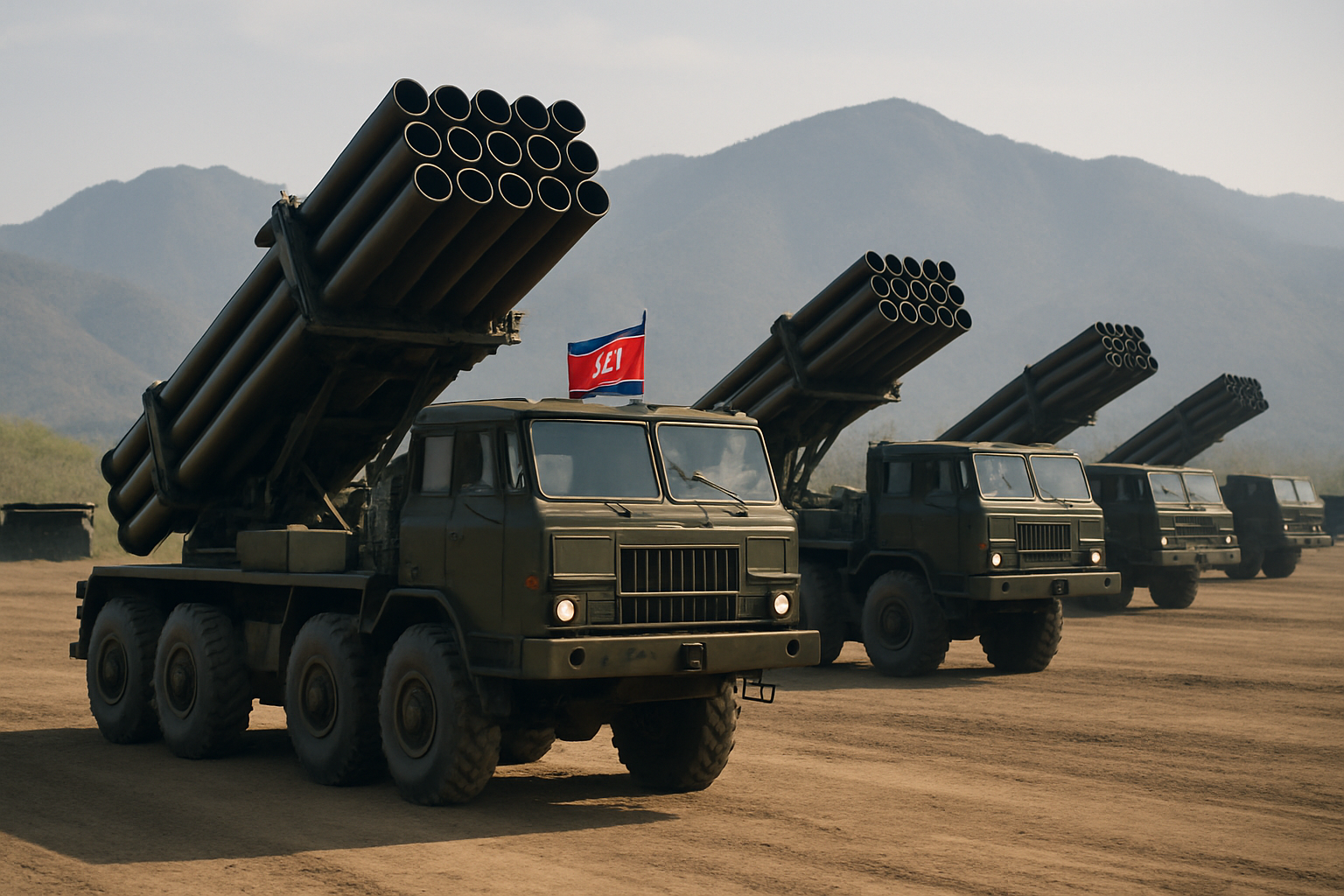
North Korean leader Kim Jong Un personally supervised a major test of 12 precision nuclear-capable rocket launchers on Saturday, accompanied by his teenage daughter Kim Ju Ae, as the regime demonstrated its advancing tactical weapons capabilities during ongoing US-South Korea military exercises.
The test, conducted against targets 360 kilometers away, marks the latest display of North Korea's sophisticated weapons program and represents the third missile test of 2026. State media reported the rocket systems achieved precision strikes while Kim Jong Un observed alongside his daughter, whose presence continues to signal her unprecedented preparation for potential succession leadership.
Strategic Timing and Regional Context
The weapons demonstration coincided directly with joint US-South Korea military exercises involving approximately 18,000 South Korean troops, exercises that Pyongyang routinely denounces as invasion rehearsals. This timing reflects North Korea's established pattern of conducting provocative tests during periods of heightened regional military activity.
According to state media reports, the rocket launchers demonstrated what officials described as exceptional accuracy in striking designated maritime targets. The test builds upon February 2026's unveiling of 600-millimeter nuclear-capable multiple rocket launcher systems, which North Korean officials described as "unique in the world" and suitable for "special attack missions."
"The test coincides with joint US–South Korea military exercises and rising concerns about regional security."
— Camille Corcoran, France 24
Kim Ju Ae's Continued Political Elevation
The presence of Kim Ju Ae at this significant military demonstration continues her systematic elevation within North Korea's political and military hierarchy. South Korean intelligence confirmed in February 2026 that North Korea has formally "entered the stage of designating the leader's daughter as successor," representing the first potential female leadership transition in the Kim dynasty's 78-year history.
Since her public debut in November 2022, Kim Ju Ae has attended increasingly significant events, including weapons demonstrations, military parades, state functions, and diplomatic engagements. Intelligence reports indicate she now provides "input on policy matters" beyond ceremonial appearances, marking a transition to substantive political involvement.
Her systematic preparation has included military training exercises, with February 2026 images showing her participating in rifle training at military shooting ranges. This comprehensive exposure to both political and military spheres reflects the regime's understanding that successful succession requires acceptance within traditionally masculine power structures.
Advanced Tactical Nuclear Capabilities
Saturday's test demonstrates North Korea's continued advancement in tactical nuclear weapons, representing a strategic shift from intercontinental deterrence to regional conflict capabilities. The precision rocket launchers tested can deliver nuclear warheads across South Korea and potentially target US regional installations, fundamentally altering Korean Peninsula strategic calculations.
Intelligence assessments confirm that North Korea possesses sufficient enriched uranium for multiple nuclear weapons despite comprehensive international sanctions. The regime's nuclear program has continued advancing throughout 2025, with military activity increasing by 23% according to regional defense assessments.
The February 2026 unveiling of the 600mm systems, followed by March naval destroyer cruise missile tests, indicates North Korea's pursuit of diverse nuclear delivery platforms. This tactical nuclear expansion provides enhanced first-strike capabilities while complicating defensive planning for regional allies.
Succession Planning Under International Pressure
The missile tests occur during a critical period of succession planning amid ongoing international tensions. Kim Ju Ae's systematic elevation represents the most significant adaptation in North Korean political culture since the regime's founding, requiring sustained legitimacy building among political elites and military leadership.
Recent developments have included her participation in high-profile military events, diplomatic functions, and policy discussions. Her September 2025 Beijing visit marked her first international travel, establishing crucial diplomatic foundations for potential future leadership responsibilities.
The cultural transformation required for female succession within the traditionally masculine Juche ideology system demonstrates the regime's sophisticated long-term strategic planning. Success depends on continued political elite and military acceptance while maintaining regime stability and dynastic continuity principles.
Regional Security Implications
The latest weapons test adds to growing regional tensions as North Korea continues military modernization while pursuing complex diplomatic positioning. In February 2026, Kim Jong Un issued conditional diplomatic openings to the United States while constitutionally redesignating South Korea as a "hostile state," reflecting strategic calculations favoring direct major power engagement.
China's restored passenger rail service to North Korea in March 2026, ending a six-year suspension, provides enhanced leverage and economic partnerships during this transition period. This triangular dynamic with Beijing's engagement creates additional complexity for regional allies' diplomatic approaches.
The timing of military demonstrations during joint US-South Korea exercises reflects North Korea's established strategy of leveraging global tensions and regional military activities for weapons testing opportunities. This pattern has become increasingly sophisticated as the regime maintains relevance in regional security calculations while pursuing potential major power engagement.
International Response and Nuclear Governance
The weapons tests occur during a broader nuclear governance crisis following the New START treaty's expiration in February 2026, marking the first time in over 50 years without US-Russia nuclear constraints. This permissive international environment has enabled regional nuclear powers to advance capabilities without traditional arms control frameworks.
UN Secretary-General António Guterres has warned that nuclear risks are at their "highest in decades," creating template-setting moments for 21st-century nuclear crisis management. The combination of North Korea's advancing capabilities, succession planning, and deteriorating global nuclear governance presents unprecedented challenges for international diplomacy.
Regional allies South Korea, Japan, and the United States face renewed difficulties addressing weapons advancement through diplomatic channels. The systematic nature of North Korea's military demonstrations alongside political transitions requires innovative international approaches that balance security concerns with conflict prevention frameworks.
Dual Development Strategy
North Korea's approach of advancing military capabilities while maintaining domestic legitimacy through tangible achievements reflects sophisticated strategic planning despite severe economic constraints. The completion of the 50,000-unit Hwasong Area housing project in Pyongyang, alongside continued weapons development, demonstrates calculated resource allocation serving multiple regime objectives.
This dual strategy provides both deterrent credibility through military advancement and domestic support through material improvements for key constituencies. The approach enables the regime to maintain international relevance while pursuing diplomatic opportunities, creating leverage for potential future negotiations.
The success of this balanced approach during unprecedented succession planning indicates the regime's capacity for complex long-term strategic management under external pressure. This template could influence similar authoritarian regimes worldwide in approaches to survival, adaptation, and diplomatic positioning in an increasingly multipolar era.
Looking Forward
The March 15, 2026 rocket launcher tests represent more than military posturing—they demonstrate North Korea's systematic approach to regime survival, succession planning, and strategic positioning amid global uncertainties. The combination of advancing nuclear capabilities, unprecedented female succession preparation, and complex diplomatic maneuvering creates a unique template for authoritarian adaptation in the 21st century.
As Kim Ju Ae's elevation continues and North Korea's military capabilities expand, the international community faces the challenge of developing effective engagement strategies that address security concerns while managing regional stability. The success or failure of this unprecedented political and military transformation will have implications extending far beyond the Korean Peninsula, potentially influencing global approaches to nuclear crisis management, diplomatic engagement, and conflict prevention for decades to come.