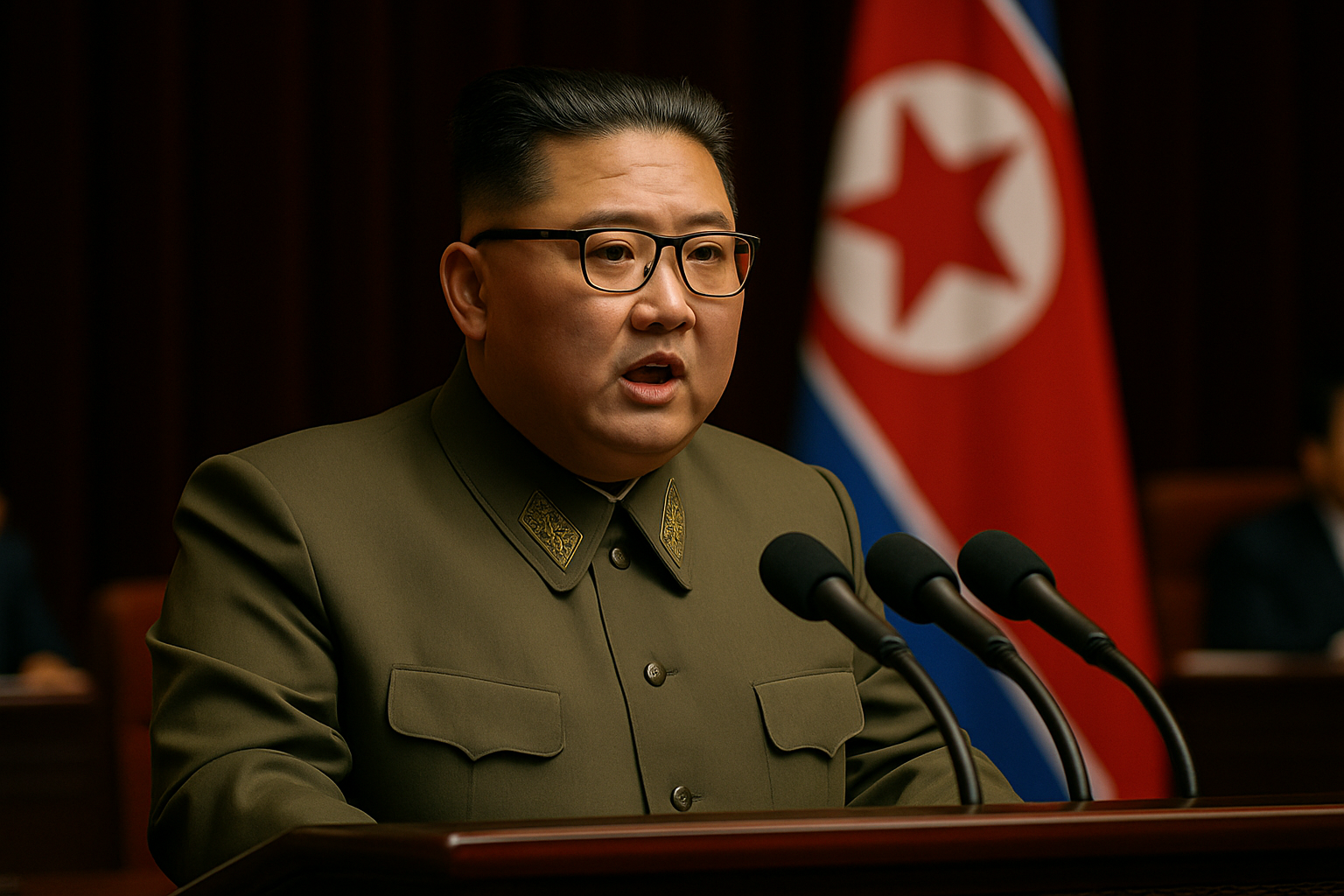
North Korean leader Kim Jong Un has declared his country's nuclear-armed status permanently "irreversible" while branding South Korea as the nation's "most hostile state," marking the most significant escalation in Korean Peninsula tensions amid an unprecedented succession transition.
Speaking after his unanimous reappointment as president of the State Affairs Commission by North Korea's rubber-stamp Supreme People's Assembly, Kim rejected any possibility of nuclear disarmament and vowed to intensify efforts against what he described as hostile forces threatening the regime's survival.
The declarations come during a critical period of dynastic transition, with Kim's teenage daughter Kim Ju Ae confirmed by South Korean intelligence as his formally designated successor—representing the first potential female leadership in the Kim dynasty's 78-year history.
Nuclear Capabilities Permanently Enshrined
State media reported that Kim called North Korea's nuclear policy "irreversible" and declared the country would "permanently strengthen its nuclear forces" while treating South Korea as its primary adversary. The leader rejected the notion that nuclear disarmament could be exchanged for economic benefits or security guarantees.
"North Korea had already proven that maintaining nuclear forces while pursuing development was the correct strategic choice," Kim stated, according to the Korean Central News Agency (KCNA).
"If the U.S. withdraws its policy of confrontation with North Korea by respecting our country's current status... there is no reason why we cannot get along well with the U.S."
— Kim Jong Un, North Korean Leader
Intelligence assessments confirm North Korea possesses sufficient enriched uranium for multiple nuclear weapons, with the regime having advanced tactical nuclear capabilities that represent a shift from intercontinental deterrence to regional conflict scenarios. This development fundamentally alters Korean Peninsula strategic calculations.
Constitutional Redesignation of South Korea
In a dramatic departure from previous inter-Korean characterizations, North Korea has formally designated South Korea as a "hostile state" in its constitution. Kim called the U.S. a "perpetrator of state terrorism" during the parliamentary session, according to reports from NK News.
The constitutional changes represent Kim's assessment that direct engagement with Washington offers better prospects than Seoul-mediated negotiations, effectively closing reconciliation possibilities with South Korea while signaling conditional openness to U.S. relations.
This strategic repositioning occurs alongside North Korea's deployment of 600mm nuclear-capable rocket systems, described by state media as "unique in the world" and "suitable for special attack missions," demonstrating the regime's continued military modernization despite international sanctions.
Unprecedented Female Succession Planning
The nuclear declarations coincide with the most significant succession developments in Kim dynasty history. South Korean intelligence definitively confirmed that Kim Jong Un has formally designated his daughter Kim Ju Ae as his successor, marking an unprecedented transition to female leadership within the traditionally masculine Juche ideology system.
Kim Ju Ae, approximately 13 years old, has moved beyond ceremonial appearances to providing "input on policy matters," representing substantial political involvement preparation. Her systematic elevation since her November 2022 public debut has included weapons demonstrations, military parades, and significantly, her first international travel to Beijing in September 2025.
Recent state media images showing Kim Ju Ae firing rifles at military shooting ranges provide concrete evidence of comprehensive leadership preparation within North Korea's defense-oriented political system, where military credentials are essential for regime legitimacy.
Regional Security Implications
The nuclear status declarations occur during a global nuclear governance crisis, with the New START treaty between the United States and Russia having expired in February 2026—creating the first period in over 50 years without bilateral nuclear constraints between the superpowers.
North Korea's military activity increased 23% in 2025, with the regime demonstrating continued advancement of weapons systems including maritime nuclear capabilities through strategic cruise missile tests from newly commissioned destroyers.
The timing of Kim's statements during ongoing U.S.-South Korea joint military exercises, which Pyongyang routinely denounces as invasion rehearsals, reflects the regime's established pattern of leveraging regional military activity for political messaging.
Diplomatic Positioning and International Response
Kim's dual-track approach combines hardline positions toward South Korea with conditional diplomatic openings toward the United States. The leader has indicated North Korea is prepared for either "peaceful coexistence or eternal confrontation," with the choice lying entirely with Washington.
China's response will be critical given its role as North Korea's primary economic partner and security guarantor. The recent restoration of passenger rail service between Beijing and Pyongyang in March 2026, ending a six-year suspension, provides China with enhanced leverage over North Korean policy during this transition period.
Regional allies South Korea, Japan, and the United States face renewed challenges in addressing North Korea's advancing weapons programs through diplomatic channels, particularly given the regime's explicit rejection of denuclearization as a negotiating option.
Economic Development Amid Military Priorities
Despite the military focus, North Korea continues its dual development strategy, recently completing a massive 50,000-unit housing project in Pyongyang's Hwasong Area. This demonstrates the regime's sophisticated resource allocation approach, maintaining both military deterrent capabilities and domestic legitimacy through tangible citizen benefits.
The completion of major infrastructure projects alongside weapons development shows North Korea's capacity for sustained military modernization despite severe international sanctions and economic constraints.
Template for Authoritarian Adaptation
The success of managing unprecedented female succession planning while advancing nuclear capabilities demonstrates sophisticated long-term strategic planning under external pressure. This approach is being closely watched globally as a potential template for authoritarian regime adaptation in the 21st century.
The combination of nuclear advancement, historic succession planning, and strategic diplomatic positioning affects not only Korean Peninsula dynamics but broader international approaches to conflict prevention and diplomatic engagement in an increasingly multipolar world.
As Kim Jong Un consolidates both his nuclear doctrine and succession plans, the international community faces the challenge of developing effective engagement strategies that address legitimate security concerns while managing regional stability in an era of renewed great power competition and nuclear governance uncertainty.