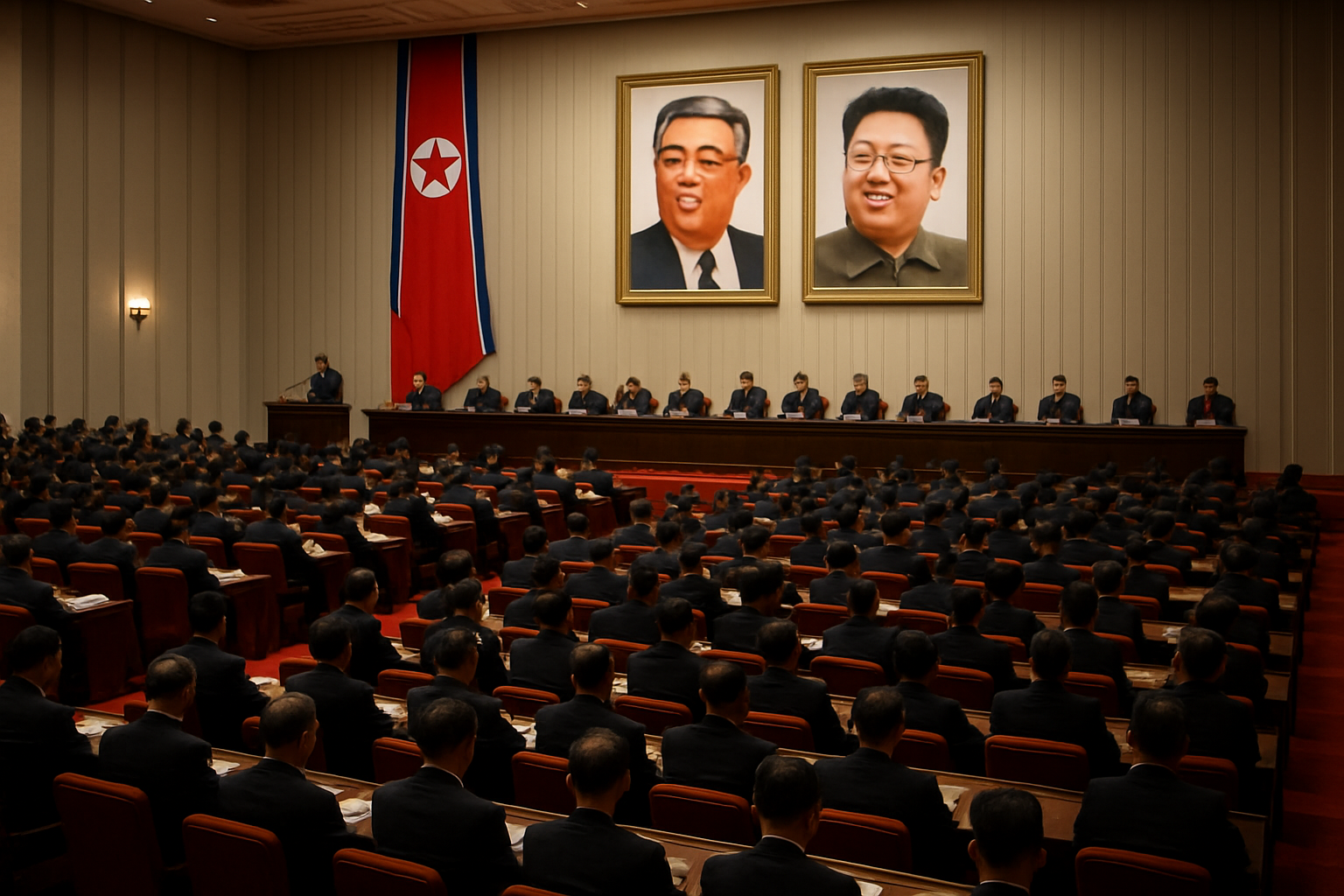
North Korea's Supreme People's Assembly unanimously reappointed Kim Jong-un as president of state affairs during its first session following recent general elections, while simultaneously elevating several of his closest aides to key positions within the legislature and state apparatus.
The ceremonial parliament convened on Sunday, March 22, with Kim Jong-un in attendance for the opening day of the 15th Supreme People's Assembly. State media KCNA reported Monday that the reappointment was conducted "in accordance with the unshakeable will and unanimous desire" of the assembly members, reinforcing Kim's position as the "supreme leader of the DPRK" as explicitly stated in North Korea's constitution.
Constitutional Framework and Political Structure
North Korea's constitution explicitly defines the president of state affairs as the "supreme leader of the DPRK" who represents the state, officially known as the Democratic People's Republic of Korea. This reappointment comes after the isolated nation conducted what critics describe as predetermined elections designed to provide a veneer of democratic legitimacy to the country's authoritarian leadership structure.
The Supreme People's Assembly, North Korea's rubber-stamp legislature, formally approves state policy and typically meets after a ruling Workers' Party Congress to transform party decisions into legal framework. The assembly's primary function remains the ceremonial endorsement of decisions already made by the party leadership.
Key Personnel Changes and Elevations
Alongside Kim Jong-un's reappointment, the assembly focused significantly on organizational changes, promoting several of the supreme leader's closest aides to elevated positions within the legislature's top posts. These personnel shuffles represent strategic positioning within North Korea's rigid political hierarchy.
However, one notable absence has drawn attention from international observers: Kim Yo Jong, the supreme leader's powerful sister, is reportedly absent from KCNA's published list of members of the State Affairs Commission, the country's top leadership body where she had served since 2021. This development raises questions about potential shifts in the inner circle dynamics of North Korean leadership.
Succession Planning Amid Political Transitions
This reappointment occurs during a critical period of succession planning within the Kim dynasty. Recent intelligence assessments have confirmed that Kim Jong-un has formally designated his teenage daughter, Kim Ju Ae, as his successor—marking an unprecedented transition to female leadership in the regime's 78-year history.
"The systematic elevation of Kim Ju Ae represents the most significant adaptation of North Korean political culture since the regime's founding."
— Intelligence analysts familiar with the succession planning
Kim Ju Ae's preparation has been methodical and comprehensive since her public debut in November 2022. Her activities have included attending weapons demonstrations, military parades, and state functions, while recent reports indicate she now provides "input on policy matters" beyond merely ceremonial appearances. This represents a substantive evolution toward genuine political involvement.
Constitutional Amendments and Reforms
The Pyongyang meeting is expected to discuss amendments and supplements to the socialist constitution, alongside the formal election of leadership bodies. These constitutional discussions occur amid broader organizational changes designed to address what Kim Jong-un has previously described as "deep-rooted" corruption within party structures.
The assembly's constitutional role involves transforming Workers' Party decisions into formal law, serving as the highest legislative body in North Korea's political system. The current session marks the first major gathering of the 15th Supreme People's Assembly following the completion of general elections.
International Context and Regional Implications
This reappointment occurs against a complex international backdrop. North Korea has continued advancing its nuclear capabilities despite comprehensive international sanctions, with recent unveiling of 600mm nuclear-capable multiple rocket launcher systems described as "unique in the world" for "special attack missions."
The regime has also demonstrated sophisticated resource allocation strategies, maintaining military advancement alongside domestic achievements such as the completion of the massive 50,000-unit Hwasong Area housing project in Pyongyang, which provides modern amenities for capital residents.
Diplomatic Positioning and Strategic Calculations
Recent diplomatic initiatives have shown North Korea pursuing a dual-track approach. Kim Jong-un has issued conditional openings toward the United States, stating that prospects for improved relations depend "entirely on the attitude of the United States," while simultaneously constitutionally redesignating South Korea as a "hostile state."
This strategic positioning reflects calculations that direct engagement with Washington offers better prospects than Seoul-mediated negotiations. The restoration of China-North Korea passenger rail service in March 2026, ending a six-year suspension, has provided Beijing with enhanced leverage over North Korean policy during this transition period.
Cultural and Political Transformation
The current succession planning represents unprecedented cultural transformation within North Korea's traditionally masculine political system. The preparation of Kim Ju Ae for potential female leadership requires sustained legitimacy building among the political elite and military hierarchy within the rigid Juche ideology framework.
Success in managing this transition while maintaining regime stability would provide a template for authoritarian adaptation in the 21st century, closely watched globally as a potential model for similar political systems facing generational change.
Looking Ahead
The reappointment solidifies Kim Jong-un's authority during this critical transition period while the systematic preparation of his successor continues. International observers will monitor future developments for signs of formal recognition of Kim Ju Ae within the party hierarchy, as well as any further changes in the composition of key leadership bodies.
The absence of Kim Yo Jong from the State Affairs Commission, combined with ongoing succession preparations, suggests that North Korea's political landscape continues evolving in ways that will have significant implications for regional security dynamics and international diplomatic engagement strategies in the years ahead.