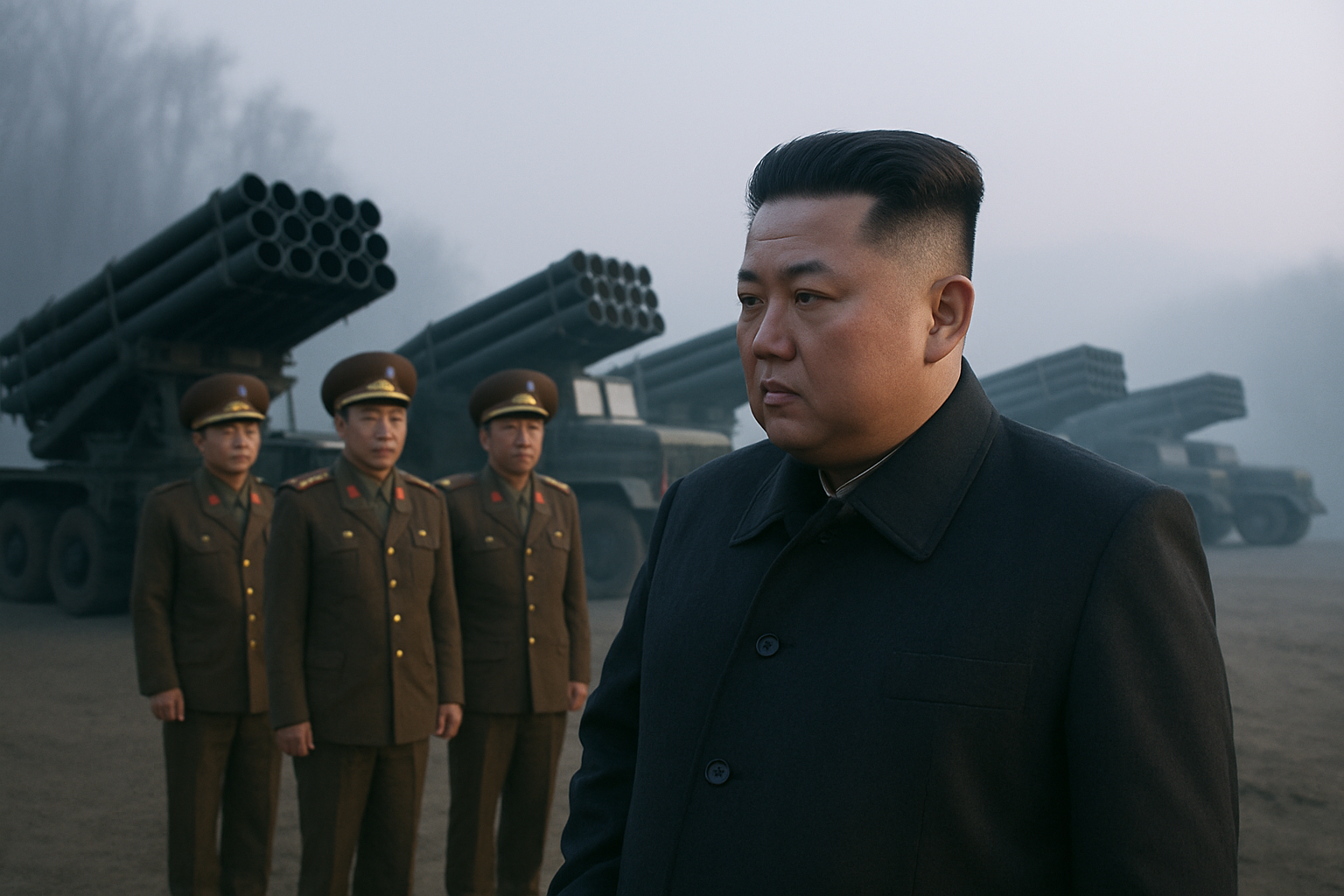
North Korean leader Kim Jong Un personally supervised the testing of 12 multiple rocket launchers with 600mm diameters, achieving what state media described as "100 percent accuracy" against a target island in the East Sea, as regional tensions escalate during ongoing US-South Korea military exercises.
The weapons test, reported by the Korean Central News Agency (KCNA) on Saturday, represents the latest in a series of military demonstrations amid deteriorating relations with Seoul and Washington. The exercise occurred as approximately 18,000 South Korean troops and undisclosed US forces conduct joint military drills through March 19, operations Pyongyang routinely denounces as invasion rehearsals.
Strategic Timing and Tactical Implications
The timing of Kim Jong Un's weapons oversight carries significant strategic weight, occurring during a volatile period when Washington is simultaneously using military force against Venezuela and Iran. South Korea's military detected approximately 10 ballistic missiles fired from North Korea's capital region toward the eastern sea, marking the third missile test of 2026.
According to intelligence sources familiar with North Korean weapons programs, the 600mm rocket systems represent a continuation of February 2026's unveiling of nuclear-capable multiple rocket launchers described as "unique in the world" for "special attack missions." These tactical nuclear weapons represent a shift from intercontinental deterrence to regional conflict capabilities, fundamentally altering Korean Peninsula strategic calculations.
Succession Planning Context
The weapons demonstration occurs amid unprecedented succession planning developments, with Kim Jong Un having formally designated his teenage daughter Kim Ju Ae as heir apparent. This represents the first potential female leadership transition in the Kim dynasty's 78-year history, requiring systematic legitimacy building within the traditionally masculine Juche ideology system.
Kim Ju Ae's systematic elevation since November 2022 has included attendance at weapons demonstrations, military parades, and state functions with increasingly prominent roles. South Korean intelligence confirms she now provides "input on policy matters" beyond ceremonial appearances, indicating substantive preparation for future leadership responsibilities.
"This is another demonstration of the regime's continued commitment to military modernization while managing an unprecedented political transition."
— Regional Security Analyst
Regional Security Implications
The rocket launcher tests demonstrate North Korea's continued military advancement despite comprehensive international sanctions. Intelligence assessments indicate the regime maintains sufficient enriched uranium for multiple weapons, with advanced centrifuge technology enabling continued development regardless of external pressure.
Japan's Coast Guard confirmed the missiles fell into international waters outside Japan's exclusive economic zone, posing no immediate threat to Japanese territory or shipping. However, the launches complicate regional security dynamics as Northeast Asian tensions increase amid broader global conflicts.
Nuclear Governance Crisis Context
These weapons tests occur during a critical period for international nuclear governance, following the expiration of the New START treaty between the United States and Russia on February 5, 2026. This represents the first time in over 50 years without formal nuclear constraints between the superpowers, creating a more permissive environment for regional nuclear advancement.
UN Secretary-General António Guterres has warned that nuclear risks are at their "highest in decades," with North Korea's continued weapons development serving as a template for other nations considering nuclear capabilities. The regime's success in maintaining sophisticated military programs despite sanctions demonstrates the limitations of current non-proliferation approaches.
Economic Development Balance
Despite military prioritization, North Korea continues demonstrating domestic achievements to maintain regime legitimacy. The recent completion of a 50,000-unit housing project in Pyongyang's Hwasong Area showcases the regime's dual strategy of military deterrence alongside tangible benefits for key constituencies.
This resource allocation toward both weapons systems and urban infrastructure, despite severe economic constraints, reveals sophisticated strategic planning for regime survival during the historic succession transition. The approach provides both defensive capabilities and domestic support mechanisms essential for political stability.
International Response Challenges
Regional allies face renewed difficulties in addressing North Korean weapons advancement through diplomatic channels. The combination of advanced military capabilities, succession planning, and major political transitions creates a complex environment requiring innovative international approaches.
China's restored passenger rail service with North Korea in March 2026 provides enhanced leverage over Pyongyang's policy directions, while Kim Jong Un's conditional diplomatic opening to the United States suggests potential for engagement. However, his constitutional redesignation of South Korea as a "hostile state" complicates traditional alliance coordination mechanisms.
Template for Authoritarian Adaptation
North Korea's management of military modernization during unprecedented political transformation provides a template closely watched globally. The success of maintaining weapons development while preparing for the first female dynastic succession demonstrates sophisticated long-term strategic planning under extreme external pressure.
The regime's continued relevance in regional security calculations, combined with potential major power engagement opportunities, shows how authoritarian systems can adapt to 21st-century challenges through careful balance of military credibility and diplomatic positioning.
Looking Ahead
The latest rocket launcher tests reinforce North Korea's strategy of combining military demonstrations with diplomatic positioning for future negotiations. As regional tensions continue mounting and global nuclear governance frameworks weaken, Pyongyang's approach to weapons development and succession planning will likely influence similar regimes worldwide.
The international community faces the ongoing challenge of addressing North Korean capabilities advancement while managing broader regional stability concerns in an increasingly complex global security environment. The regime's demonstrated ability to maintain sophisticated weapons programs despite comprehensive sanctions suggests the need for fundamentally different approaches to conflict prevention and diplomatic engagement in the multipolar era.