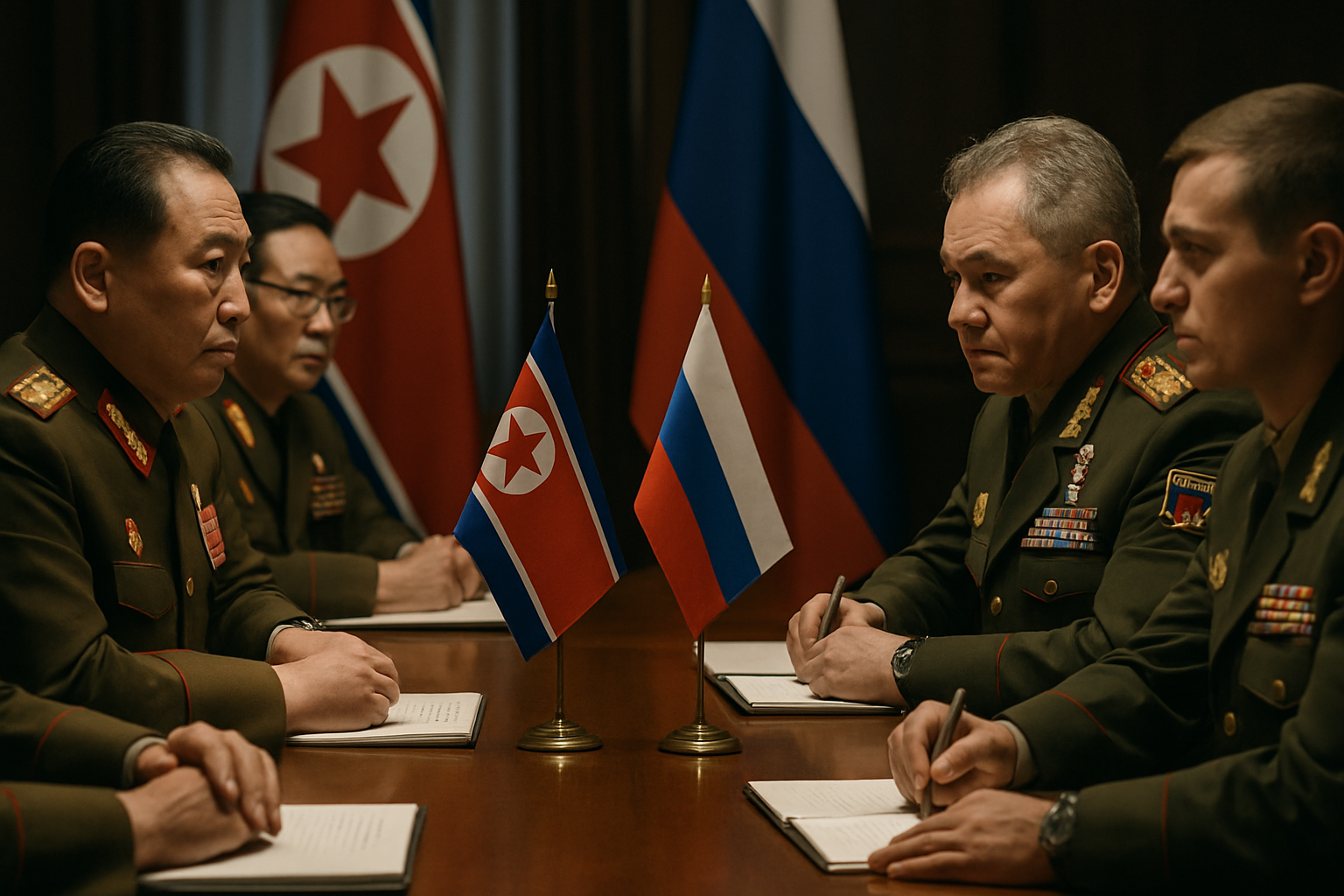
Kim Jong Un has reaffirmed North Korea's steadfast commitment to supporting Russia's military campaign in Ukraine, describing it as a "sacred war" while unveiling a memorial museum dedicated to North Korean soldiers who fought alongside Russian forces in the strategically important Kursk region.
The North Korean leader's declaration came during a high-level meeting with Russian Defense Minister Andrey Belousov in Pyongyang on Sunday, marking a significant escalation in the military partnership between the two nations as global tensions continue to mount. The meeting underscored the deepening alliance between Moscow and Pyongyang, built on their shared opposition to Western influence and mutual strategic needs.
Memorial Museum Honors Fallen North Korean Warriors
In a ceremony laden with symbolic significance, Kim Jong Un inaugurated a memorial hall in Pyongyang honoring North Korean soldiers who supported Russia's war efforts against Ukraine. The leader praised the memorial as "a great fortress where the souls of loyalists and the hearts of love for the motherland beat high," emphasizing the ideological dimension of North Korea's military commitment to Russia.
The timing of the memorial's unveiling is particularly significant, occurring on the first anniversary of Russia's declaration of North Korean military involvement in the conflict. Russian Defense Minister Belousov personally awarded prestigious Orders of Courage to 10 North Korean service members, commending them for their "boundless devotion to the motherland" and their valor in fighting Ukrainian forces in Russia's Kursk region.
"The partnership stemmed from their converging needs – Russia's demand for manpower and materiel, and North Korea's need for military technology and economic support."
— Regional Security Expert, South China Morning Post
Strategic Military Cooperation Deepens
The military alliance between North Korea and Russia has evolved far beyond diplomatic rhetoric. Intelligence reports confirm that Pyongyang has provided substantial military assistance to Moscow, including missiles, munitions, and thousands of troops to support Russia's operations in Ukraine. In return, analysts indicate that Moscow is providing North Korea with financial aid, advanced military technology, food supplies, and energy resources.
This mutual support system has proven crucial for both nations as they face international isolation and sanctions. North Korea's provision of military personnel has helped address Russia's manpower challenges in Ukraine, while Russian technological transfers have advanced North Korea's weapons capabilities despite comprehensive international sanctions.
The cooperation extends beyond immediate military needs. Recent developments include the restoration of military aviation links, with Russian Air Force flights resuming operations to Pyongyang, and expanded commercial partnerships that provide North Korean firms with trademark protection in Russia.
Kim Jong Un's "Sacred War" Declaration
During the meeting with Belousov, Kim Jong Un made his most explicit statement yet regarding North Korea's commitment to Russia's military objectives. State media reported that the North Korean leader vowed to help Moscow achieve victory in what he characterized as Russia's "sacred war" against Ukraine and Western influence.
Kim's declaration that North Korea will continue to support Russia's policies represents a significant escalation in rhetoric, moving beyond diplomatic support to active military partnership. This commitment comes at a time when Kim is also managing unprecedented domestic changes, including the systematic preparation of his daughter Kim Ju Ae as his potential successor – the first female heir in the dynasty's 78-year history.
Regional Security Implications
The strengthening North Korea-Russia military alliance creates complex new dynamics in Northeast Asian security architecture. Regional allies South Korea, Japan, and the United States face renewed challenges in addressing the evolving partnership through traditional diplomatic channels.
The alliance gains additional complexity through China's role in the region. Beijing has maintained its position as North Korea's primary economic partner while recently restoring passenger rail service between the two countries after a six-year suspension. This triangular relationship between China, North Korea, and Russia creates new diplomatic challenges for Western allies seeking to manage regional security concerns.
The timing of these developments coincides with a broader global nuclear governance crisis. The expiration of the New START treaty between the United States and Russia in February 2026 marked the first time in over 50 years without bilateral nuclear constraints between the superpowers, creating what UN Secretary-General António Guterres has described as a "grave turning point" with nuclear risks at their "highest in decades."
Anti-Western Alliance Consolidation
Security experts view the North Korea-Russia partnership as part of a broader consolidation of anti-Western alliances during a period of deepening global instability. Both nations are using their cooperation in the Ukraine war as a symbol of their unwavering stance against Western dominance and their commitment to creating alternative international frameworks.
This strategic alignment extends beyond military cooperation to encompass economic, technological, and diplomatic dimensions. Both countries, facing extensive Western sanctions and human rights accusations, are developing alternative cooperation frameworks that bypass traditional Western-dominated institutions.
The partnership represents a template for bilateral cooperation among nations excluded from traditional multilateral frameworks, potentially influencing similar arrangements globally and reshaping international governance patterns for decades to come.
Succession Planning Amid Military Expansion
The military developments occur against the backdrop of Kim Jong Un's management of an unprecedented succession transition. Intelligence sources confirm that Kim Ju Ae has moved beyond ceremonial appearances to providing substantial policy input, representing the most significant adaptation of North Korean political culture since the regime's founding.
The female succession preparation within North Korea's traditionally masculine Juche ideology system requires sustained legitimacy building among the political elite and military hierarchy. Military demonstrations and international partnerships serve multiple purposes: regime strength demonstration, successor credential building, and capabilities showcase during this historic political transformation.
International Response Challenges
The strengthening military partnership between North Korea and Russia presents significant challenges for international conflict prevention and diplomatic engagement. Traditional approaches may prove inadequate for addressing what experts describe as an emerging "religious-political synthesis" rather than conventional authoritarianism.
Regional allies must develop innovative frameworks for engaging with this evolving leadership structure while managing security concerns. The success or failure of diplomatic approaches to this partnership will have template-setting implications for 21st-century conflict prevention and crisis management approaches.
The North Korea-Russia military alliance represents more than a regional security concern – it provides a model for authoritarian adaptation and international cooperation that could influence similar partnerships worldwide, fundamentally affecting global governance patterns and international relations for decades to come.