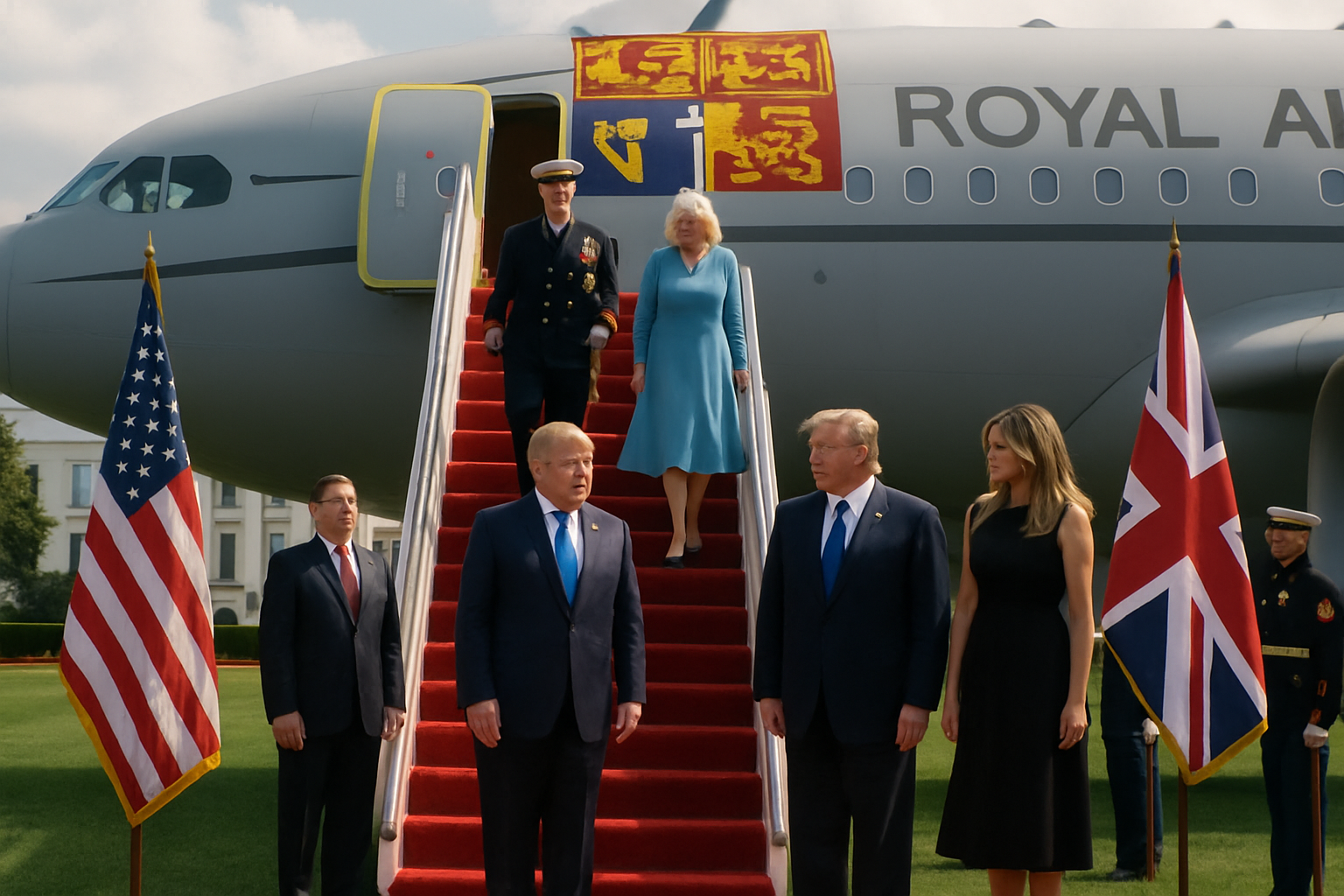
King Charles III and Queen Camilla arrived in Washington on Monday afternoon for their first state visit to the United States as reigning monarchs, beginning a four-day diplomatic mission that carries unprecedented significance amid the most strained US-UK relations since the Iraq War.
The British royal couple landed at Joint Base Andrews, Maryland, where they were greeted by U.S. Chief of Protocol Monica Crowley in a formal ceremony marking the first visit by a British monarch to America since Queen Elizabeth II's 2007 trip. The visit commemorates the 250th anniversary of the United States' declaration of independence from British rule.
Arrival Ceremony and White House Reception
President Donald Trump and First Lady Melania Trump welcomed the royal couple at the White House for an intimate tea ceremony in the Green Room, continuing a tradition of American presidents hosting British royalty. The reception represented a significant diplomatic gesture given the current tensions between the two nations over Britain's refusal to support American military operations against Iran.
German media reported that the visit includes carefully orchestrated private meetings designed to avoid repetition of previous incidents where Trump publicly criticized foreign leaders. Palace officials emphasized that the visit proceeds "on advice of the British government" and celebrates "the historic connections and modern bilateral relationship" between the two nations.
Diplomatic Crisis Context
The state visit unfolds against the backdrop of the most serious breakdown in the US-UK "special relationship" since the Iraq War. President Trump has publicly criticized Prime Minister Keir Starmer's government for declining to support "Operation Epic Fury," the largest US-Israeli military campaign against Iran since 2003.
"He [Starmer] didn't help at all. I never thought I'd see this from Britain," Trump told The Sun newspaper, declaring the relationship "obviously not what it was." The UK government maintains it "does not believe in regime change from the skies" and has refused to provide British bases for strikes against Iran, referencing lessons learned from the Iraq intervention.
"We cannot repeat the same mistakes made in Iraq. Britain does not believe in regime change from the skies."
— UK Government position on Iran operations
European allies have delivered a crushing rejection of Trump's demands for naval coalition support in the Strait of Hormuz, with German Defense Minister Boris Pistorius leading resistance by asking "What does Trump expect a handful of European frigates to do that the powerful US Navy cannot?"
Security Concerns and Enhanced Protocols
The royal visit proceeds despite significant security concerns following the White House Correspondents' Dinner shooting on April 26, where Cole Thomas Allen, a 31-year-old California elementary school teacher, breached security at the Washington Hilton and fired shots before being subdued by the Secret Service. One agent was wounded but protected by body armor and is expected to make a full recovery.
Acting Attorney General Todd Blanche expressed complete confidence in the royal couple's safety, with British royal security cooperating closely with US Secret Service to ensure enhanced protection protocols. The incident marked the third major security threat targeting President Trump since his return to office.
Historic Constitutional Monarchy Context
The visit occurs during an unprecedented crisis for the British Royal Family, with Prince Andrew's historic arrest in February 2026 on misconduct charges related to Jeffrey Epstein connections. The arrest marked the first detention of a senior British royal since King Charles I in 1647, creating a constitutional watershed that tests the monarchy's relationship with democratic accountability.
King Charles III issued an unprecedented statement declaring that "law must take its course" with "full support and cooperation" for authorities investigating his brother, prioritizing institutional integrity over family loyalty. The UK government is actively considering legislation to remove Prince Andrew from the royal line of succession.
Congressional Address and Ceremonial Program
The state visit includes a historic Congressional address by King Charles III, marking only the second time in history that a British monarch has spoken before American lawmakers. The first occasion occurred during Queen Elizabeth II's 2007 visit, making this address particularly significant given the current policy disagreements between the two nations.
Russian media noted that the visit will include traditional White House ceremonies, a state dinner, and additional events in New York City and Virginia focusing on climate and cultural causes. A stop in Bermuda is also planned as part of the comprehensive diplomatic program.
International Reactions and Analysis
European media coverage has emphasized the delicate nature of the visit, with several outlets highlighting how King Charles must navigate his constitutional role of maintaining institutional relationships despite temporary political tensions. Greek sources noted that the visit represents a significant diplomatic challenge requiring the monarch to balance his symbolic role with the practical realities of strained government relations.
The visit's timing during multiple global crises—including the Iran conflict that has caused oil prices to surge past $100 per barrel and led to the cancellation of over 18,000 flights worldwide—adds additional complexity to the diplomatic proceedings.
Iran War Impact on Global Relations
The broader context of the visit includes the ongoing "Operation Epic Fury," which has cost $11.3 billion in its first week and resulted in over 150 US wounded troops and 3 confirmed deaths. The conflict has created an unprecedented aviation crisis with Dubai International Airport shut down indefinitely due to missile damage, and major shipping companies suspending operations through the critical Strait of Hormuz.
Iranian retaliation has included the first attack on European territory since World War II, with drones striking RAF Akrotiri in Cyprus, prompting an unprecedented European naval coalition response led by HMS Dragon and including Spanish, Italian, French, Dutch, and Greek vessels.
Template-Setting Diplomatic Significance
Constitutional experts view the visit as a critical test of whether constitutional monarchy can preserve long-term alliance structures while navigating partisan disagreements. King Charles's role as a symbolic anchor for US-UK relations during this period of unprecedented policy disagreement could establish important precedents for 21st-century alliance management.
The success or failure of maintaining institutional relationships despite fundamental policy disagreements will influence how democratic nations manage alliance obligations versus sovereignty principles in an era of increasing multipolar competition.
Looking Ahead
The four-day visit will test the resilience of the "special relationship" between the United States and United Kingdom at a time when traditional alliance frameworks face unprecedented strain. With the visit proceeding despite diplomatic tensions, security concerns, and ongoing international crises, it represents a defining moment for both the constitutional monarchy's diplomatic role and the future of transatlantic relations.
As King Charles and Queen Camilla navigate this complex diplomatic landscape, their visit will likely be remembered as either a successful demonstration of institutional relationship preservation during policy disagreements or as a symbol of the challenges facing traditional alliances in the contemporary geopolitical environment.