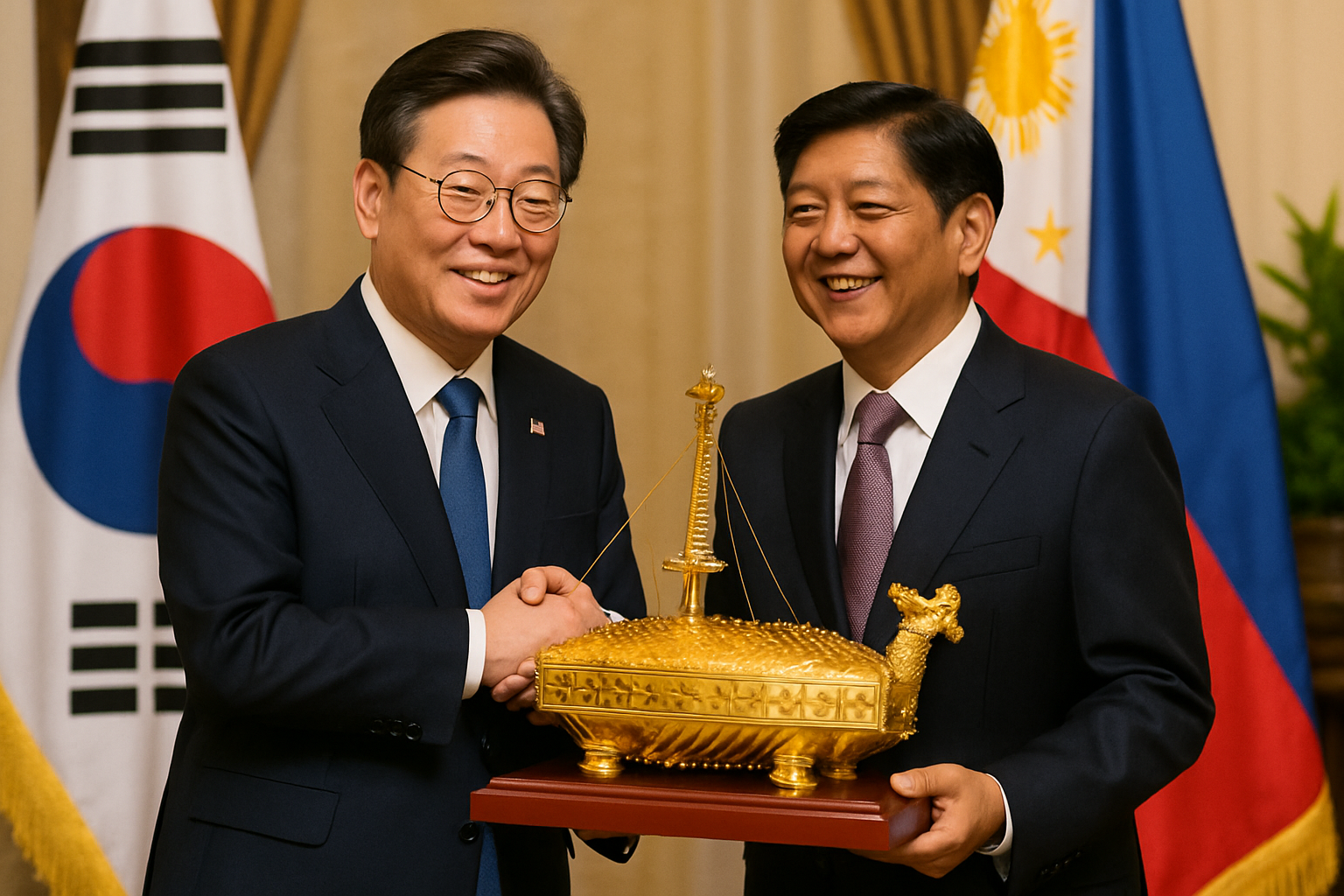
South Korea is intensifying its diplomatic outreach across Asia through a sophisticated blend of cultural symbolism and strategic partnerships, as President Lee Jae Myung's state visit to the Philippines demonstrates the nation's growing influence in regional affairs through both traditional heritage and modern cooperation frameworks.
The centerpiece of President Lee's two-day state visit was the ceremonial presentation of a golden-plated Korean turtle ship model to Philippine President Ferdinand Marcos Jr., a gesture that embodies South Korea's approach to cultural diplomacy in the contemporary Asian context. The turtle ship, known as "geobukseon" in Korean, represents one of history's most innovative naval designs from the late 16th century during Admiral Yi Sun-sin's legendary naval campaigns.
Historic Naval Symbol Bridges Centuries of Maritime Heritage
The golden turtle ship model serves as more than decorative diplomacy—it represents the shared maritime heritage that connects Korea and the Philippines as archipelagic nations with rich seafaring traditions. The original turtle ships were revolutionary warships featuring iron-plated hulls and advanced cannon systems that proved decisive in Korea's defense against Japanese invasions from 1592-1598.
This cultural exchange occurs within the broader context of South Korea's systematic elevation as a regional cultural and diplomatic power. The presentation follows President Lee's successful three-day Singapore summit in early March 2026, where he announced a $300 million Global AI Fund for joint artificial intelligence development, demonstrating Korea's commitment to both cultural heritage preservation and technological advancement.
Comprehensive Defense and Economic Agreements
Beyond the symbolic turtle ship presentation, the state visit produced substantial bilateral agreements spanning critical sectors including defense cooperation, nuclear energy, and technology transfer. The signing of ten comprehensive agreements represents the most ambitious Korea-Philippines partnership framework in recent diplomatic history.
Defense cooperation agreements particularly significant given the evolving security landscape in the South China Sea and broader Indo-Pacific region. South Korea's advanced defense technologies, including sophisticated radar systems and maritime surveillance capabilities, complement the Philippines' strategic geographic position and growing defense modernization requirements.
"These agreements represent our shared commitment to regional stability and prosperity through authentic partnership."
— President Lee Jae Myung, South Korea
Nuclear energy cooperation reflects South Korea's world-class nuclear technology expertise and the Philippines' growing energy security needs. South Korea's proven track record in safe nuclear operations and advanced reactor technologies provides crucial support for Philippine energy diversification strategies.
Regional Context of Korean Cultural Diplomacy
The Philippines visit represents the latest in South Korea's strategic cultural diplomacy initiatives across Asia. Recent months have witnessed unprecedented Korean cultural influence, from BLACKPINK achieving historic 100 million YouTube subscribers to coordinated cultural programming during Chinese New Year celebrations featuring Korean government participation.
However, Korean cultural expansion faces sophisticated challenges, including coordinated Southeast Asian boycott campaigns across Malaysia, Indonesia, and Thailand driven by disputes over K-pop concert fan behavior and controversial official comments. This resistance demonstrates the complexity of cultural diplomacy in the digital age, where audiences have evolved from passive consumers to active cultural diplomacy participants.
The turtle ship presentation strategy represents South Korea's response to these challenges—emphasizing authentic historical heritage and governmental respect rather than commercial entertainment exports. This approach signals diplomatic maturation toward sustainable cultural partnerships based on mutual respect and shared values.
Technology and Innovation Partnerships
Agriculture sector agreements leverage South Korea's advanced farming technologies and sustainable agricultural practices to support Philippine food security objectives. South Korea's success in agricultural modernization, particularly in greenhouse cultivation and precision farming techniques, provides valuable expertise for tropical agriculture optimization.
Technology transfer components encompass telecommunications infrastructure, digital governance systems, and industrial automation. South Korea's proven success in digital transformation—from broadband deployment to e-government services—offers practical templates for Philippine modernization initiatives.
Strategic Implications for Asian Diplomacy
The Korea-Philippines partnership framework exemplifies South Korea's evolution from regional middle power to influential Asian leader capable of shaping bilateral and multilateral relationships. President Lee's diplomatic approach combines traditional cultural elements with contemporary strategic cooperation, creating sustainable partnership models.
This cultural diplomacy strategy occurs during South Korea's broader international engagement expansion. Recent diplomatic successes include the Singapore AI cooperation agreement, successful Olympic cultural programming, and continued international partnerships despite global tensions affecting other major powers.
The timing proves particularly strategic given evolving regional dynamics including China's increasing assertiveness, North Korea's continued nuclear development, and the United States' shifting Indo-Pacific priorities. South Korea's cultural diplomacy provides alternative frameworks for regional engagement based on shared heritage and mutual economic benefits rather than military competition.
Economic Development Through Cultural Heritage
The turtle ship presentation demonstrates sophisticated economic diplomacy linking cultural heritage to contemporary business opportunities. Korean shipbuilding technology, advanced naval systems, and maritime engineering expertise offer substantial economic partnerships for Philippine maritime industry development.
Cultural tourism potential significant through Korean historical exhibitions, educational exchanges, and heritage site partnerships. The turtle ship model may inspire broader Korea-Philippines cultural initiatives including museum collaborations, academic exchanges, and tourism promotion campaigns.
These economic multiplier effects extend beyond bilateral relationships to influence regional tourism patterns, cultural industry development, and international brand building for both nations.
Looking Forward: Sustainable Cultural Partnerships
The success of President Lee's Philippines visit provides templates for South Korea's broader Asian diplomacy strategy. Combining authentic cultural heritage with practical cooperation frameworks creates sustainable partnerships transcending political changes and economic fluctuations.
Future Korean cultural diplomacy initiatives will likely emphasize historical authenticity, governmental respect, and mutual benefit rather than commercial entertainment dominance. This approach addresses Southeast Asian resistance to Korean cultural expansion while building genuine international partnerships.
The golden turtle ship presentation represents more than symbolic diplomacy—it embodies South Korea's commitment to respectful cultural exchange, strategic partnership development, and regional leadership through authentic engagement rather than cultural dominance. As regional dynamics continue evolving, such approaches may prove essential for sustainable international cooperation in the 21st century Asian context.