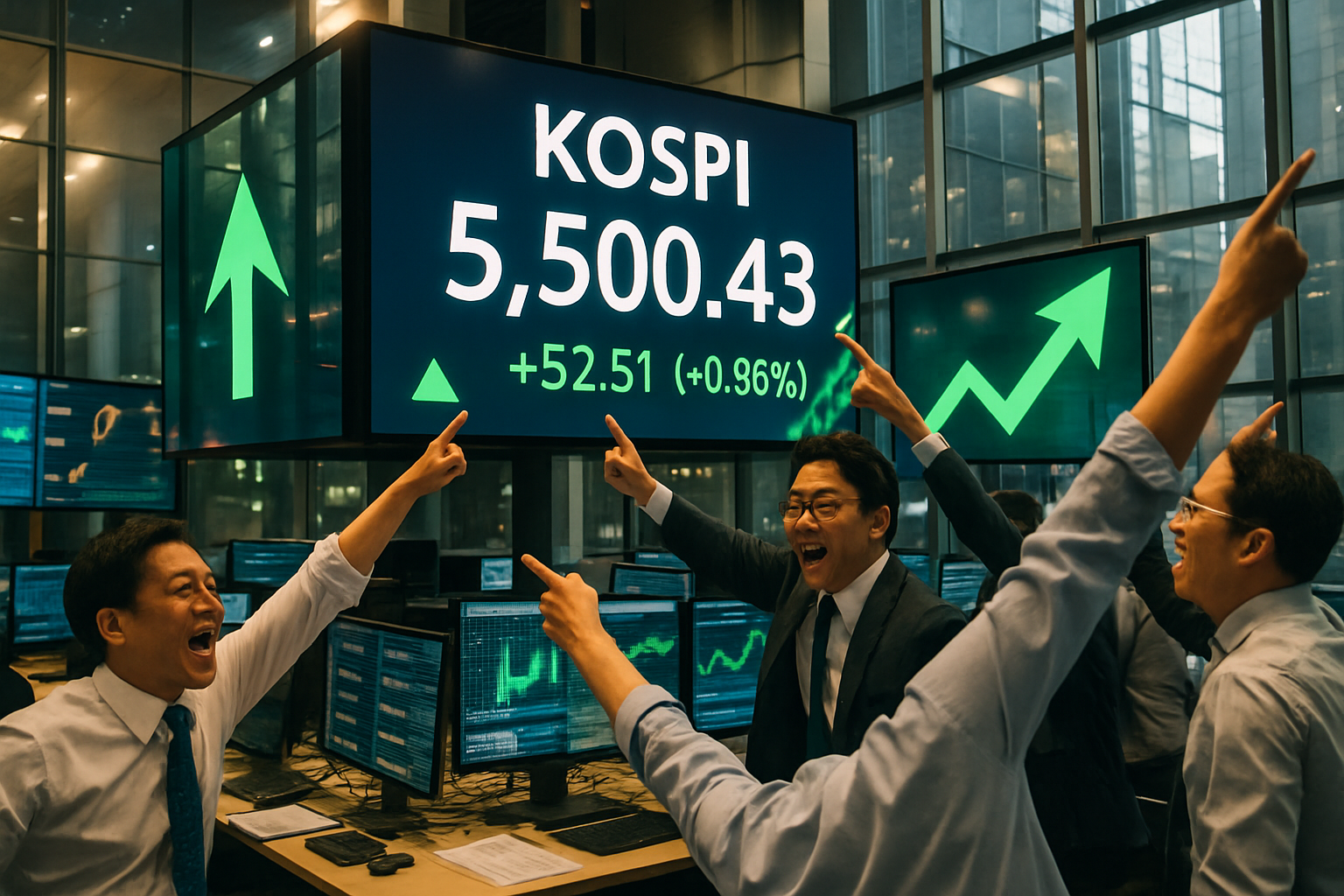
South Korea's stock market achieved a historic milestone on February 12, 2026, as the KOSPI index broke through the 5,500-point barrier for the first time, jumping nearly 3% in midday trading amid a wave of positive market sentiment that has swept across Asian markets.
The benchmark Korea Composite Stock Price Index (KOSPI) surged past the psychological 5,500 threshold during morning trading in Seoul, marking a significant achievement for South Korea's equity markets and reflecting broader optimism among investors about the country's economic prospects.
Breaking Through Historical Resistance
According to Yonhap News Agency reports, the KOSPI's breakthrough above 5,500 points represents a continuation of the strong momentum that has characterized South Korean markets in early 2026. The index's nearly 3% gain in a single trading session demonstrates the intensity of buying pressure as investors position themselves for what many analysts believe could be a sustained rally.
This historic milestone builds on South Korea's remarkable market performance throughout the recent period, with the country's stock exchange becoming increasingly attractive to both domestic and international investors. The surge reflects confidence in South Korea's economic fundamentals and its position as a key technology and manufacturing hub in Asia.
Market Context and Momentum
The KOSPI's achievement comes during a period of renewed optimism in global financial markets. Recent memory from market analysts indicates that South Korean stocks have been participating in broader Asian market rallies, with the KOSPI showing particular strength compared to regional peers.
In early February 2026, Korean markets demonstrated resilience even as global markets experienced volatility. Historical data shows the KOSPI was among the leaders during previous Asian market recoveries, with gains of over 4% recorded during similar positive sentiment periods, outperforming both Japanese and other regional indices.
Economic Fundamentals Supporting Growth
Several factors appear to be driving the current market enthusiasm in South Korea:
- Strong corporate earnings expectations from major conglomerates
- Robust technology sector performance, particularly in semiconductors
- Improving economic indicators and consumer sentiment
- Supportive monetary policy environment
- Increased foreign investment flows into Korean equities
The technology sector, which forms a significant portion of the KOSPI's weighting, has been particularly buoyant. Major Korean technology companies have benefited from global demand for semiconductors and electronic components, despite ongoing supply chain challenges affecting the broader industry.
Global Market Integration
South Korea's market success reflects the country's deep integration into global financial systems. The KOSPI's performance has increasingly correlated with international market trends while maintaining its own distinct characteristics driven by domestic economic factors.
The breakthrough above 5,500 points coincides with broader positive sentiment across Asian markets, where investors have been rotating capital back into regional equities after periods of uncertainty. This regional momentum has provided additional support for Korean stocks as international fund managers increase their allocation to Asian markets.
"This historic milestone demonstrates the maturity and strength of South Korea's capital markets. The KOSPI breaking 5,500 points reflects both strong fundamentals and growing investor confidence in Korea's economic trajectory."
— Market Analyst, Seoul Financial District
Sector Leadership and Participation
The rally to 5,500 points appears to have broad-based participation across multiple sectors of the Korean economy. Technology companies, which have been at the forefront of Korea's economic transformation, continue to lead gains, but the momentum has spread to traditional industries including automotive, shipbuilding, and consumer goods.
Financial services companies have also contributed significantly to the index's advance, benefiting from expectations of continued economic growth and potential interest rate stability. The banking sector's performance has been particularly noteworthy, with major institutions posting strong trading volumes as investors position for potentially improved lending conditions.
International Investment Flows
Foreign institutional investors have played a crucial role in driving the KOSPI toward its historic milestone. International fund managers have been increasing their exposure to Korean equities, attracted by the country's strong corporate governance improvements, transparent regulatory environment, and compelling valuations relative to other developed markets.
The sustained foreign buying pressure has provided crucial support for the market's advance, with international investors demonstrating confidence in South Korea's long-term growth prospects despite global economic uncertainties.
Technical Analysis and Future Outlook
From a technical perspective, the KOSPI's breakthrough above 5,500 points removes a significant resistance level that had previously capped the index's advance. Market technicians suggest that the decisive move above this psychological barrier could open the door for further gains, with the next major resistance levels potentially at 5,700 and 5,800 points.
However, analysts caution that markets rarely move in straight lines, and some consolidation around current levels would be healthy for the long-term sustainability of the rally. The key will be whether the index can maintain support above the 5,500 level during any potential pullbacks.
Policy Environment and Support
The South Korean government's economic policies have created a supportive environment for market growth. Initiatives aimed at promoting innovation, supporting small and medium enterprises, and enhancing the country's competitiveness in emerging technologies have contributed to investor optimism about Korea's economic future.
Recent policy measures, including efforts to strengthen the domestic capital markets and attract foreign investment, have helped create the conditions for the current market strength. The government's balanced approach to economic management has provided stability while allowing market forces to drive growth.
Risks and Considerations
Despite the celebration surrounding the KOSPI's historic achievement, market participants remain mindful of potential risks that could affect future performance. These include:
- Global economic uncertainties and potential market volatility
- Geopolitical tensions in the region that could impact investor sentiment
- Changes in global monetary policy that could affect capital flows
- Potential overvaluation concerns if the rally extends too rapidly
Experienced investors emphasize the importance of maintaining a balanced perspective, recognizing that while the current momentum is encouraging, markets can be subject to sudden changes in sentiment and external factors.
Looking Ahead
The KOSPI's breakthrough above 5,500 points marks a significant milestone in South Korean financial market history. As trading continues through the remainder of February 12, market participants will be closely watching whether the index can maintain these elevated levels and potentially establish new trading ranges.
The achievement reflects the maturation of South Korea's economy and its capital markets, demonstrating the country's ability to attract domestic and international investment while maintaining competitive advantages in key industries. As global investors continue to seek opportunities in dynamic Asian markets, South Korea's stock exchange appears well-positioned to benefit from this trend.
The success of the KOSPI in reaching this historic level also underscores the importance of South Korea's role in the global economy, particularly in technology and manufacturing sectors that continue to drive innovation and growth worldwide. As the market closes today, investors will be analyzing whether this breakthrough represents the beginning of a new chapter in Korean market performance or a peak that will require consolidation before further advances.