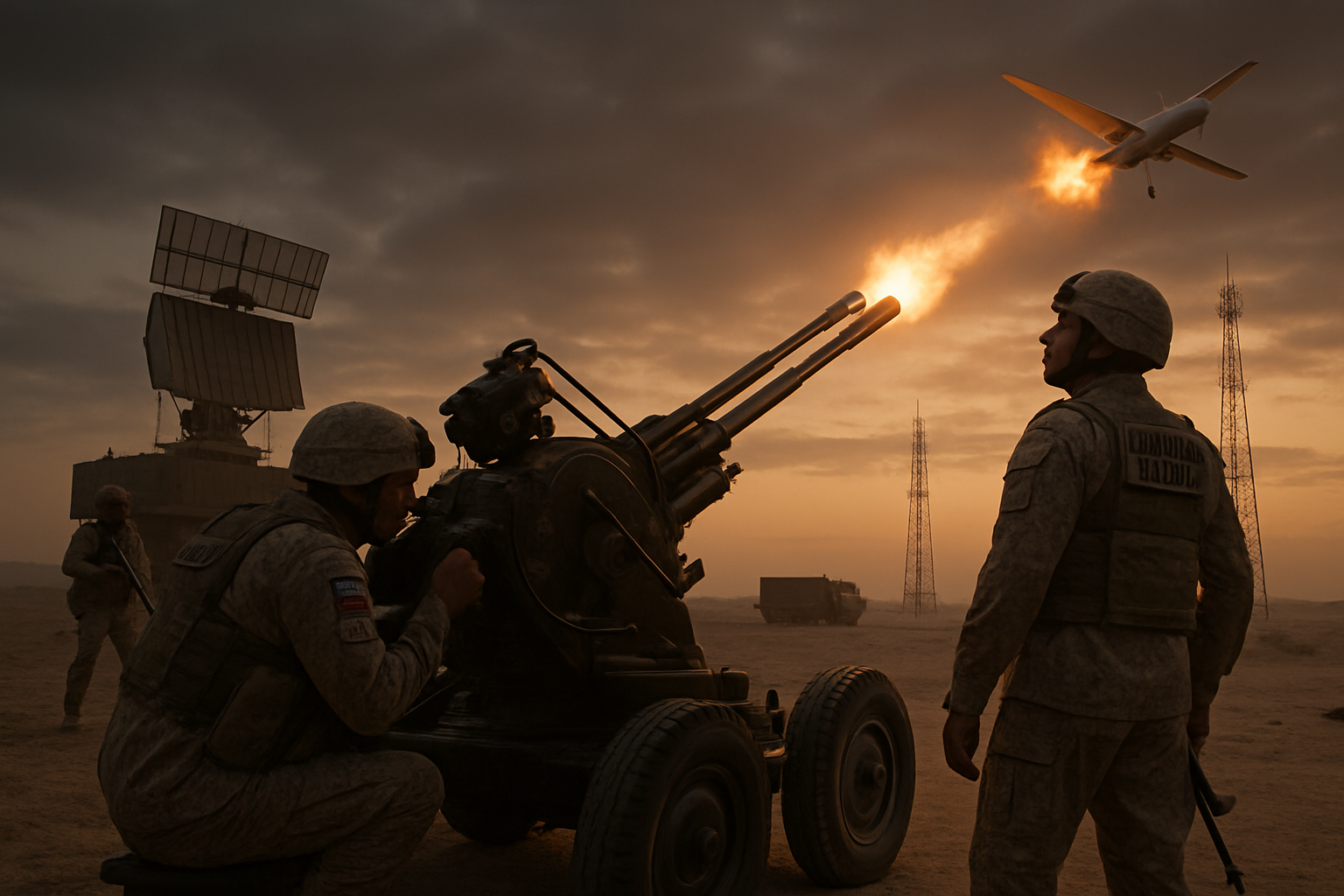
Kuwait's National Guard announced Sunday that its forces successfully intercepted and downed four drone aircraft within areas under their protection, marking the latest escalation in regional tensions as the Iran-Israel conflict continues to expand across the Middle East.
The operation, confirmed by multiple regional sources, represents Kuwait's ongoing defensive posture amid what has become the most dangerous international crisis since the Cold War, with Iranian forces conducting systematic attacks across the Persian Gulf under Operation True Promise 4.
Strategic Context and Regional Escalation
The drone interceptions come as part of Iran's Revolutionary Guard's declared policy of "no red lines remain," targeting Western assets and allies across the region. Kuwait has found itself increasingly in the crosshairs as the conflict, which began with the massive US-Israeli Operation Epic Fury following the death of Iranian Supreme Leader Ali Khamenei on March 1, continues to expand beyond its initial scope.
According to comprehensive intelligence gathered from the ongoing crisis, Kuwait has already suffered significant impacts from the regional conflict. Previous Iranian attacks on Kuwait International Airport resulted in 32 injuries among foreign nationals, while drone strikes have repeatedly targeted critical infrastructure including fuel storage facilities and military installations.
"The National Guard's task force was able to successfully down four drone aircraft in the sites it secures within the country."
— Kuwait National Guard Statement
Broader Regional Security Implications
Kuwait's successful interception represents a crucial defensive victory amid what experts describe as the most comprehensive regional security crisis in decades. The small Gulf state has been caught between maintaining its traditional diplomatic neutrality and defending against systematic Iranian targeting of Gulf Cooperation Council (GCC) member territories.
The attacks are part of Iran's broader strategy under Operation True Promise 4, which has resulted in casualties across multiple Gulf states. The United Arab Emirates has suffered one civilian death in Abu Dhabi, while Qatar intercepted 65 missiles and 12 drones using Patriot systems, resulting in eight injuries from debris. Even Cyprus, representing the first European territory attacked since World War II, has been targeted by Iranian drones striking RAF Akrotiri base.
Kuwait's Defensive Infrastructure
Kuwait's National Guard operates sophisticated air defense systems designed to protect critical national infrastructure. The successful interception of four drones demonstrates the effectiveness of these systems against low-flying, small-profile threats that have become Iran's preferred method of regional harassment.
The Gulf state has been forced to relocate some civilian aviation operations to Saudi Arabia due to repeated Iranian drone attacks on Kuwait International Airport. This disruption represents part of a broader aviation crisis that has seen over 18,000 flights cancelled worldwide, making it the most extensive aviation disruption since COVID-19.
Energy Security and Economic Warfare
The drone attacks on Kuwait are part of Iran's systematic campaign against regional energy infrastructure. Iran's Revolutionary Guard has declared the Strait of Hormuz "unsafe for shipping," effectively blocking 40% of global seaborne oil transit. This has contributed to oil prices surging past $100 per barrel for the first time since 2022.
Kuwait's Mina Al-Ahmadi Refinery has been among the targeted facilities, with Iranian drones causing infrastructure damage that highlights the vulnerability of Gulf energy assets to asymmetric warfare. The attacks represent a form of economic warfare designed to pressure Gulf states to distance themselves from US military operations against Iran.
International Response and Coalition Strain
The sustained Iranian attacks on Kuwait and other Gulf states have severely strained the unprecedented Saudi/UAE/Qatar/Egypt coalition that had previously supported diplomatic solutions to the crisis. Egyptian President Abdel Fattah el-Sisi has condemned attacks on "sisterly Arab countries," warning of "comprehensive chaos" spreading across the region.
Kuwait's position is particularly precarious given its historical role as a diplomatic mediator in regional conflicts. The country now finds itself forced into a defensive posture while maintaining its traditional policy of regional neutrality.
Military and Technical Analysis
The successful interception of four drones represents significant operational success for Kuwait's air defense capabilities. Iranian drone attacks typically employ swarm tactics designed to overwhelm defensive systems, making the complete interception particularly noteworthy.
These attacks are part of Iran's broader asymmetric response to Operation Epic Fury, the largest US-Israeli coordinated military operation since 2003. With costs reaching $11.3 billion in the first week alone, the operation has targeted over 3,000 Iranian sites while Iranian forces have responded with systematic regional targeting.
Humanitarian and Economic Impact
The ongoing crisis has forced massive international evacuations, with over 115,000 Australians and 30,000 Germans stranded in the region. Kuwait has closed its embassy operations indefinitely, while multiple countries have issued immediate evacuation orders for their citizens.
The economic impact extends far beyond military targets. Natural gas prices have surged 24% in Europe and 78% in the United States, while major shipping companies Maersk and MSC have suspended operations in the Persian Gulf, leaving over 150 tankers stranded with billions in cargo.
Nuclear Diplomacy Collapse Context
The current crisis emerged from the complete breakdown of US-Iran nuclear negotiations, despite achieving a "broad agreement on guiding principles" in Geneva - the most progress since the JCPOA collapse in 2018. The fundamental disagreement proved insurmountable: Iran excluded ballistic missiles and proxy forces as "red lines" in nuclear-only talks, while the US demanded comprehensive negotiations covering missiles, armed groups, and human rights.
Iran continues uranium enrichment at 60% purity with over 400kg of weapons-grade material, sufficient for multiple nuclear weapons if weaponized. The nuclear governance crisis has been compounded by the expiration of the New START treaty in February 2026, creating the first 50+ year period without US-Russia nuclear constraints.
Looking Forward: Regional Stability at Risk
Kuwait's successful drone interceptions represent a tactical victory in what has become a strategic challenge for regional stability. UN Secretary-General António Guterres has called the crisis "the greatest test of multilateral cooperation in crisis management in the modern era."
The coming weeks will be critical in determining whether the crisis can be contained to prevent broader regional war. Kuwait's defensive success demonstrates the importance of maintaining robust air defense capabilities, but the underlying political tensions require diplomatic solutions that currently appear beyond reach.
As Trump administration officials demand Iran's "unconditional surrender" while claiming the right to personally choose Iran's next Supreme Leader, the diplomatic path appears increasingly narrow. The crisis represents a template-setting moment for 21st-century international relations, with implications for energy security, nuclear governance, and conflict resolution approaches extending decades beyond current events.